TL;DR
Minimal dressing doesn’t have to mean assembling a wardrobe of universally approved basics or stripping away every interesting thing about the way you dress. Sometimes the most distinctive wardrobes are the quietest because every piece has been chosen with specificity: the men’s coat instead of the expected tailored one, the dark green boots instead of black, the trouser with an interesting shape. This fall capsule wardrobe is about wearing fewer ideas at once, trusting your own taste, and realising that once you know your style, you don’t have to prove it every time you leave the house.
There are weeks when I want clothes to do quite a lot. I want to dive into strange proportions or get all vintagey with things that might not have a lot of practical sense.
I want to put together an outfit that looks as though each of its components might have met accidentally in a thrift store and decided to remain friends.
And then there are those weeks when I want a grey coat.
This feels like one of those weeks.
Not because I have suddenly renounced interesting clothes or have discovered that all beige is in fact a revelation. Which actually might be my version of a midlife crisis.
Don’t worry, I am not changing my ethos. I still thrive on strange things, and I still believe a wardrobe should contain evidence of the actual person who lives inside it.
It is just that sometimes I like to think about the other side of personal style, and what happens when you know yourself well enough that you don’t feel compelled to demonstrate it every time you get dressed.
Because fashion always talks about finding personal style, but we talk considerably less about what happens after you find it.
Which is probably done by design to give that little bit of self-doubt and keep you running on the trend-cycle treadmill.
Sorry, that is the pessimist in me coming out.
When Personal Style Becomes Another Thing to Perform
For all the recent enthusiasm around personal style, we’ve managed to turn something that was supposed to free us from fashion rules into another set of them.
I am absolutely guilty of this as well. I like to think of them more as tips or guidelines to help you if you get in a rut, but ultimately rules are still rules.
Some that I talk about frequently are your outfit having an unexpected element. It should contain tension. Try to juxtapose masculine and feminine, vintage and modern, expensive and inexpensive. Add the red sock. Tie something around something else. Or put a brooch somewhere brooches have historically always feared to go.
Like I said, I enjoy plenty of this. Styling is fun. Experimentation is how we figure out what we like.
But on the flip side, there is a point where the pursuit of an “interesting outfit” starts leaning into the pursuit of a trendy one. We’re still asking for external approval; it just has different criteria than usual.
Which isn’t necessarily freedom. And if anything, I want you to feel free in the way you choose what you want to wear.
There is something satisfying about reaching the point where you can put on a black sweater and trousers and then resist that urge to add six things just so you can prove that you know what you’re doing.
But you do know what you’re doing, which is why you stopped.
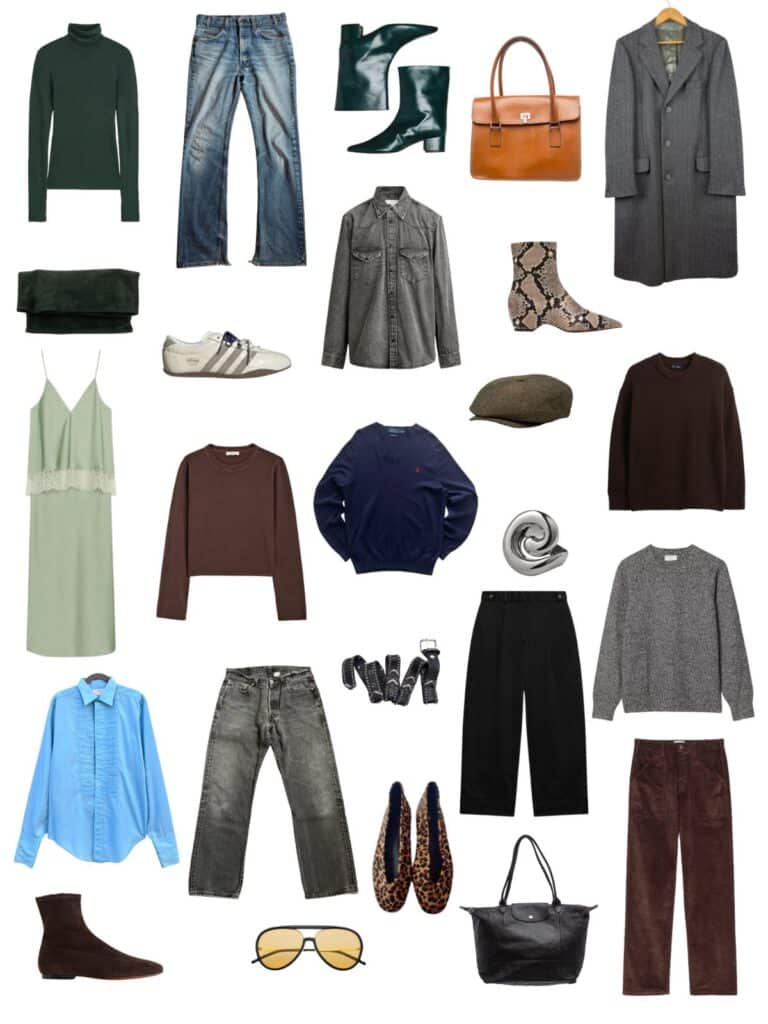
Green Turtleneck | Vintage Blue Jeans | Green Boots | Cognac Bag | Grey Coat | Snake Print Boots | Grey Denim Shirt | White Sneakers | Green Clutch | Green Dress | Brown Long Sleeve | Navy Sweater | Flat Cap | Large Ring | Brown Sweater | Grey Sweater | Black Trousers | Vintage Belt | Grey Jeans | Blue Tuxedo Shirt | Brown Flat Boots | Sunglasses | Animal Print Flats | Black Tote | Brown Cords

Minimal Style Isn’t the Same Thing as Generic Style
Minimalism has acquired some unfortunate baggage.
This comes with some well-known stereotypes. One being that the minimalist wardrobe has been presented as a shopping list of Perfect Things.
The perfect white shirt. The perfect black trousers. The perfect cashmere crewneck. The perfect camel coat. The perfect loafer. The perfect leather tote.
Everything tasteful. Everything versatile. Everything timeless. Everything strangely devoid of fingerprints.
The problem isn’t any of those clothes. I own and love versions of several of them. The problem is the assumption that simplicity requires neutrality not only in colour and silhouette, but also in personality.
And it doesn’t.
A simple wardrobe and a generic wardrobe are two completely different things. And the distinction, I think, is specificity.
The Specific Wardrobe
The idea for this capsule really began with two pieces.
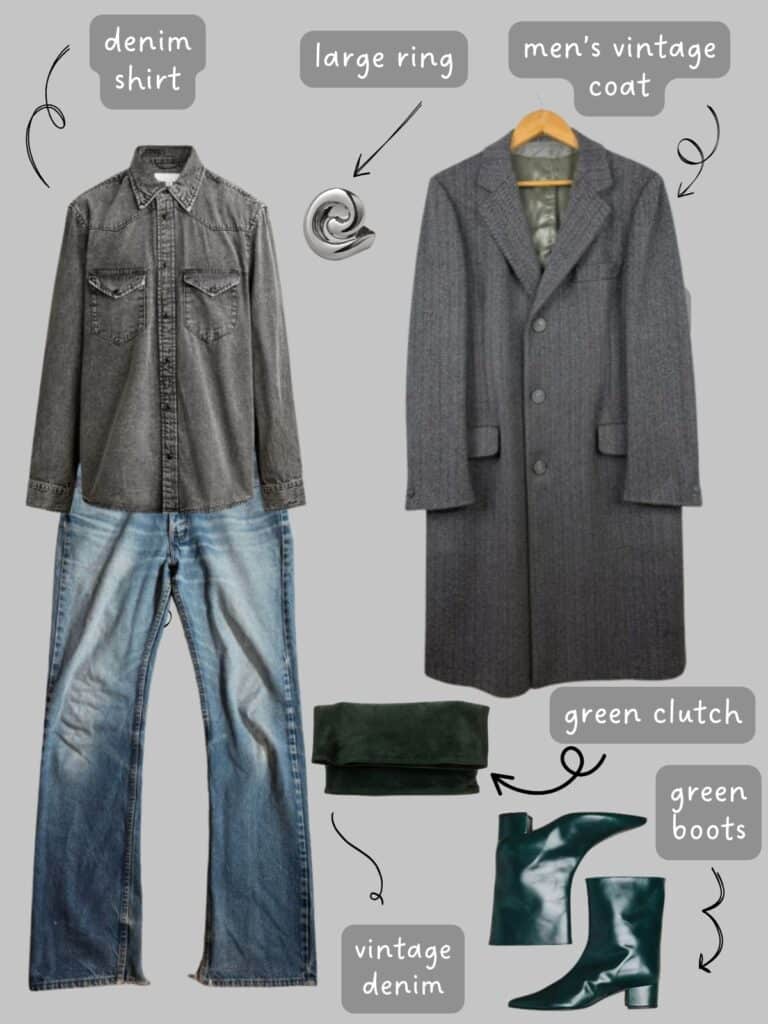
The first is a long grey men’s herringbone coat, vintage. It’s traditional and restrained, with a subtle woven texture and the slightly stern proportions of proper menswear. It isn’t flashy. It doesn’t need to be.
The second is a pair of dark green leather boots. They’re similarly simple, clean, pointed, low block heel, but the colour changes everything. Black would have been the obvious choice.
They’re green.
Not bright green. Not “statement shoe” green. A deep, almost-black bottle green that you might not notice immediately.
Which is precisely why I like them. Scratch that, I love them.
Together, these pieces helped clarify something I’ve been circling for a while: I don’t necessarily want special clothes. I want specific clothes.
There is a difference. A special piece announces its importance. It might have an unusual print, dramatic embellishment, enormous proportions or some other feature designed to become the focal point of an outfit.
A specific piece can be incredibly quiet.
It’s simply the version you chose when you could have chosen any other.
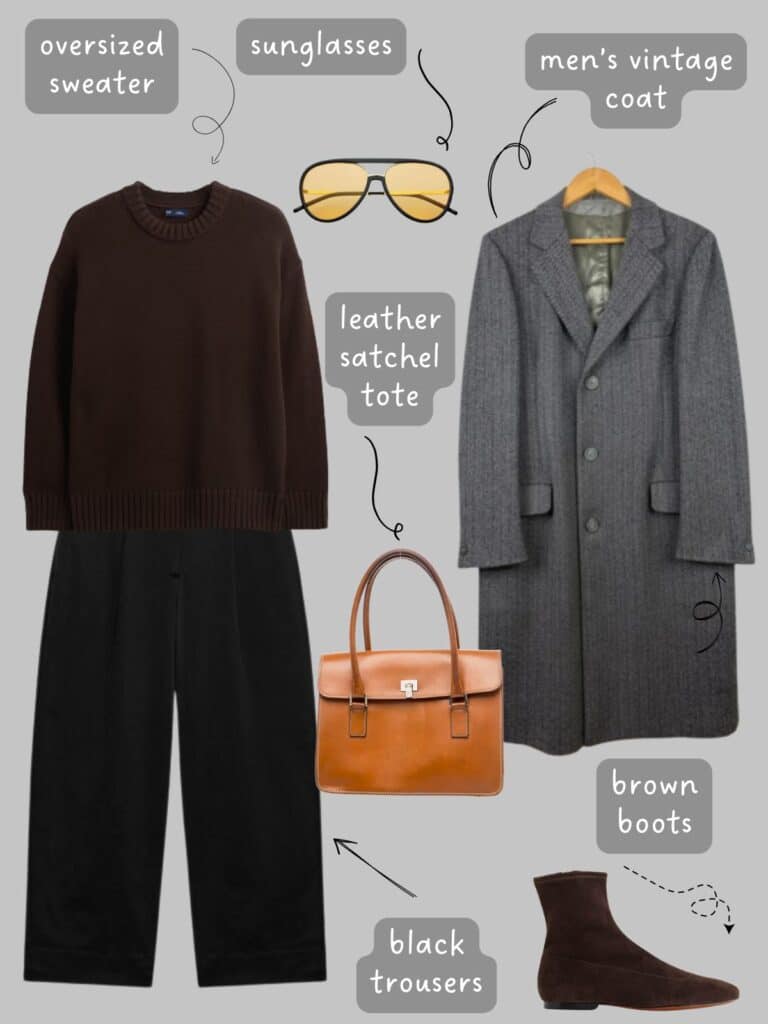
The men’s coat rather than the women’s coat. The green boot rather than the black boot. The murky brown sweater rather than oatmeal. The trouser with a slightly strange curve through the leg.
The old leather bag that’s softened and collapsed in places rather than the pristine structured tote.
None of these pieces necessarily deserves the designation “statement”, but together they make a wardrobe that could belong to only one person.
Minimal Dressing Actually Exposes Your Taste
This may be one of the things I find most interesting about genuinely simple outfits: there is nowhere to hide.
When you’re wearing four things, you notice all four things.
You notice the length of the coat. You notice where the trouser falls. You notice the toe of the shoe. You notice whether the sweater is fitted or boxy, whether the shirt collar sits close to the neck or spreads dramatically across the jacket.
In a complicated outfit, those details can disappear into the overall effect. In a minimal one, they become the effect.
Which is why I don’t think minimal dressing requires less taste, because I actually think it exposes your taste instead.
That doesn’t mean everything has to be perfectly tailored or painstakingly selected. In fact, I often prefer minimal clothes when something is slightly wrong or off.
Like a men’s blazer that’s longer than conventional styling wisdom recommends. Trousers pooling slightly over a shoe. An old coat with shoulders that weren’t designed for your shoulders. A sweater that’s gone soft from years of washing.
Those imperfections are often what keep minimalism from becoming sterile. They remind us that clothes are being worn rather than displayed.
The Fall Colour Palette: Almost Neutral
The palette I imagine for this wardrobe is restrained, but I don’t want it completely neutral.
Charcoal. Black. Grey. Cream. Dark brown. Navy.
And then we have that green.
I love the idea of bottle green functioning almost as a false neutral too. Perhaps it appears only in the boots (I found it in a trench too). Maybe it reappears in a knit, a bag or clutch, a sock or a thin belt. It doesn’t need to become a “colour story” in the mood-board sense of the phrase.
It’s simply there.
This is also where colour becomes much more interesting to me than the obligatory “pop of colour.”
A pop of colour often feels like an accessory added after the outfit is finished because someone told us neutrals were boring.
A strange neutral feels integrated into the person’s taste.
Oxblood can do this. Olive can do it. Aubergine, tobacco, petrol blue and murky mustard can all behave almost like neutrals when they’re dark or desaturated enough.
They are called ish colours: green-ish, purple-ish, blue-ish. You get the point.
They’re colours for people who want colour without feeling required to become cheerful about it.
Menswear Makes Minimalism More Interesting
The men’s coat also points toward another important part of this wardrobe: menswear.
Not menswear-inspired clothing necessarily. Actual menswear, which is a key part of my wardrobe.
Putting a woman’s body into clothing that wasn’t proportioned specifically to flatter it immediately makes a simple outfit more interesting.
A men’s shirt might have too much fabric through the body, or a men’s coat may have broader shoulders and a straighter line.
Men’s sweaters often hang differently through the waist and hips. And those differences create a silhouette without requiring decoration.
And because this wardrobe is so restrained, proportion becomes one of our primary styling tools.
- A long masculine coat over a narrow skirt.
- An oversized men’s shirt with well-cut trousers.
- A large sweater with a pointed, elegant boot.
- A substantial blazer over something delicate.
Nothing needs to clash dramatically. We’re just allowing masculine and feminine shapes to exist beside one another without making a tremendous fuss about it.
Build Around Shape, Not Statement Pieces
You need to resist the temptation to make every item noteworthy.
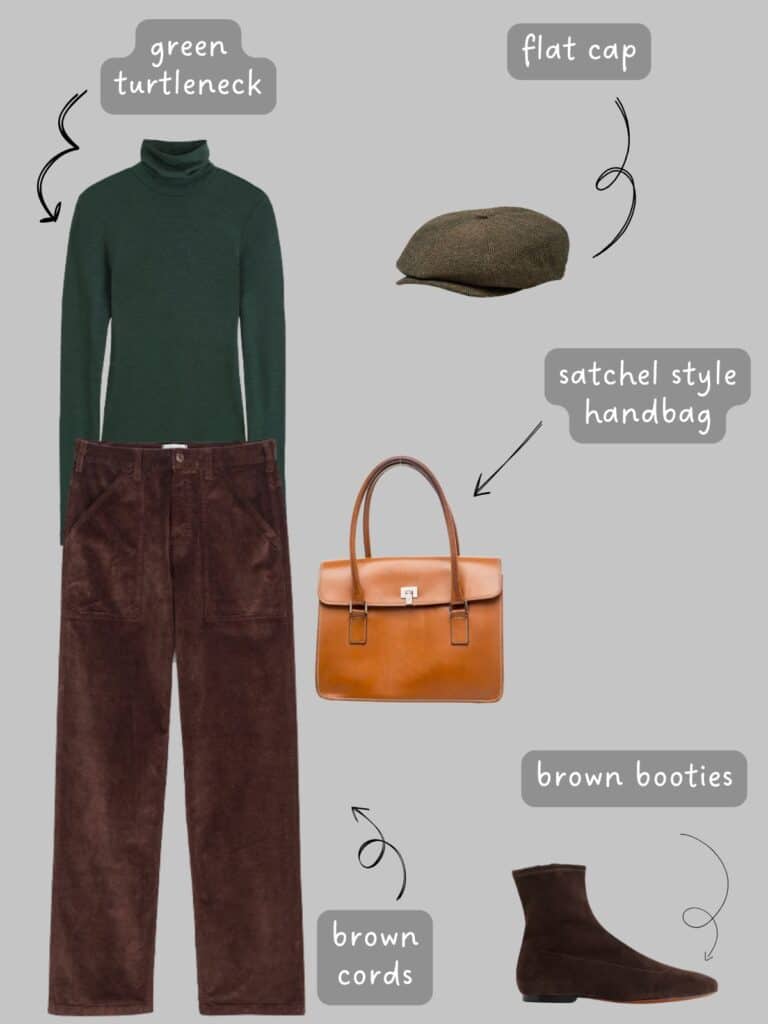
The grey men’s coat is already an anchor. From there, I’d look for perhaps one excellent trouser with an interesting shape like wide, curved, pleated or slightly puddled, along with a straighter trouser or dark jeans.
Maybe a simple midi skirt, probably narrow rather than voluminous, because I love the severity of that shape with the pointed green boots.
For tops, keep things even quieter. A charcoal crewneck. A dark brown or black knit. A men’s button up shirt. A long-sleeved tee. Perhaps one fine-gauge knit that sits close to the body to contrast with all the larger outer layers.
And don’t worry terribly much about whether each piece qualifies as a “wardrobe essential.”
That’s another idea worth abandoning.
The goal isn’t to create the most universally useful capsule wardrobe. It’s to create the smallest collection of clothes that feels specifically useful to you.
Those are very different exercises.
Texture Can Do the Work Colour Usually Does
When the palette gets quieter, texture starts becoming much more visible.
The subtle pattern in an old wool coat. Brushed cashmere. Crisp cotton. Shiny leather boots. Matte trousers. A worn leather bag. Corduroy. Suede. Ribbed wool.
Suddenly an outfit containing three shades of charcoal isn’t flat at all.
This is something minimalist dressing often understands better than trend-driven dressing: visual interest doesn’t always need to come from adding another thing.
Sometimes you simply need materials that react differently to light.
A glossy green boot under a heavy grey wool coat already creates contrast.
You don’t need to attach a silk scarf, three necklaces, an enormous brooch and a decorative keychain to reassure everyone that you have visited the internet recently.
Let the Accessories Be Old
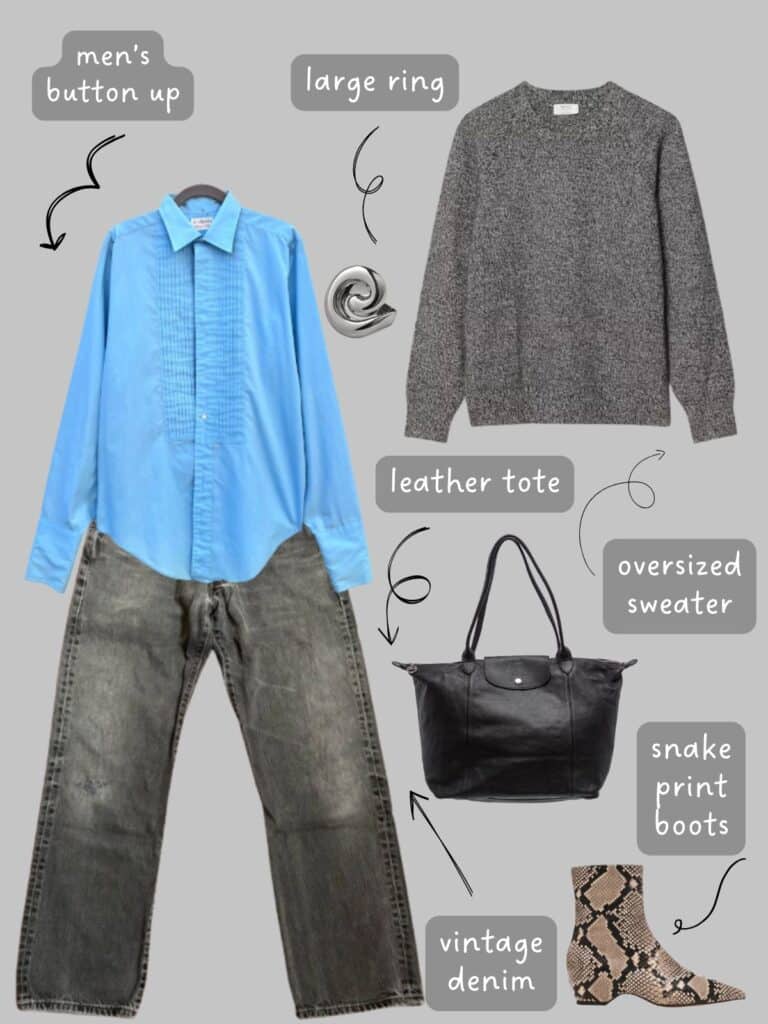
I also didn’t want immaculate accessories with this wardrobe. Give me a leather bag that’s been carried for fifteen years.
The belt that’s starting to soften around the holes. The watch you’ve worn forever and you inherited from your grandfather after he died.
The ring that doesn’t even know what the current jewellery cycle is. Maybe one slightly peculiar piece of jewellery that you found secondhand and can’t identify with any confidence.
A minimal wardrobe benefits enormously from things with history because they prevent simplicity from looking newly purchased.
I didn’t want this wardrobe to look as though someone decided to “become a minimalist” last Thursday and ordered an entirely new personality accordingly.
I want it to look accumulated, quietly, over time.
The Best Basics Might Not Be Basics
This is where shopping for this kind of wardrobe becomes interesting.
Instead of searching for the perfect basic, I’d start asking what makes a supposedly basic piece feel specific to me.
Maybe you don’t want a white button-down. You want an old men’s tuxedo shirt.
Maybe you don’t want black trousers. You want charcoal trousers with an exaggerated pleat.
You didn’t want the classic camel coat, and gravitated to an enormous grey men’s coat from the 1980s.
You decided that you didn’t want black ankle boots; you wanted green ones instead.
The differences can be tiny.
You aren’t shopping for something that photographs as unusual from twenty feet away. You’re looking for the detail that makes you prefer this one over that one.
This is also why secondhand shopping works beautifully here. When you stop searching for a standardised perfect item, the enormous inconsistency of secondhand clothing becomes useful.
Different decades give you different proportions. Men’s departments give you different cuts. Older clothes have different fabrics and construction.
Instead of trying to make the thrift store provide exactly what you’ve already imagined, you can let it show you versions you hadn’t considered.
You Don’t Need an Unexpected Element in Every Outfit
An outfit does not always need a twist.
Sometimes a grey sweater, black trousers, grey coat and green boots are enough. Sometimes the green boots aren’t even necessary. Sometimes black loafers would be perfectly fine.
Personal style isn’t diminished by repetition, simplicity or occasionally being completely unremarkable.
In fact, I think the constant requirement to be visually interesting can become its own kind of conformity.
If everyone is adding the unexpected sock, perhaps the unexpected move is to wear the normal sock.
I realise we’ve reached a dangerous level of philosophical investment in hosiery here, but the point stands.
You Have Nothing to Prove
Maybe this is where minimalism becomes interesting again.
Not as an aesthetic reset. Not as an aspirational lifestyle. Not as a purge of everything colourful, sentimental, impractical or strange.
And definitely not as an excuse to replace your wardrobe with twelve expensive “timeless essentials.”
Instead, minimalism can simply mean wearing fewer ideas at once.
Which means that you can still own the bizarre vintage jacket, or still love the leopard bag.
It’s okay to occasionally dress like an eccentric museum curator who has become involved in a minor inheritance dispute.
Those clothes aren’t going anywhere, but you don’t have to wear every part of your personality simultaneously.
In allowing an outfit to be quiet, you aren’t relying on the outfit to establish that you’re interesting.
The coat can just be a coat, and the sweater can just be a sweater.
And then you pull out the green boots.
And the fact that you chose them instead of black tells me all I need to know.
Minimalist Fall Outfit Ideas
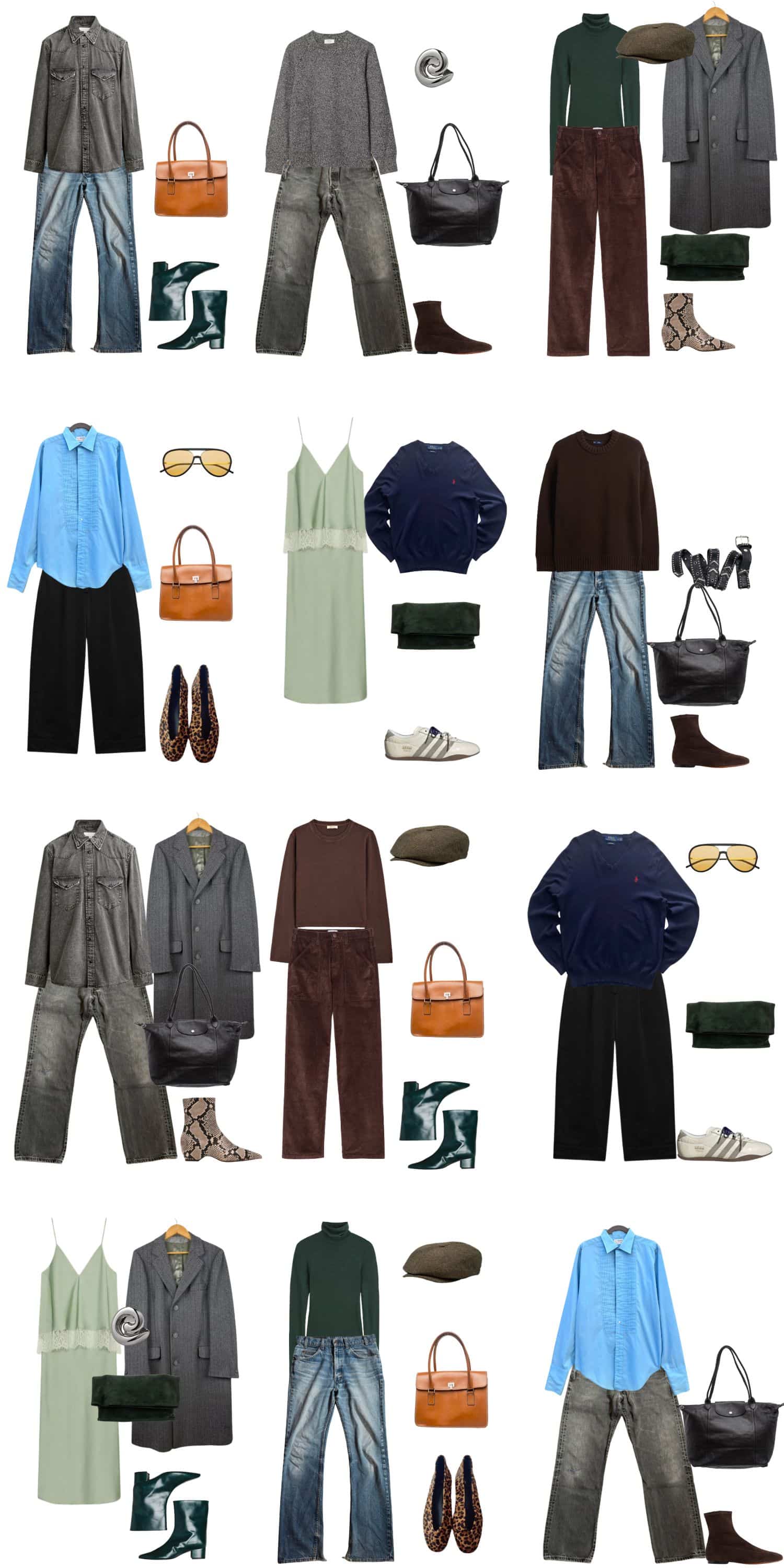
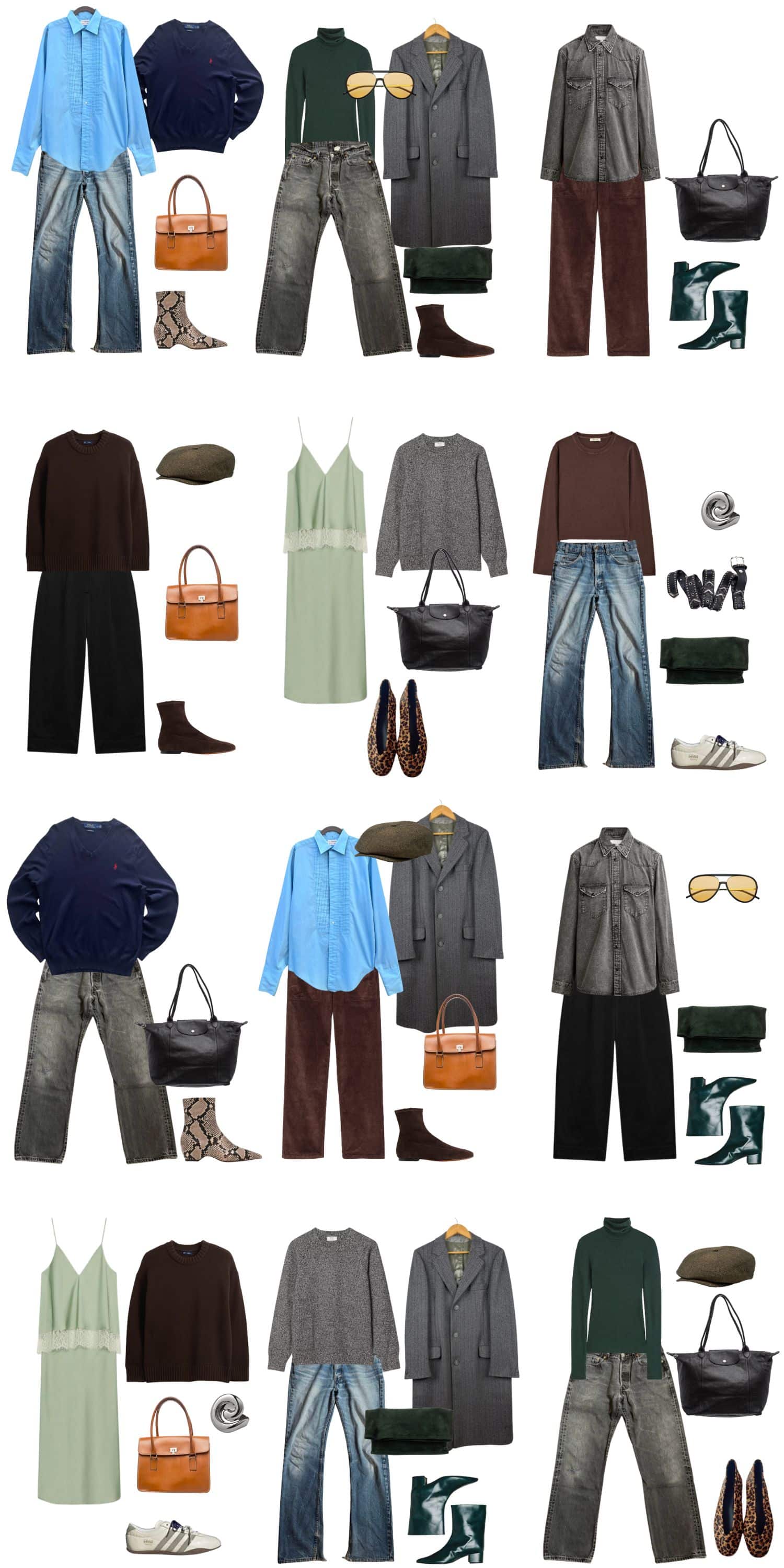
Green Turtleneck | Vintage Blue Jeans | Green Boots | Cognac Bag | Grey Coat | Snake Print Boots | Grey Denim Shirt | White Sneakers | Green Clutch | Green Dress | Brown Long Sleeve | Navy Sweater | Flat Cap | Large Ring | Brown Sweater | Grey Sweater | Black Trousers | Vintage Belt | Grey Jeans | Blue Tuxedo Shirt | Brown Flat Boots | Sunglasses | Animal Print Flats | Black Tote | Brown Cords
SHOP THE UK LINKS
This post contains affiliate links. By using my links to shop I may receive a small commission (at no cost to you). Thanks for supporting what I do 



What a great article, Sara! This is exactly how I’ve been feeling lately.
The Anthopolgie green boots are amazing. I did find something similar on Amazon. LEMUTISME womens Chelsea ankle boots. I’m not posting a link just go look for it. Thank you Sara for all the inspiration.