TL;DR
Somewhere in all our optimising, like the right shoes, the right neutrals, the correct capsule math, it’s possible to edit the personality right out of your clothes. This fall capsule starts with useful basics (grey tailoring, denim, simple knits) and deliberately breaks them with one piece that doesn’t belong, because the thing that makes an outfit yours is usually the one decision somebody else wouldn’t have made.
We Have Become Very Good at Dressing Correctly.
This is something I have been mulling over for a while that bothers me. There is more style advice available to us now than at any other point in human history, and you would think it would have resulted in an unprecedented era of magnificent dressing.
But instead we get a lot of blah, and I sometimes wonder whether it has made us extremely good at just looking fine.
We know what goes together.
We know that loafers work with tailored trousers, a white shirt looks good under a blazer, straight-leg jeans are a foundational piece, and a neutral sweater almost always earn its cost per wear.
We know how to build a capsule wardrobe, dress for our body type, identify our colour season, define our style in three words and locate the exact burgundy handbag currently being described as “the only bag you need this fall.”
We can open Pinterest and find seventeen ways to wear something before we’ve even removed the tags.
None of this information is bad. Much of it is actually quite useful, especially if you need guidance or inspiration.
I have spent years talking about how good a blazer is to have for everyday wear, so I’m hardly going to stage a coup against tailoring at this point.
But I do think when every dressing decision is optimised, then you stop making mistakes.
And unfortunately…or fortunately, depending on who is reading right now, the mistakes are often where things start getting interesting.
That is what I kept thinking about while putting together this fall wardrobe. It didn’t seem to have an obvious theme.
I actually formulated the entire wardrobe before I even knew which direction that I wanted to go. I wanted to see if something shaped itself.
I actually didn’t write a sentence until I put together the wardrobe, which is totally ass backwards for me. And for someone who didn’t know what direction to take, it ended up being really, really long, so I apologise in advance.
There was grey dress pants and a blue denim shirt, which suggested one direction. Dark denim and charcoal knitwear suggested another.
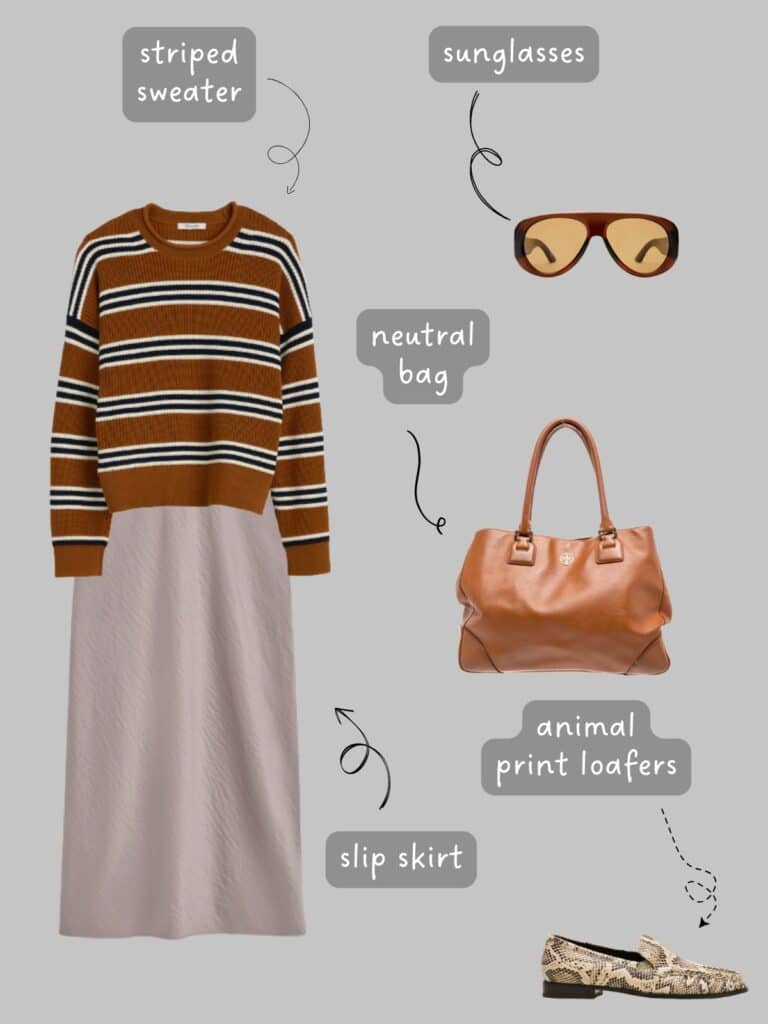
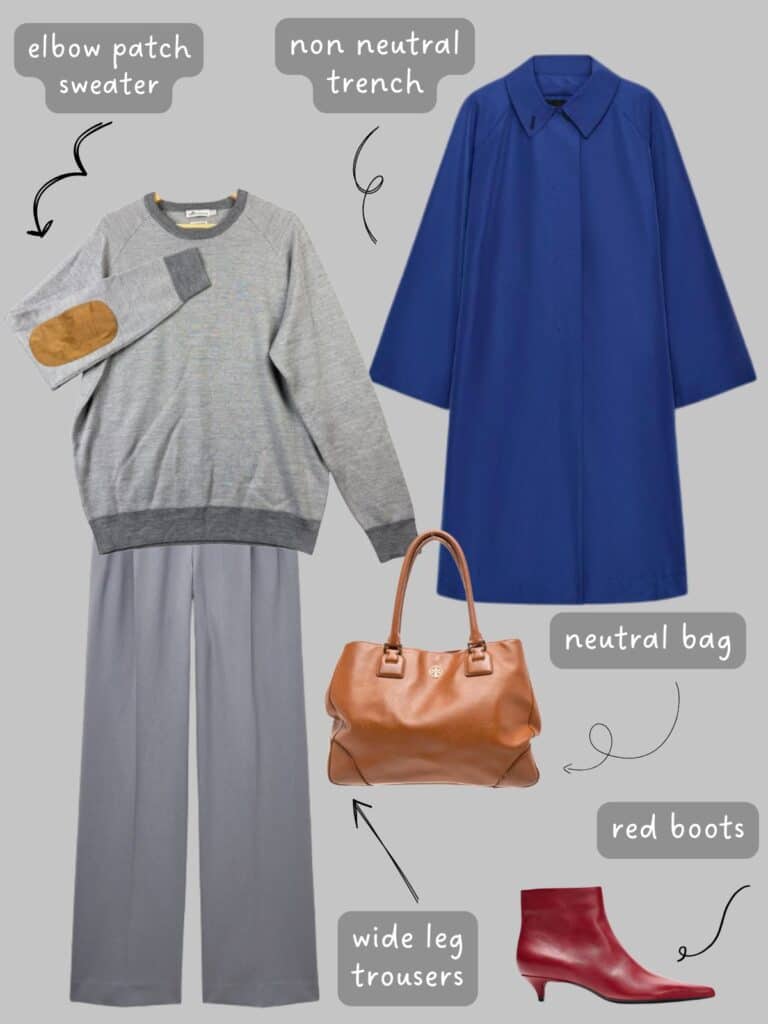
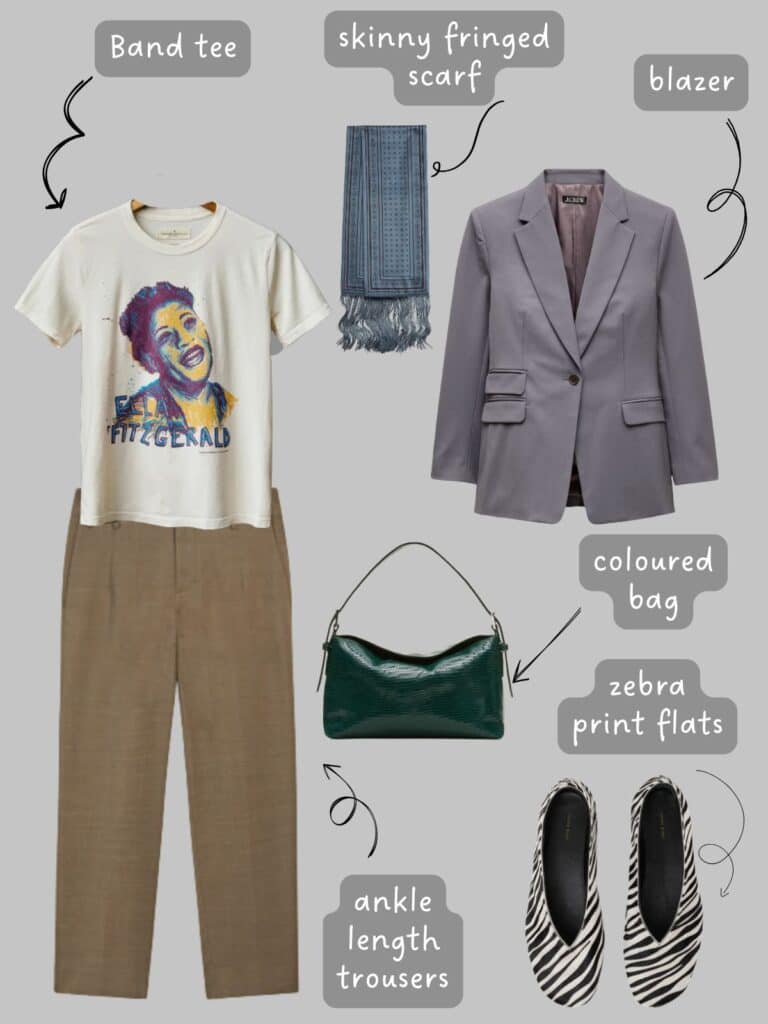
Then a pair of bright blue sneakers arrived. Then zebra flats. A turquoise necklace with an enormous rose hanging from it. Red kitten-heel boots. Snakeskin loafers. An Ella Fitzgerald tee. A glossy green embossed bag.
And, for reasons I can no longer adequately defend, a pink cummerbund. I have it in black (I wore it today), I might now regret that I did not get it in pink.
And then I just kept waiting for the aesthetic to reveal itself.
It didn’t. Until eventually I realised that might be the point of this one.
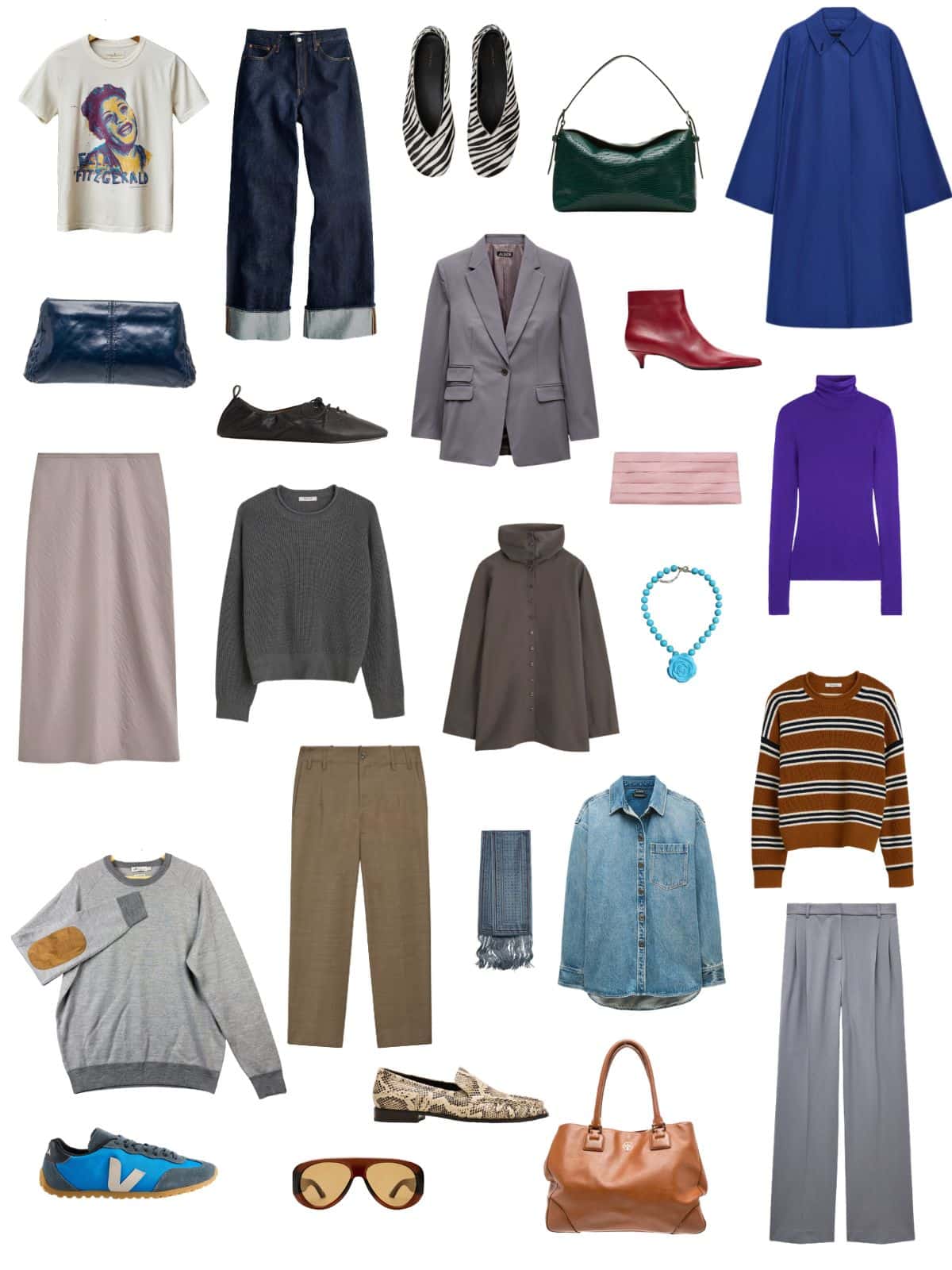
Ella Fitzgerald T-shirt | Indigo Denim | Zebra Flats | Green Bag | Blue Trench Coat | Red Boots | Grey Blazer | Black Jazz Flats | Navy Blue Clutch | Slip Skirt | Grey Sweater | Funnel Neck Shirt | Pink Cummerbund | Blue Necklace | Purple Turtleneck | Brown Striped Sweater | Denim Shirt | Fringe Scarf | Brown Ankle Trousers | Elbow Patch Sweater | Blue Sneakers | Sunglasses | Snake Print Loafers | Cognac Bag | Grey Trousers

What If Your Wardrobe Doesn’t Need an Aesthetic?
We have become very attached to naming the way we dress.
Minimalist. Quiet luxury. Dark academia. Coastal grandmother. Indie sleaze. Eclectic grandpa. Office siren. Clean girl. Mob wife. Tomato girl.
At this rate, I assume 90s divorcée will become an aesthetic before Christmas. Which is actually an interesting concept that I might try to visually puzzle together at a later date.
Aesthetic labels can be fun, and they can be genuinely useful when you’re trying to identify what you’re drawn to. But they have also become another set of instructions.
Once you decide you are a minimalist, you begin asking whether a turquoise rose necklace is minimalist enough.
Once you decide you are classic, you wonder whether zebra shoes are too much.
Once you’ve carefully assembled three style words, an interesting pink cummerbund might find itself standing before a tribunal.
Does this fit my aesthetic? Is the question we often ask, but maybe, just maybe that’s the wrong question. Don’t gasp. Stay with me.
Maybe the only question that you need to ask is…
Do I like it?
Groundbreaking, right? But most of us forget that it is the most important thing about our clothes.
When I looked at this wardrobe, I didn’t see a coherent aesthetic so much as a coherent person.
Someone who likes tailoring and denim. Men’s shirting and uncomplicated knitwear.
She likes strong colour, but apparently has very little interest in sensible footwear. Which is like the story of my life.
She enjoys clothes that are slightly elegant and slightly strange.
That is a point of view which (to me) is much more useful than an aesthetic.
You Don’t Need a Cohesive Wardrobe. You Need a Cohesive Person.
This is where I think we’ve misunderstood capsule wardrobes.
Traditionally, the goal is cohesion. Everything should work together. Colours repeat. Silhouettes coordinate. Shoes work across multiple outfits. Nothing is allowed into the capsule unless it can prove its usefulness under questioning.
There is practical wisdom in that, especially if you’re trying to own less.
But cohesion doesn’t necessarily mean similarity.
A grey suit, Ella Fitzgerald tee, turquoise necklace, zebra flats, cuffed jeans, violet turtleneck and pink cummerbund don’t sound particularly cohesive when written down.
But they can all be believable on the same person. And that is a different way of viewing your wardrobe.
Instead of asking whether every item looks like it belongs beside every other item, ask whether they all feel like things you would genuinely choose.
And maybe this results in your preferences contradicting one another.
Good. This is life, and life is full of contradictions.
You can like masculine tailoring and feminine shoes. You can love grey and also want something in the brightest blue available to humanity.
You can spend years building a practical wardrobe and still feel an irrational attachment to something that matches nothing.
Personal style doesn’t require resolving those contradictions. And for those that truly get it, it often requires keeping them.
The Interesting Person Wardrobe
I started thinking of this as an “interesting person wardrobe” because there’s an important distinction between wearing interesting clothes and being an interesting person wearing clothes.
The first can sometimes result in a performance.
Buy the statement piece. Add the quirky accessory. Wear something unexpected so everyone understands that you are a creative person who has thoughts.
That’s not what I’m interested in. The interesting person wardrobe is almost the opposite.
Because most of it can be remarkably ordinary.
Nothing there is going to stop traffic. And that’s useful to have in your wardrobe arsenal.
Because ordinary clothes create room for the things that are specific to you.
The turquoise necklace doesn’t have to compete with twelve other interesting decisions. The snakeskin loafer can sit underneath a grey trouser and simply exist.
A bright red boot can appear below dark denim without requiring an entire outfit constructed around the fact that you are wearing red boots today.
The basics become infrastructure because they aren’t the personality. They just make the personality possible.
Every Outfit Needs One Bad Decision
This became the rule I kept returning to while looking at these pieces.
Build the sensible outfit first.
Grey trousers. Denim shirt. Neutral bag.
Fine.
Now make one “bad” decision.
Add the turquoise rose necklace.
Or start with dark cuffed denim, a charcoal sweater and black lace-up flats which is perfectly respectable. The carry the glossy green bag.
Grey suit with a simple knit underneath?
Absolutely. Now wear the bright blue sneakers.
Button-down and jeans?
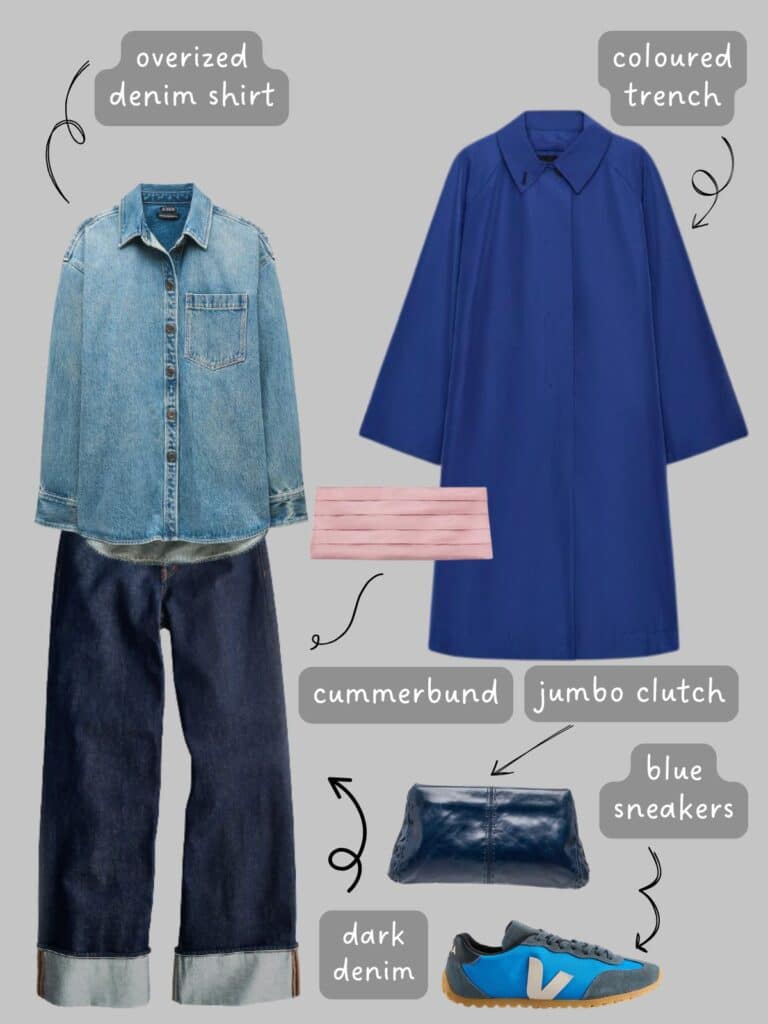
Of course. Then put the pink cummerbund over it.
The “bad decision” isn’t actually bad. It is simply the thing that breaks the expected styling script.
It’s the shoe that technically isn’t the best shoe, or the colour that appears nowhere else.
- The formal accessory worn casually.
- The casual piece underneath tailoring.
- A masculine thing paired with something delicate.
- Something beautiful paired with something a bit ugly.
It’s the moment when you look at the outfit and think, I’m not entirely sure about this.
And that moment is useful, so pay attention.
There Is a Difference Between Wrong and Unfamiliar
This may be one of the hardest things to learn about personal style.
Sometimes an outfit just genuinely doesn’t work. It actually happens a lot.
We’ve all been there. Occasionally the trousers are just wrong. But sometimes what we’re reacting to isn’t wrongness. It’s just unfamiliarity.
Our eyes are extraordinarily trainable. The more we see a silhouette, colour combination or styling idea, the more normal it begins to look.
This is partly how trends work. Something appears ridiculous, then interesting, then suddenly everyone owns it, and six months later we’re being informed that it is dated.
So when you try something you haven’t seen repeatedly, your first reaction may be uncertainty. Which doesn’t mean you need to immediately take it off.
Look again. Walk away from the mirror, then come back.
Maybe try a different shoe. Push up the sleeves. Remove one thing, or add another. This is where getting dressed becomes experimentation rather than execution.
And I think we’ve lost some of that because we can now look up the answer before trying to solve the problem ourselves.
Stop Finishing the Outfit
Stop the obsession with the fashion advice of making outfits look “finished.”
- Add the belt.
- Add jewellery.
- Repeat the colour.
- Choose the coordinating bag.
- Balance the proportions.
- Make sure everything appears intentional.
Some of my favourite outfits have something unresolved about them.
The shoe doesn’t quite relate to the rest. The colour appears once and disappears.
The coat is slightly too big or in my case really too big. The shirt hangs lower than expected.
There is a visual loose end, and you don’t need to fix it.
If you wear bright blue sneakers with a neutral outfit, you don’t need another blue accessory near your face to reassure everyone that the shoes were intentional.
You put them on your feet and that was the intention. Maybe your whole outfit is blue, but the sneakers are BLUE, blue and that makes them stand out in a sea of blue.
The red boots don’t require a red handbag. The green bag doesn’t need to “pick up” another green element. The zebra shoes aren’t asking for a corresponding zebra belt.
Sometimes repeating the unusual thing actually makes it less interesting, so let it be the interruption.
Every wardrobe needs clothes willing to stand quietly while another piece gets the laugh.
In this capsule, that’s the grey knitwear, dark denim, blue shirting, neutral bag, and tailored trousers.
They aren’t boring. They are doing important work.
Put the turquoise necklace with a purple turtleneck slip skirt, green bag and red boots and we may have inadvertently joined the circus.
Put it over a grey sweater with jeans and black shoes, and suddenly it’s fantastic.
This is why I don’t believe the answer to a boring wardrobe is necessarily buying more interesting clothes.
Sometimes you already own enough interesting clothes, and what you just need are clothes quiet enough to let them speak.
The relationship between ordinary and unusual matters more than either category on its own.
Too much sensible, and the wardrobe can become anonymous, but too much statement and nothing is actually making a statement anymore.
Personal style often lives in the tension between the two.
The Pink Cummerbund Has Entered the Chat
We need to discuss it.
Because of all the things someone might reasonably put on a fall capsule wardrobe shopping list, a pink cummerbund is unlikely to crack the top hundred.
It is not versatile in the traditional capsule wardrobe sense. It isn’t a wardrobe essential.
You will not find it on a list entitled 12 Timeless Pieces Every Woman Needs By 40, and for this we should probably be grateful.
But that’s exactly why I picked it.
A cummerbund comes with instructions. It belongs to formal dressing. It has a designated purpose and an established context.
Ignore all of that. Put it over an oversized pale blue shirt with grey trousers.
Try it over the Ella Fitzgerald tee underneath the blazer. Wear it with denim. Use it to interrupt an otherwise extremely sensible grey outfit.
Once you stop asking what a garment is supposed to do, you can start getting creative with figuring out what else you can do with it.
That’s one of the easiest ways to make an existing wardrobe feel larger without buying anything.
- A scarf can become a belt.
- A formal accessory can be worn with jeans.
- A man’s shirt can become a jacket.
- An evening piece can appear at noon.
- A fancy shoe can go to the grocery store.
Clothes become much more interesting once we stop respecting their job descriptions.
Specificity Is Better Than Eccentricity Here
There is an important distinction here, because the goal isn’t to manufacture weirdness.
I don’t think personal style comes from waking up and asking, What is the strangest thing I can possibly put on my body today?
Because that train of thought is costumey. Eccentricity becomes interesting when it is incidental.
You bought the necklace because you loved it. You kept the old men’s sweater because it fits perfectly. You always notice red shoes.
You can’t explain why you keep buying grey trousers when you already own grey trousers. You like tiny heels, but also enormous shirts. You have been committed to animal-print footwear since 2004.
Individually, none of those preferences constitutes an aesthetic.
But together, they become your taste, and taste becomes more interesting as it gets more specific.
At some point, you have to become comfortable with the possibility that not everybody else will like what you like.
And that is when things start getting good.
Personal Style Requires Giving Up Consensus
There is safety in dressing well. People understand it.
A beautiful neutral coat, flattering jeans, classic loafers and a tasteful leather bag aren’t going to cause much controversy.
And there is absolutely nothing wrong with wearing that.
But if every decision is based on whether most people would agree that it looks good, eventually you’re not developing taste. I would say you’re averaging it.
Personal style requires occasionally choosing the thing that wouldn’t win the vote.
Not because you’re trying to be rebellious, but because you like it more. Which is a surprisingly difficult muscle to build.
We are constantly shown what other people approve of. Likes, saves, comments, bestseller lists, trending items, influencer outfits, “most flattering” guides. There is always a little numerical reassurance available that tells us whether we’re choosing correctly.
But taste isn’t democratic. The point isn’t to choose what nobody else likes, either.
The point is to stop needing the vote.
There Is Something Very Grown-Up About Not Picking a Lane
When we’re younger, clothes often help us establish belonging.
Music, subculture, social group, career, aspiration, all these give us clothing as ways to signal who we are and where we fit.
Then you live for a while, and things start to accumulate.
Maybe the person who loved punk also discovers beautiful tailoring. The minimalist develops a weakness for ridiculous shoes. The woman who once thought she hated colour buys a violet turtleneck and realises she was actually just tired of beige.
You don’t have to discard the previous versions of yourself every time another one arrives. That might be one of the great privileges of getting older.
You get to keep all of them.
Your wardrobe doesn’t have to demonstrate that you understand the current cultural definition of how a woman your age should dress. It doesn’t need to make you look younger. It doesn’t need to make you look expensive. It doesn’t need to communicate that you’re “still fashionable.”
It can simply become increasingly specific to the person who has been living inside it.
An Interesting Wardrobe Can’t Be Bought in One Season
This is also why I’m always suspicious of the idea that we can shop our way into personal style.
The fashion industry is very good at selling identities. The moment eclectic dressing becomes desirable, there will be an eclectic dressing starter pack.
The moment everyone gets tired of quiet luxury, there will be a carefully merchandised collection designed to help us look as though we’ve rejected carefully merchandised collections.
You can already buy clothes that look thrifted, faded, repaired, inherited and accidentally discovered.
Conveniently, they are available in six sizes with free shipping. But a wardrobe that actually feels personal usually takes time.
Some things are new, and some are secondhand. Some are old enough that you can’t remember when you bought them.
We have our sensible purchases, and then we have our “accidents”.
You don’t have to buy everything secondhand for this philosophy to work. Nor does every purchase need an emotional backstory.
The point is simply that a personal wardrobe benefits from not arriving all at once.
The Goal Isn’t to Look Interesting
This is where I think the distinction matters most.
The goal of the Interesting Person Wardrobe isn’t to convince strangers that you’re interesting because that would be exhausting.
The goal is to build enough trust in your own preferences that you stop requiring every choice to be validated before you make it.
Some outfits will work, some won’t, and that is okay.
Some things you’ll buy and eventually wonder what possessed you, but on the opposite side, some “bad decisions” will become the pieces you wear for fifteen years.
That’s part of it.
Perhaps what we’ve been editing out when we optimise our wardrobes within an inch of their lives is the possibility of surprise.
Because a wardrobe built entirely around avoiding regret will also avoid discovery.
Interesting Fall Outfit Ideas for Women
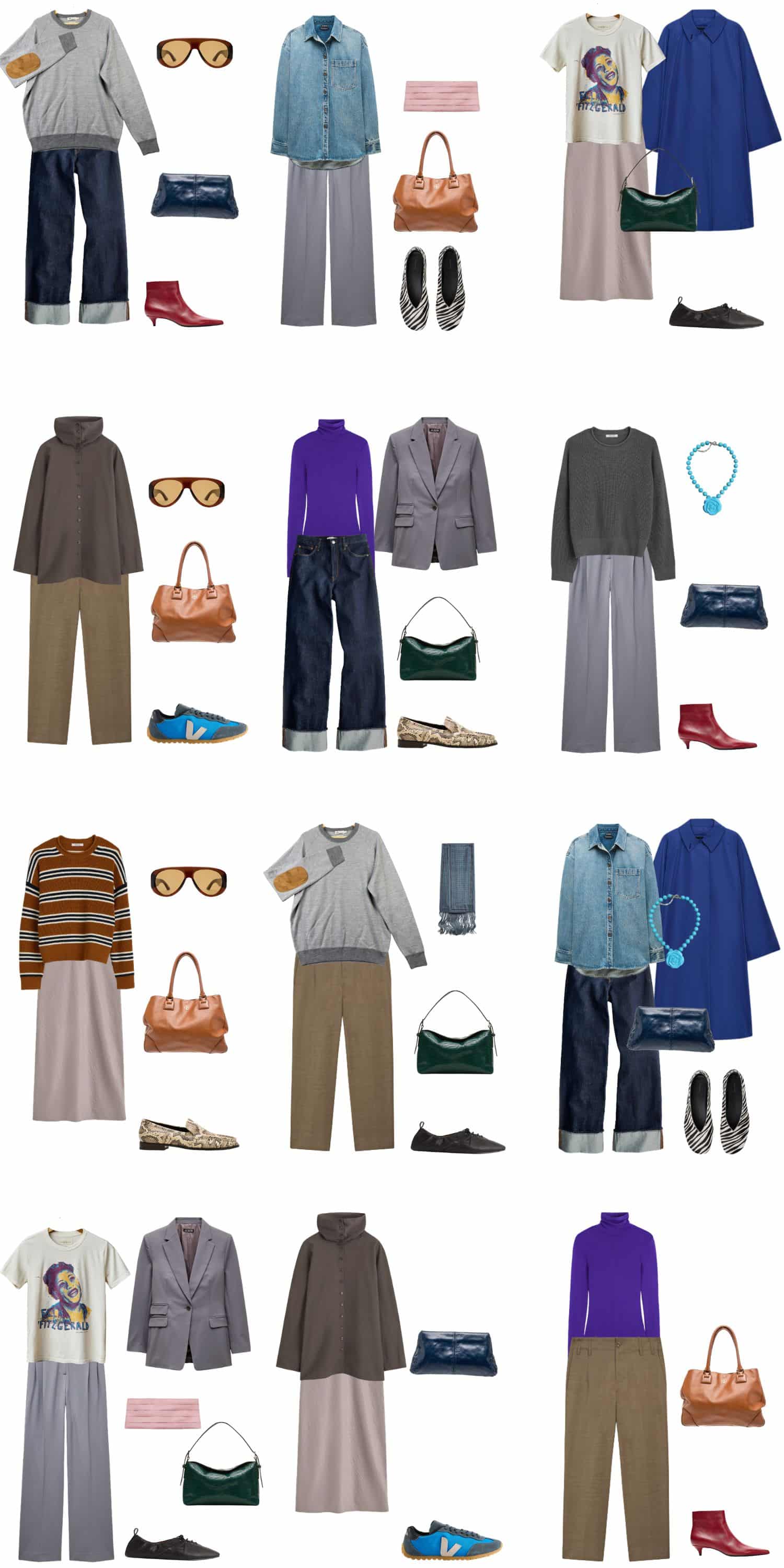
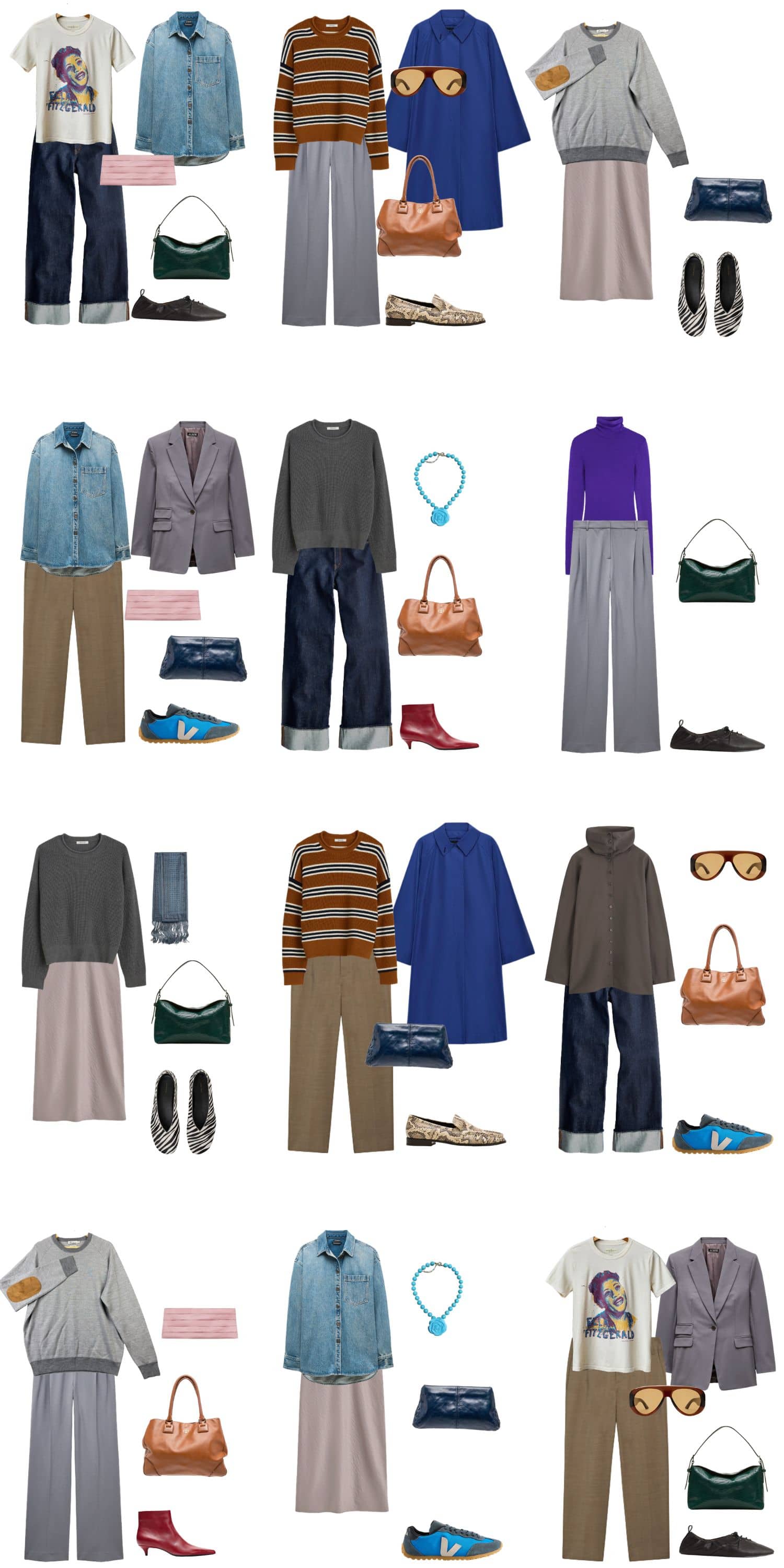
Ella Fitzgerald T-shirt | Indigo Denim | Zebra Flats | Green Bag | Blue Trench Coat | Red Boots | Grey Blazer | Black Jazz Flats | Navy Blue Clutch | Slip Skirt | Grey Sweater | Funnel Neck Shirt | Pink Cummerbund | Blue Necklace | Purple Turtleneck | Brown Striped Sweater | Denim Shirt | Fringe Scarf | Brown Ankle Trousers | Elbow Patch Sweater | Blue Sneakers | Sunglasses | Snake Print Loafers | Cognac Bag | Grey Trousers
SHOP THE UK LINKS
This post contains affiliate links. By using my links to shop I may receive a small commission (at no cost to you). Thanks for supporting what I do 



Hear me out: cummerbund as a top under the denim, etc.
I love, love love the thinking behind this article!
So good.