TL;DR
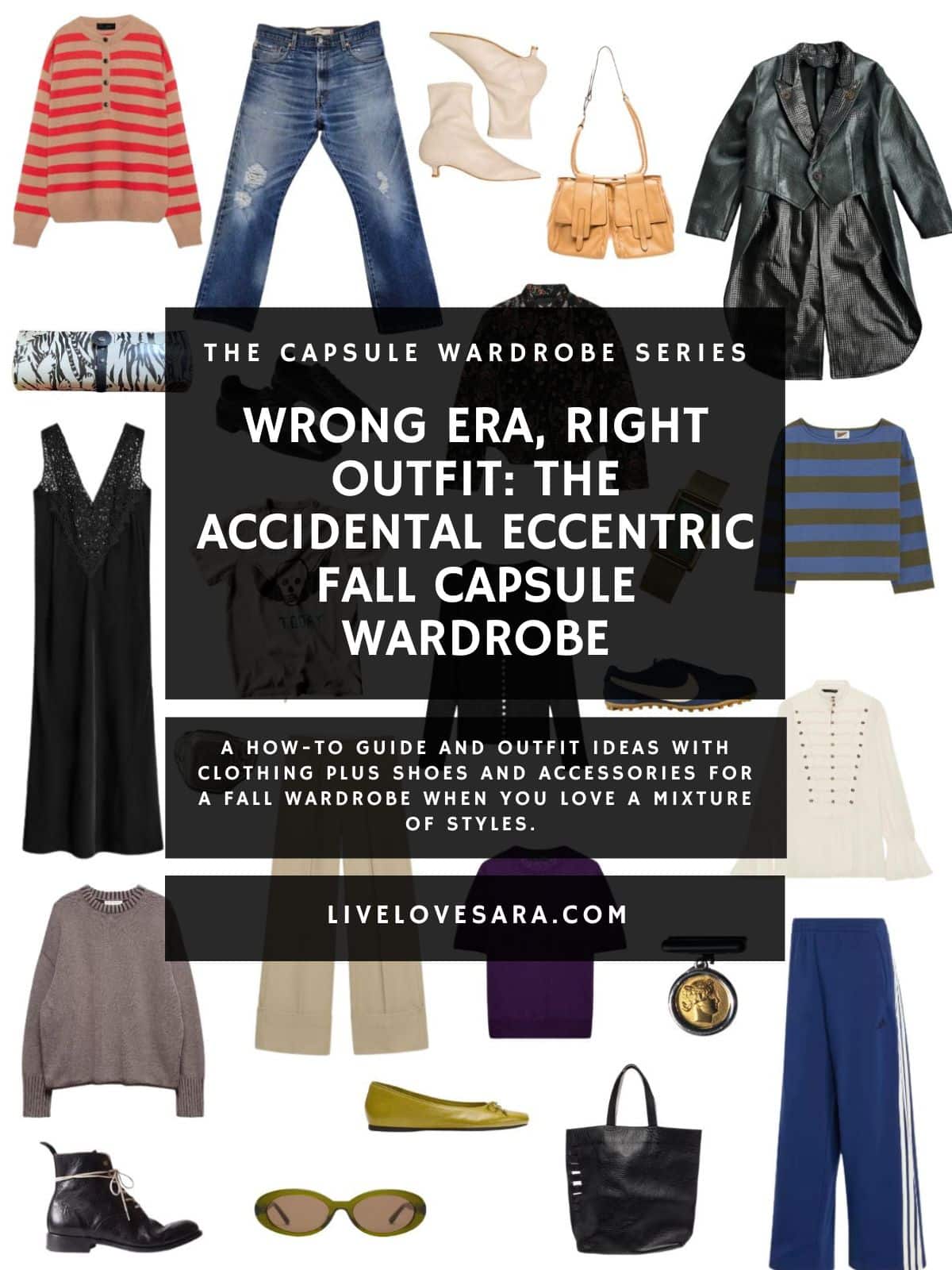
This fall capsule wardrobe mixes historical references, battered denim, romantic lace, menswear tailoring, ordinary knits and strange little flashes of colour without trying to make them agree. The goal isn’t to dress vintage or even to dress “timelessly.” It’s to build a wardrobe that exists outside the trend timeline altogether: collected from different eras, worn without reverence and interesting precisely because nobody can quite tell what year you’re supposed to be dressing for.
Let’s take a moment to reflect on a very specific word that fashion uses to compliment our clothes when it wants to assure us we’ve spent our money responsibly.
WE all know it. Many of us chase it, thinking it will produce the best, most long-lasting wardrobe.
Timeless. It is actually kind of obnoxious when I think about it.
The timeless coat. The timeless trouser. The timeless black dress. The timeless investment bag that, which often costs roughly what my first car did.
Maybe more, because my first car was the cheapest one Hyundai offered at that time.
Timelessness is supposed to mean that something won’t date. Buy the correct beige trench now and theoretically you can emerge from your home in 2047 looking exactly as tasteful as you did in 2026.
Maybe you will, maybe you won’t.
But I am not interested in timelessness. What actually interests me much more is clothing that doesn’t avoid looking dated at all.
Clothing from different decades, different traditions and completely different ideas about how a person ought to dress, worn together in ways that make the timeline not obvious.
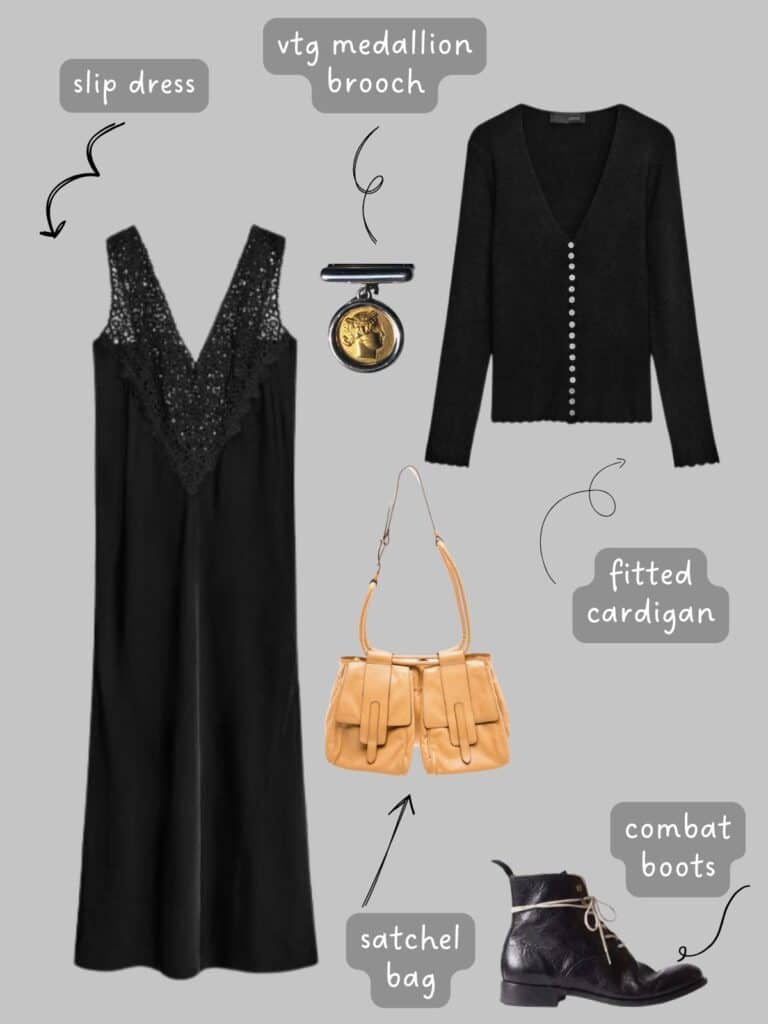
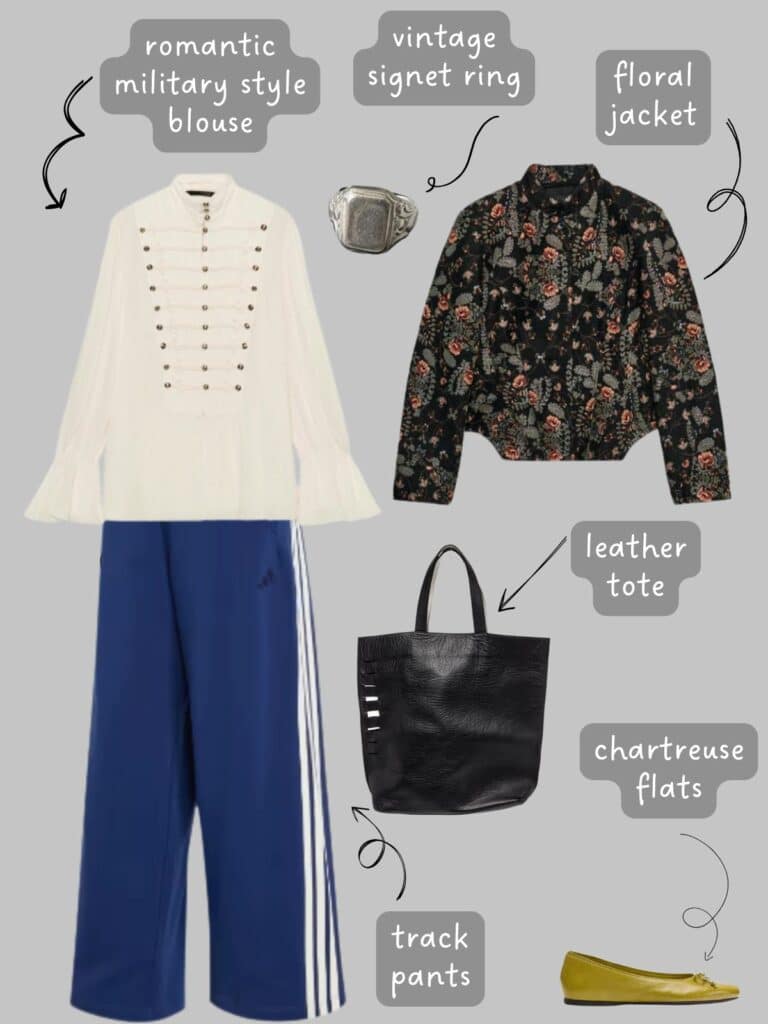
A Victorian-ish blouse with battered jeans. A romantic black slip dress under an ordinary cardigan. Wide masculine-ish trousers with chartreuse-green ballet flats.
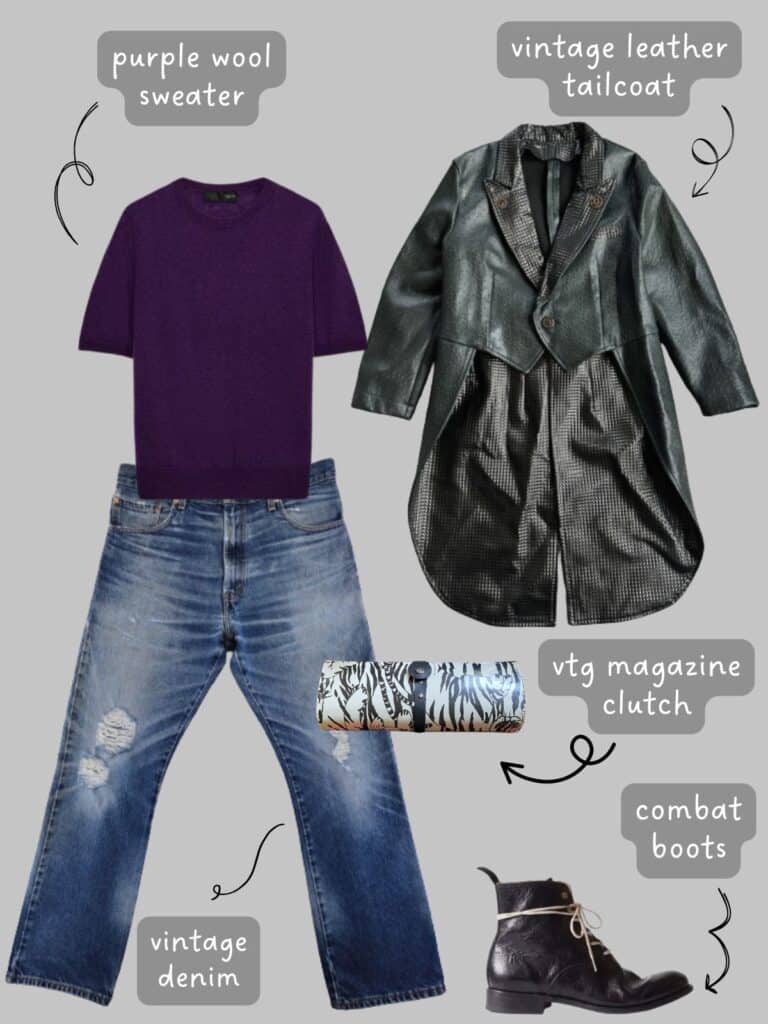
An old-fashioned tailcoat over a purple knit. Cream kitten-heel boots with denim that looks like it has seen some things.
Nothing matches historically, because it is not supposed to, which is why it works.
Bear with me, I am going to be cheesy for a moment. This isn’t timeless dressing, it’s time-less dressing.
Because if we remove the timeline entirely, you stop dressing for an era or aesthetic and start dressing like yourself.
This post builds on last week’s post with similar thoughts and realisations but a different output.
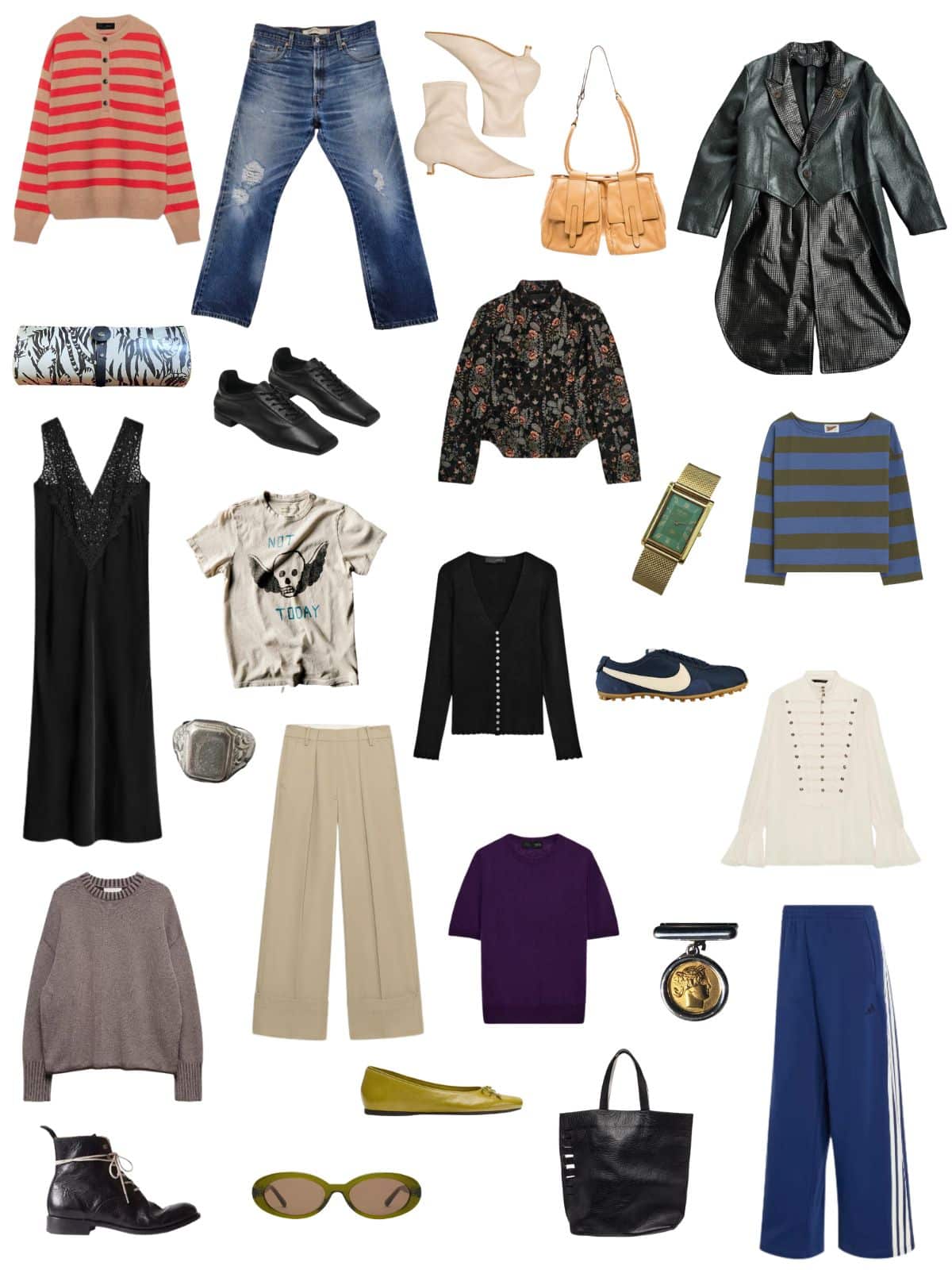
Striped Cashmere Sweater | Vintage Levis | Cream Boots | Satchel Bag | Vtg Leather Tailcoat | Striped Shirt | Vtg Watch | Floral Jacket | Black Oxfords | Magazine Clutch | Slip Dress | Graphic T-shirt | Vtg Signet Ring | Fitted Cardigan | Sneakers | Military Style Blouse | Vtg Medallion Brooch | Purple Sweater Tee | Wide Leg Trousers | Brown Sweater | Combat Boots | Sunglasses | Green Flats | Black Tote | Track Pants

The Problem With Looking Current
Fashion has always dated us. You can look at an old photograph and often place it within a few years without seeing anything except the clothes.
The height of a waistband, width of a trouser leg, shape of a shoe or proportions of a jacket can give the game away immediately.
And there’s nothing wrong with that. It is fun, and clothes are cultural objects, so of course they reflect the period in which we wear them.
The problem begins when looking current becomes something we’re expected to actively maintain.
Suddenly we’re monitoring ourselves.
- Are skinny jeans back?
- Are ballet flats already over?
- Is that blazer shape dated?
- Are ankle boots wrong now?
Have we moved on from oversized things? Are we supposed to be wearing fitted things? And how fitted? Is this fitted or is this giving 2012? Apparently there is a difference, and presumably somebody on the internet is willing to explain it to me, and I am just way too fucking tired to listen or even care.
The anxiety isn’t really about the clothes. It’s more about getting caught wearing the wrong year. Remember this scene from Legally Blonde? “Don’t stomp your little last-season Prada shoes at me, honey!” and how it was supposed to be an insult?
People still feel the same way, and a lot have problems wearing the same pieces multiple times. I was hoping that we would move past this at this point, but it only seems to have got worse.
So when you have reached a certain age, it is exhausting that you’ve already lived through several of these cycles, only to eventually watch the thing you were told to throw away return as the thing you’re told to buy.
At some point, surely we’re allowed to stop participating in this administrative process. Right?…Right?
What If Your Outfit Doesn’t Have a Date?
This is where the wardrobe I’ve been building started to become interesting. At first, I couldn’t figure out what the pieces had in common; I was just excited by them, as you should be when it comes to the clothes in your wardrobe.
There was a black lace slip dress. A cream blouse with vaguely military, vaguely historical detailing. Distressed vintage jeans. Wide beige trousers with enormous cuffs.
A floral jacket that looks as though it might once have been upholstery in a very interesting house. A striped henley sweater in cashmere. A purple knit. Black lace-up shoes. Cream pointed boots. Chartreuse green ballet flats.
And then there is the tailcoat. Obviously.
Because apparently my practical fall wardrobe now requires a tailcoat. I just can’t get enough.
The pieces weren’t giving me a neat aesthetic. It kind of danced around and seemed determined to resist one.
But when I dug a bit deeper I noticed that they were speaking the same language. They all felt slightly displaced.
The blouse seemed to belong to another century. The slip dress carried the residue of the 1990s. The trousers borrowed from traditional menswear. The floral fabric felt older still. The ballet flats were both old-fashioned and very current.
And then the distressed denim was familiar enough to belong almost anywhere, which is kind of like an anchor.
Put them together, and the references start cancelling each other out. You can’t date the outfit because the outfit itself doesn’t know what year it is.
Perfect, we are getting to my point.
The Accidental Eccentric
There is another reason I like this wardrobe, though, and it has less to do with fashion history than with what happens when you spend years honing your taste.
I think some of the most interesting dressers become eccentric accidentally. Not eccentric in the theatrical sense. Which I talked about recently.
They aren’t waking up and thinking, How might I appear delightfully unconventional today?
Because that is performative and would be exhausting.
They simply just like things. They like an old men’s coat, so they keep it. They find a strange pair of shoes in an unhelpful colour and buy them anyway. They inherit jewellery.
They thrift something because the fabric is extraordinary. They own a completely sensible pair of trousers and then wear them with something that might not make sense.
Twenty years pass, and suddenly their wardrobe has developed a personality without having to try. Which is the opposite of building an aesthetic from scratch.
There was no mood board. No three style words. No carefully edited shopping list designed to produce a coherent personal brand.
It was just years of noticing things, and keeping the ones that spoke to them.
Dressing From Several Lives at Once
The most compelling thing about mixing eras isn’t the vintage reference itself. It’s when they collide.
A historical blouse worn with a historical skirt can become costume. The same blouse with damaged jeans hits differently.
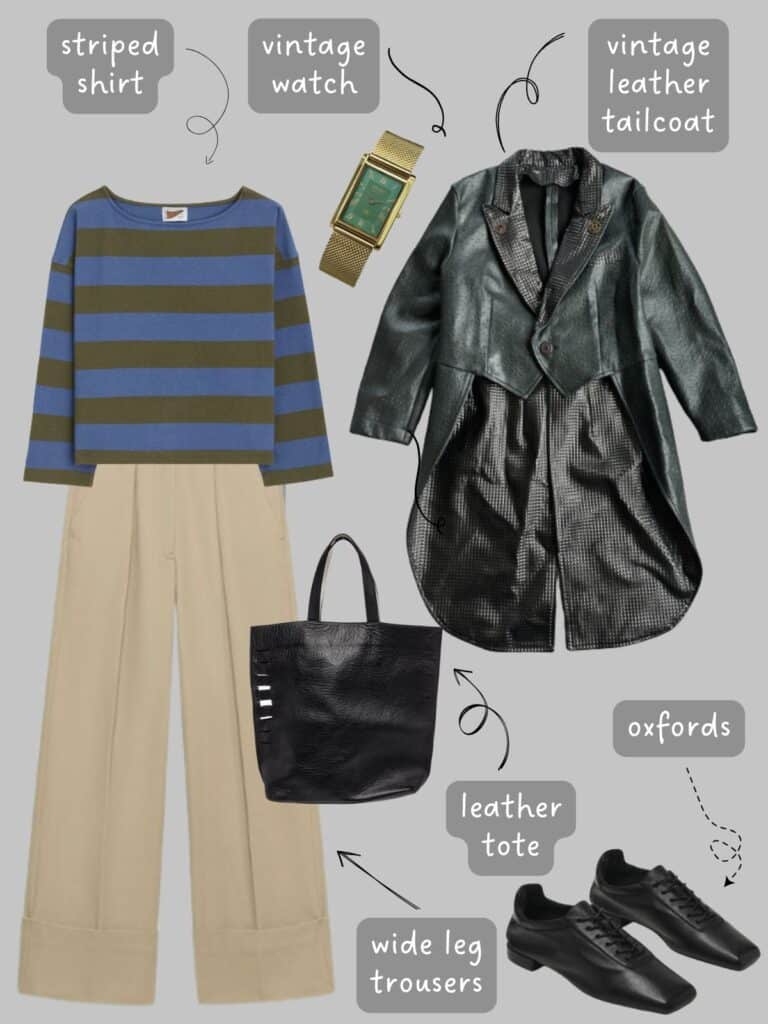
A tailcoat with formal trousers tells a very specific story, but add a striped sweater in a fun colour, and it tells another one entirely.
A lace slip with delicate heels might read romantic. Put a cardigan over it and add battered boots, and suddenly the sweetness has bite.
That tension is what makes these pieces useful. You aren’t trying to recreate the past, you are taking it apart and rebuilding it.
- A little military tailoring here.
- A bit of 1990s minimalism there.
- An old-fashioned shoe shape.
- A men’s trouser.
- A romantic textile.
Something distinctly contemporary thrown into the middle so nobody gets any ideas about historical accuracy.
We aren’t doing costumes, so historical accuracy does not matter.
How to Dress Like the Wrong Era on Purpose
The trick isn’t buying vintage clothes from every decade and piling them onto your body like a very fashionable archaeological dig.
Which would actually be fun to me because fashion history is one of my passions.
It’s much simpler than that.
Choose references rather than costumes.
One historical detail is often enough. A high collar. Unusual buttons. A brocade textile. A long coat. A lace neckline. A square-toed shoe. A menswear trouser.
Then interrupt it, because that’s the important part.
If something feels very romantic, add something utilitarian. If it feels formal, add denim.
If it feels masculine, don’t necessarily “balance” it with femininity; perhaps add one peculiar feminine detail and leave the rest alone.
If everything feels tasteful, add the chartreuse-green shoe. Especially add the chartreuse-green shoe. It’s my favourite colour.
The interruption is what prevents the outfit from becoming an aesthetic exercise.
A Fall Capsule Wardrobe Without a Timeline
This capsule still needs to function like a wardrobe, which means the unusual pieces can’t be allowed to completely take over.
I’d build the clothing pieces around roughly four roles rather than one aesthetic.
There are anchors: distressed jeans, wide neutral trousers, track pants, a graphic t-shirt.
There are quiet layers: the purple knit, striped henley, black cardigan and perhaps one deliberately plain oversized sweater or basic tee.
And then there are the pieces that distort the timeline: the slip dress, military-inspired cream blouse, floral jacket and tailcoat.
Not every outfit needs one of the latter. Because if you pair the cream blouse and the tailcoat, you might look like the vampire Lestat.
That’s important to note. But if you want to look like Lestat, more power to you because that is a pretty badass inspiration.
But sometimes the strange green ballet flat is enough.
The shoes can do much of the same work. A battered black lace-up boot gives the wardrobe history and toughness. A sleek black lace-up flat feels slightly menswear, slightly dance shoe.
The cream kitten-heel boots introduce polish, but not too much. The green ballet flats provide the kind of inexplicable colour decision I want from this wardrobe.
For the fifth pair, I’d go deliberately ordinary: a retro sneaker or very simple loafer.
The wardrobe needs somebody sensible enough to drive everyone home.
The Bags Should Look Like They Came From Different People
This is not the capsule where I would buy three coordinated handbags because there is no fun in that.
I’d want a leather bag that seems to have a travel satchel feel. A structured tote that is modern.
And then something strange.
Maybe tapestry. Maybe metallic. Maybe an unusual shape or colour. Maybe something beaded or handmade-looking.
The bags should feel as though they were acquired independently rather than selected as a set.
The same goes for accessories.
An old watch. A brooch. A signet ring. A scarf. Pearls with something un-pearl-like. Jewellery that looks inherited even if it came from the flea market you went to three Saturdays ago.
The point isn’t provenance.
Stop Saving the Weird Stuff
This might actually be the most important part. If you want an eccentric wardrobe, you have to normalise wearing eccentric clothes.
Not all at once. Just regularly.
The strange jacket cannot remain the Strange Jacket. It has to become the jacket you throw over jeans.
The dramatic dress cannot permanently be awaiting an occasion. Put a sweater over it.
The unusual shoes cannot live in their box because you’re waiting to find the outfit that “goes.” Wear them with the outfit that doesn’t.
Interesting personal style often isn’t the result of owning dramatically different clothes. It’s the result of becoming completely comfortable with your own peculiar combinations.
Because one of the great tragedies of an interesting wardrobe is owning wonderful clothes that you are apparently saving for the day your actual life becomes interesting enough to deserve them.
Wear the strange coat. You are going to the pharmacy.
The coat will cope.
Thrift Stores Are Particularly Good at Breaking Time
There is an obvious reason secondhand shopping works beautifully for this kind of wardrobe. The inventory has no respect for chronology.
A 1990s skirt hangs beside a 2018 blouse beside an old men’s blazer beside something homemade in 1974 beside a pair of shoes from three seasons ago.
The trend cycle has already been dismantled for you, and then you’re forced to look at the object itself. Versus walking into a store where everything has been designed, styled and merchandised to explain exactly what you’re supposed to want right now.
Secondhand stores let different versions of fashion coexist.
Maybe Timeless Was Never the Goal
I don’t actually want my wardrobe to look the same forever. I don’t think that’s how personal style works.
We change. Our bodies change. Our lives change. Our tolerance for uncomfortable shoes changes dramatically.
We rediscover something we’d forgotten.
We encounter new things. We keep old things. We get rid of things we once thought we’d love forever. Then we regret getting rid of things we thought we’d love forever.
A wardrobe built over a life shouldn’t look frozen in time, it should be the opposite and actually contain evidence of time passing. Which is different from looking dated.
So maybe this is where the idea of timeless style has always bothered me, because it suggests escaping time, and I don’t want to escape it.
I want the 1990s dress and the old coat and the new shoes and the thrifted blouse and the jeans I’ve worn half to death to coexist.
I want a wardrobe that couldn’t have been bought in one season because it couldn’t have existed in one season.
Wrong Era. Right Outfit.
So the moral is to keep the things you love long enough. Buy the strange thing occasionally.
- Let new clothes meet old clothes.
- Let men’s tailoring sit beside lace.
- Let elegant shoes meet ruined denim.
Let something beautiful be a little ugly, and something ordinary sit beside something absurd.
Stop checking whether the decades match.
The year is irrelevant.
Fall Outfit Ideas for Women
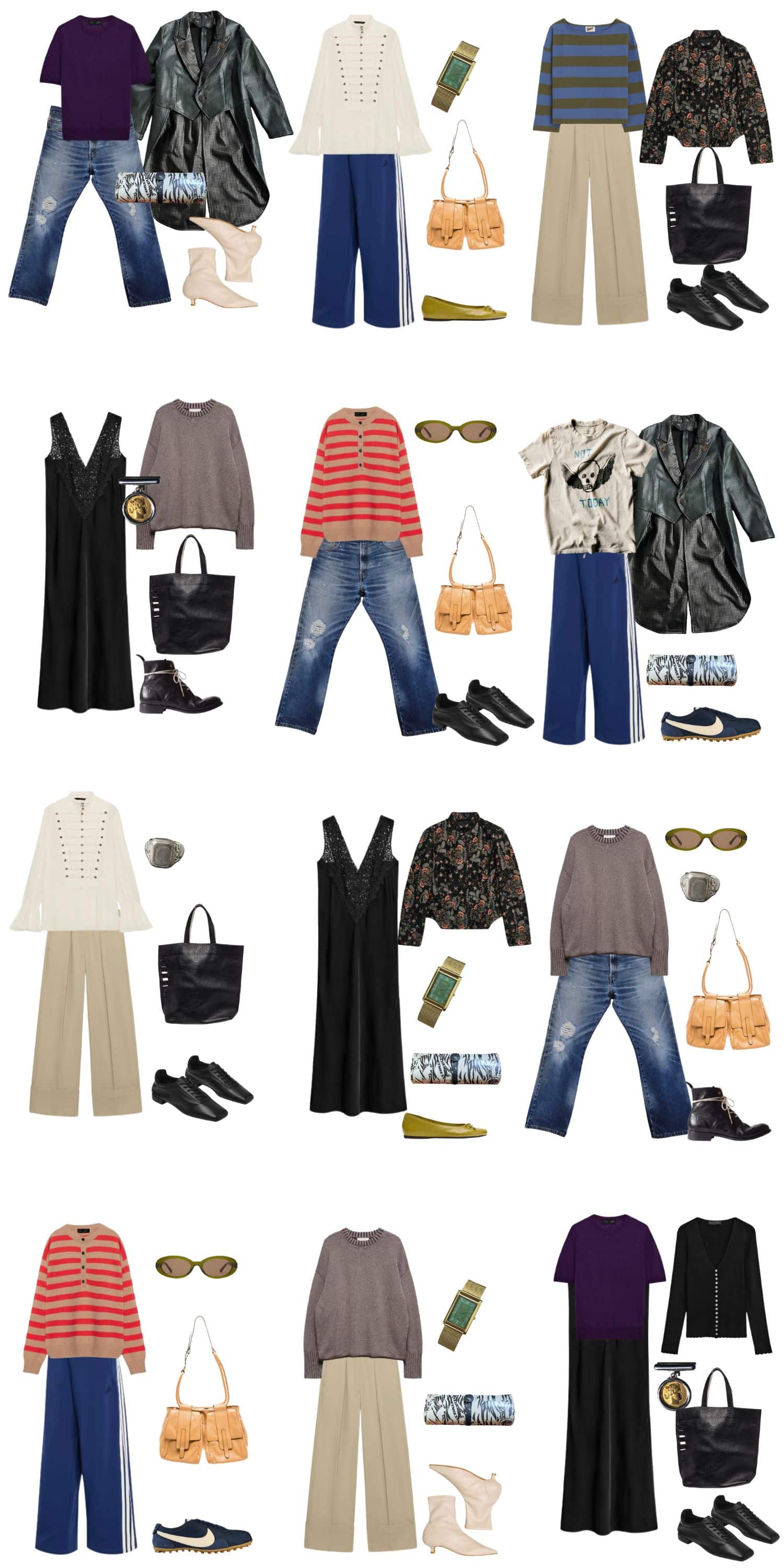
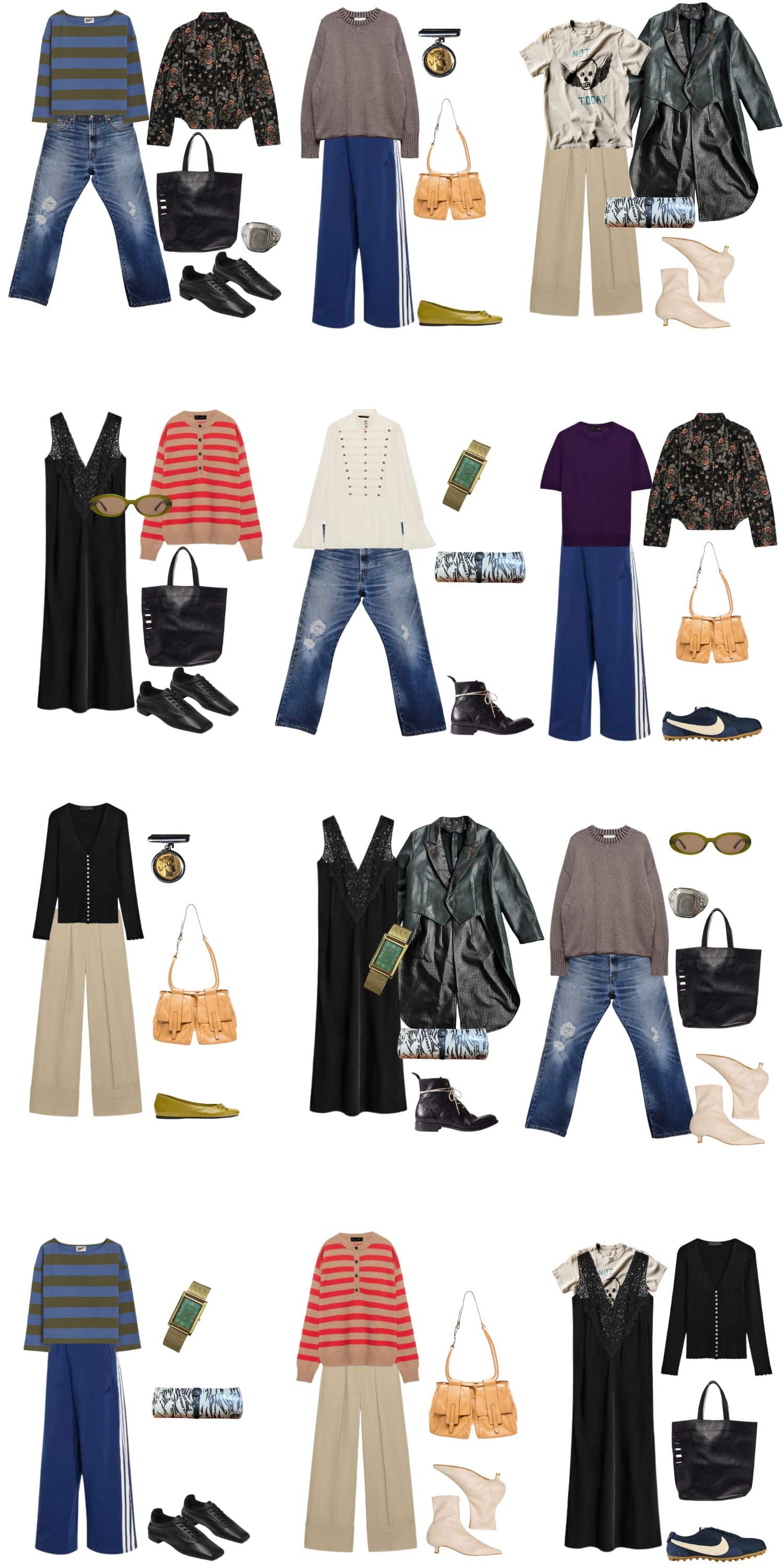
Striped Cashmere Sweater | Vintage Levis | Cream Boots | Satchel Bag | Vtg Leather Tailcoat | Striped Shirt | Vtg Watch | Floral Jacket | Black Oxfords | Magazine Clutch | Slip Dress | Graphic T-shirt | Vtg Signet Ring | Fitted Cardigan | Sneakers | Military Style Blouse | Vtg Medallion Brooch | Purple Sweater Tee | Wide Leg Trousers | Brown Sweater | Combat Boots | Sunglasses | Green Flats | Black Tote | Track Pants
SHOP THE UK LINKS
This post contains affiliate links. By using my links to shop I may receive a small commission (at no cost to you). Thanks for supporting what I do