TL;DR
A curated wardrobe is built around an idea. A collected wardrobe is built around a life. The difference isn’t aesthetic, it’s philosophical. Curation asks: Does this fit the vision? Collection asks: Does this mean something?
This is not an argument against curation. It’s an argument for stopping apologising if your wardrobe doesn’t have one. You can build a curated wardrobe. You can only live long enough to have a collected one.
Confession: Sometime in the mid-nineties, I stole a pair of Levi’s from my dad. He never knew, well, I actually think he probably did know, but he never said anything, even when I sashayed past wearing them.
I still have them.
They don’t fit perfectly. They never did. I prefer the oversized slouch anyway.
They are faded in places that have nothing to do with me, worn soft from the years he wore them. By any reasonable measure, I should have retired them by now. I haven’t. I won’t.
This is not a story about denim.
Why “curated” stopped meaning anything, and what we lost when it did
We are living through peak curation.
The word itself has become almost meaningless. Every Instagram grid, every wardrobe haul, every “get ready with me (GRWM)” video is described as curated, as though intentional assembly were the highest form of personal style.
Maybe it isn’t.
I want to talk about a different kind of wardrobe, which I see reflected in the wardrobes of many women that I admire, as well as in my own closet.
It is less photogenic, harder to explain and describe, and mostly absent from the current conversation of the trend cycle. It isn’t built around an aesthetic. It doesn’t have a colour palette or a guiding philosophy.
It accrues. Piece by piece, year by year, mostly by accident. It looks like nothing in particular, but it looks exactly like the person who wears it.
This is a collected wardrobe. And it is not the same thing as a curated one.
The real difference between a curated wardrobe and a collected one
A curated wardrobe begins with an idea. I want to look French. I want to look minimalist. I want to look expensive, effortless, undone.
The clothing is selected in service of that idea. Each piece is evaluated against a vision. Nothing makes it in that doesn’t belong.
A collected wardrobe begins somewhere messier.
You bought the jacket because you were in a city you loved, and it was there.
You kept the shirt that doesn’t quite fit because of who you were when you bought it, and getting rid of it feels, irrationally, like getting rid of her.
You wore the boots into the ground because you walked somewhere that mattered in them.
You still have the ring from the flea market, the one that turned your finger green for a month, because you’ve never been able to explain why you love it, and that is a good enough reason.
None of this is logical. A curated wardrobe would never allow it.
But a collected wardrobe doesn’t ask for logic. It asks only: Does this mean something? And if the answer is yes, even if the something is embarrassing, even if it’s just a feeling you can’t name, it stays.
Years later, those pieces accidentally become a style. But the style was never the point to begin with.
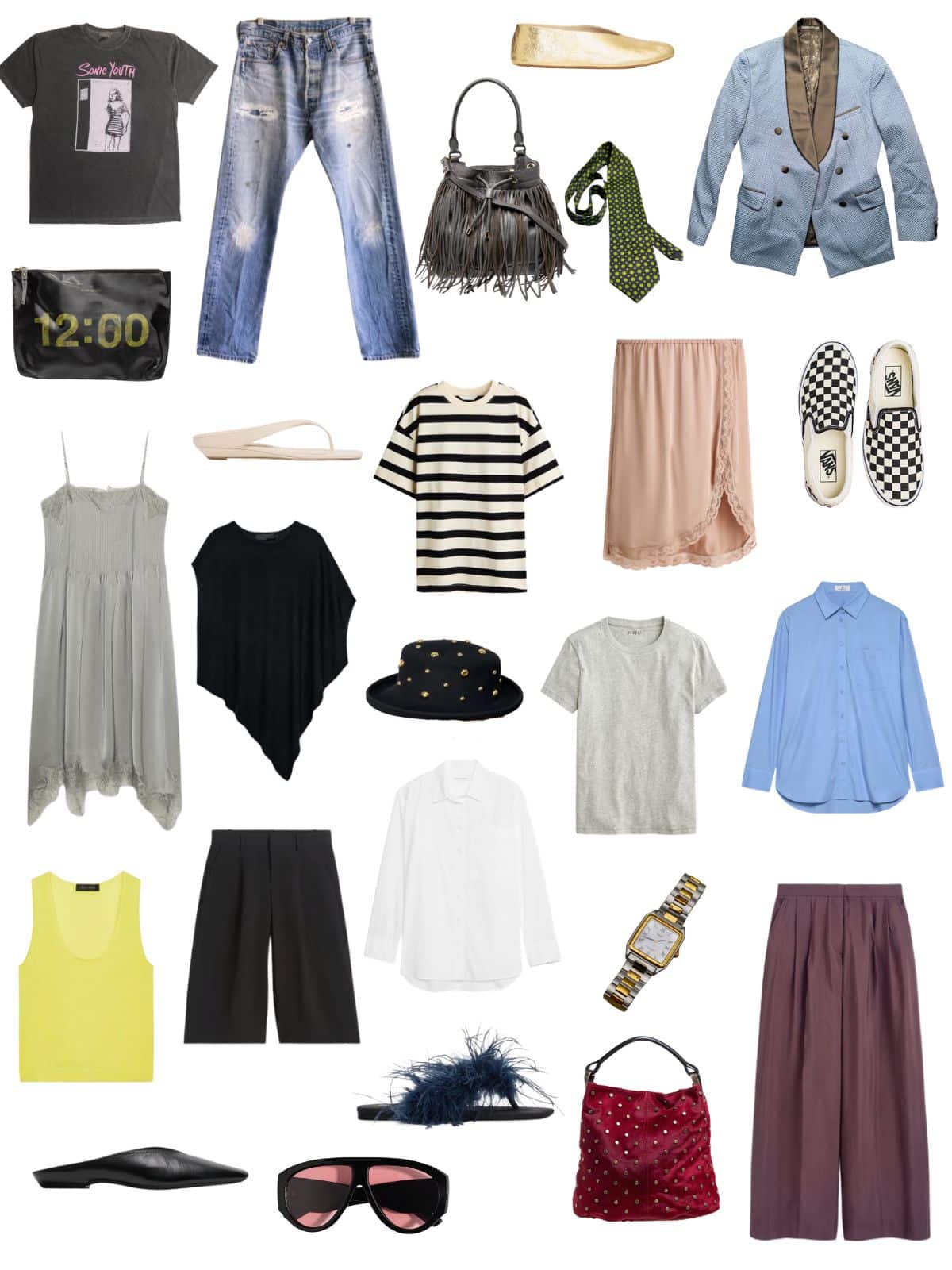
Sonic Youth Tee | Vintage Levis | Fringe Bucket Bag | Gold Flats | Vintage Tie | Tuxedo Jacket | Checkered Vans | Pink Skirt | Striped T-shirt | Off-white Wedge Sandals | Clock Clutch | Grey Dress | Black Asymmetric Top | Studded Hat | Grey T-shirt | Blue Button Up | Vintage Watch | White Button Up | Black Culottes | Yellow Tank Top | Black Mules | Sunglasses | Fringe Flip Flops | Burgundy Studded Bag | Burgundy Trousers

Your wardrobe is a biography, not a mood board
Here is what I think is actually true: a curated wardrobe tells you who someone wants to be. A collected wardrobe tells you who they’ve been.
That distinction matters more than it sounds.
Curation is aspirational by nature. It selects toward an ideal, editing out anything that doesn’t serve the image.
Which is fine. Useful, even. But it is also, in a way, a kind of erasure.
The pieces that don’t fit the vision don’t make the cut. Neither do the years they came from.
A collected wardrobe doesn’t edit. It accumulates. Mistakes stay in. Obsessions stay in. The phase you went through that you’d rather forget stays in, usually in the back of the closet, usually still worn occasionally because some part of you hasn’t fully let it go.
The result is messier. It is also more honest. These pieces survive every wardrobe clean-out. They become something many style guides overlook entirely: evidence.
Evidence of places you’ve been, of who you’ve loved, and evidence of versions of yourself that still matter.
This is not an argument against curation. It is an argument for recognising that collected style is not the absence of style. It is a different kind entirely.
One that cannot be built in six months from a Pinterest board. One that requires something curation cannot manufacture.
Time.
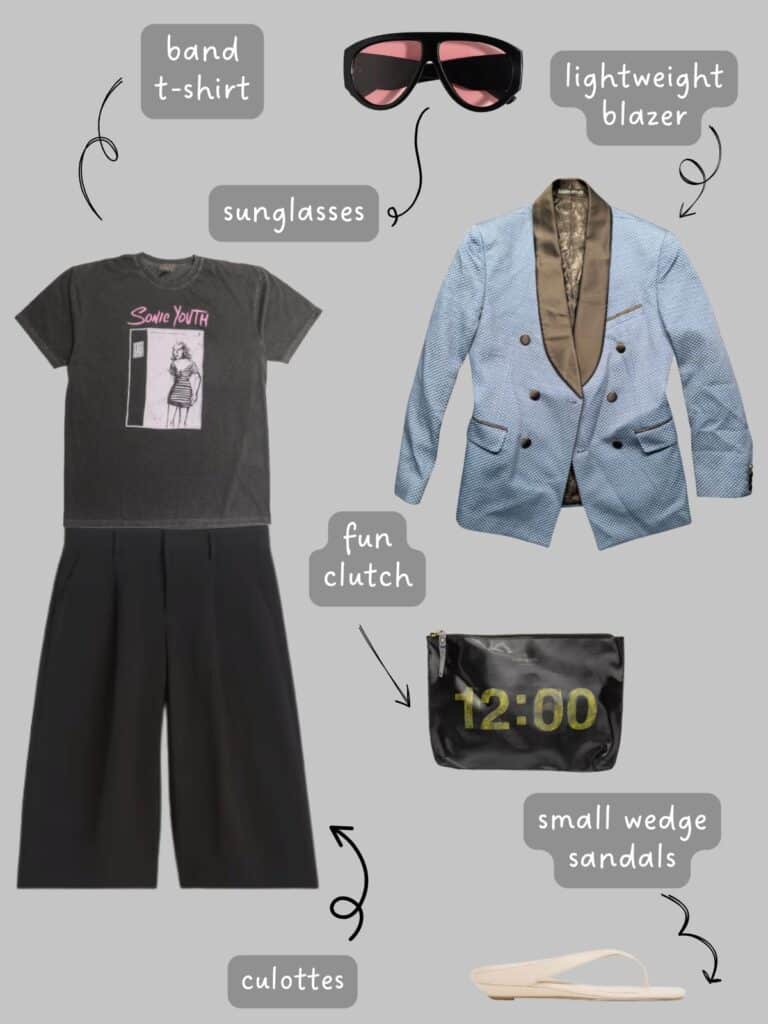
Why the most interesting wardrobes belong to women who’ve stopped trying to have one
A twenty-year-old can curate a wardrobe over a weekend. The references are there, the templates are there, the algorithm will helpfully show you exactly what the finished version is supposed to look like.
Curation scales. It is learnable. It is, in the best sense of the word, efficient.
A collected wardrobe cannot be rushed. It requires years of buying things for the wrong reasons and keeping them anyway.
It requires enough life to have accumulated something worth wearing. Enough history to have inherited things, lost things, found things in places you can still picture.
Enough distance from who you were at twenty to wear the evidence of it without embarrassment.
I think that this is going to land differently for specific demographics. I am thinking specifically of women in their forties and beyond.
Not because they are more stylish. But because they have more material to work with.
The wardrobe has had time to become a record. The pieces have had time to mean something. The style that emerges from that is not assembled. It is something that you arrived at.
Iris Apfel understood this. So did Patti Smith. So, in her own completely unconcerned way, did Maggie Smith. None of them dressed like they were building toward something. They dressed like people who had already been somewhere.
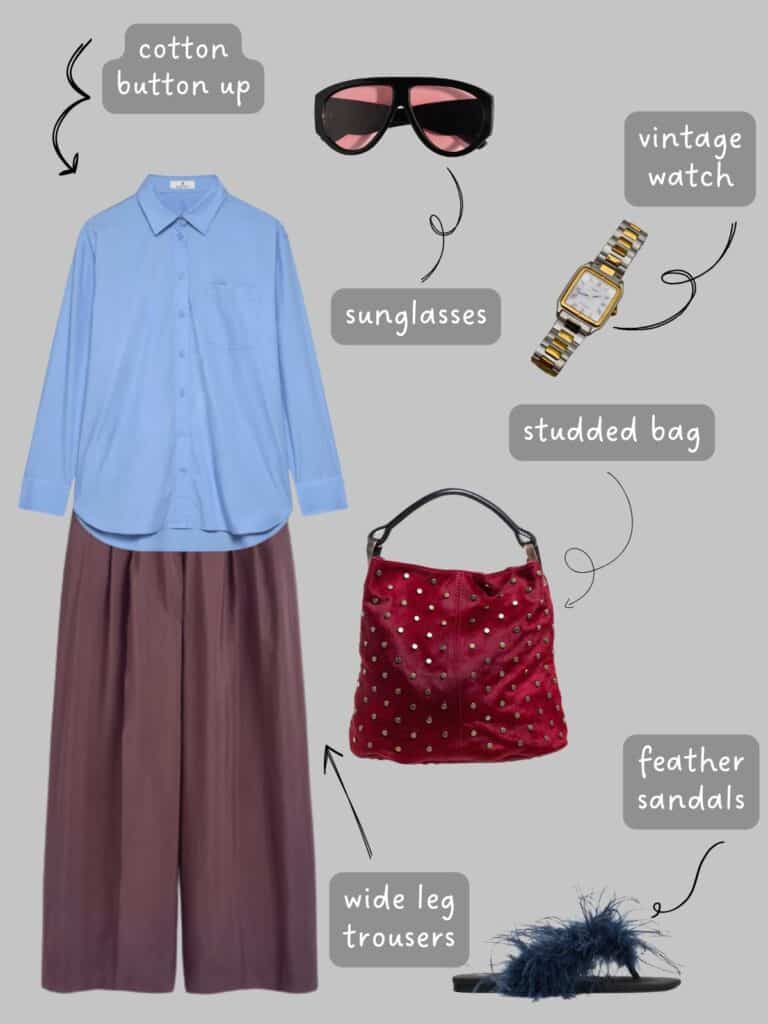
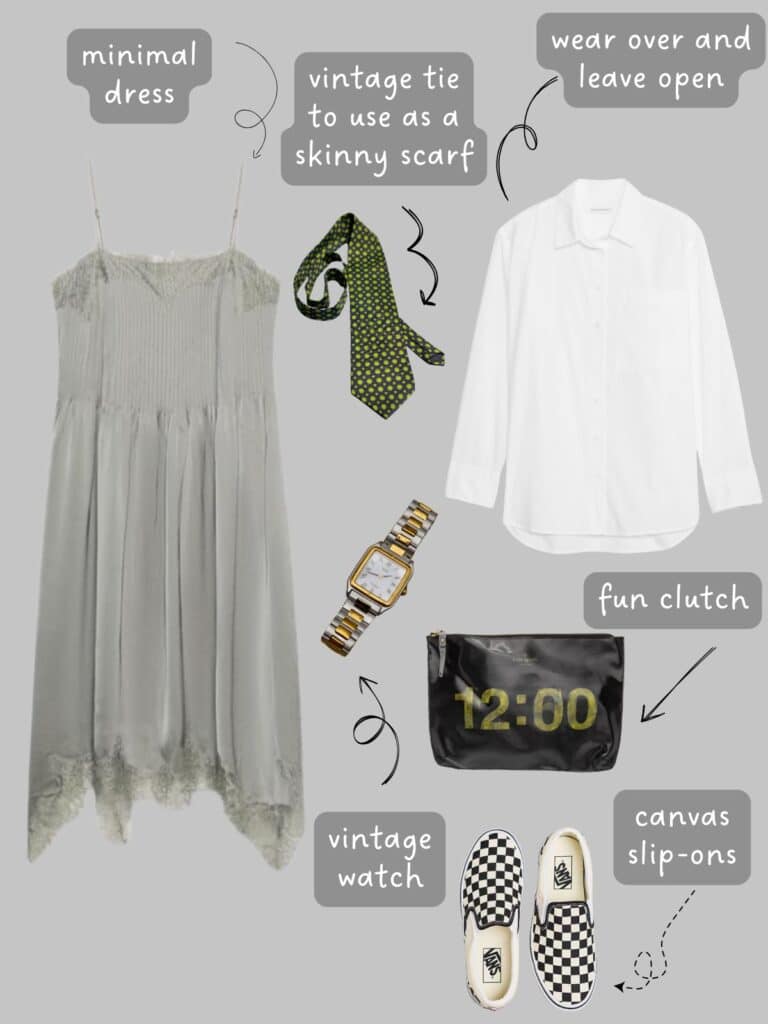
Before you go shopping, go looking in your own closet first
Before you go looking for anything new, it might be worth going looking for what you already have. Not to build a wardrobe from scratch. Just to remember what’s already in yours.
A few places to start.
The thing that belonged to someone else first.
Something from a parent, a grandparent, an ex, a friend. It carries history that predates you, which is exactly what makes it worth wearing. You don’t need to explain where it came from. You just need to stop leaving it in the back of the closet.
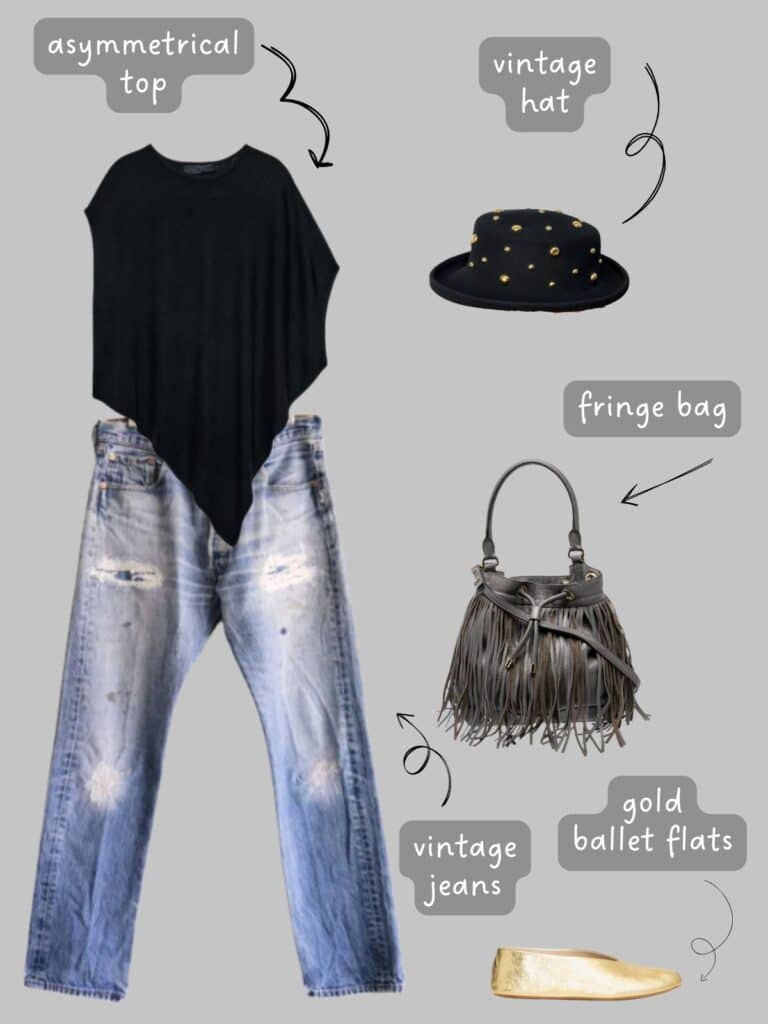
Maybe your grandfather’s favourite tie worn wrapped around like a skinny scarf.
The piece you bought somewhere you loved.
The city, the trip, the Saturday afternoon you still think about. You’ve been saving it for the right moment without realising the right moment was always just a regular Tuesday. Wear it now.
Maybe a hat that you bought when you were vintage shopping in Paris.
The phase piece.
The item from a version of yourself you’ve since outgrown but haven’t entirely let go of. The fact that you kept it means something. It belongs in the rotation, not as a costume, but as evidence. You were that person once. She’s still in there somewhere.
Something like a band tee from a concert in the 90s, you still love the music but you don’t wear it as often as you once did.
The thing that doesn’t match anything.
You’ve been waiting for the rest of the wardrobe to catch up to it. It won’t. That’s not a problem. Wear it with whatever is closest and see what happens. The collected dresser has always known that the most interesting combinations are the ones that weren’t planned.
How about that light blue vintage tuxedo jacket you had to have but never know how to wear it.
The lucky find you’ve been saving.
The flea market ring, the thrifted jacket, the thing you almost didn’t buy and then couldn’t stop thinking about until you went back. You found it for a reason. Stop saving it for a special occasion that dresses the same as every other occasion. It’s already special. It’s yours.
Maybe an old watch that caught your eye even though you aren’t really a watch person.
The thing that’s worn in rather than worn out.
Like a preloved bag that still has so much life.
The soft spots, the fading, the slight imperfection that makes it look like it has a story, because it does. A collected wardrobe doesn’t retire things for looking lived in. That’s the whole point.
Some ideas to think about to help get you thinking in this direction are:
- old band tee
- men’s button-down
- inherited blazer
- worn leather bag
- linen trousers
- vintage jewelry
- broken-in shoes
I picked the pieces in this wardrobe based on the items in mine that check the above boxes of the different life experience prompts I gave.
Yours might look similar, but most likely it will be completely different because it is based on the life you have lived.
I still have the Levi’s.
I still have the brown suede blazer I bought in the early 2000s that has never fit me correctly and that I wear anyway.
Some things earn their place in a wardrobe not by being right but by being present long enough to become yours.
Neither piece would survive a curation exercise. Both would be flagged as wrong fit, wrong era, no clear role in a cohesive wardrobe story.
And they would be correct. There is no cohesive wardrobe story. There is just the wardrobe. The one that happened.
The one that looks a lot like a life.
You can build a curated wardrobe. You cannot build a collected one becasue this version is shaped by concerts, thrifting, family members, travels, mistakes, favourite books, old jobs, changing tastes, and years of collecting little pieces of a life.
All of these things become less of a wardrobe and more of an autobiography hanging in a closet.
Summer Outfit Ideas for a Collected Closet
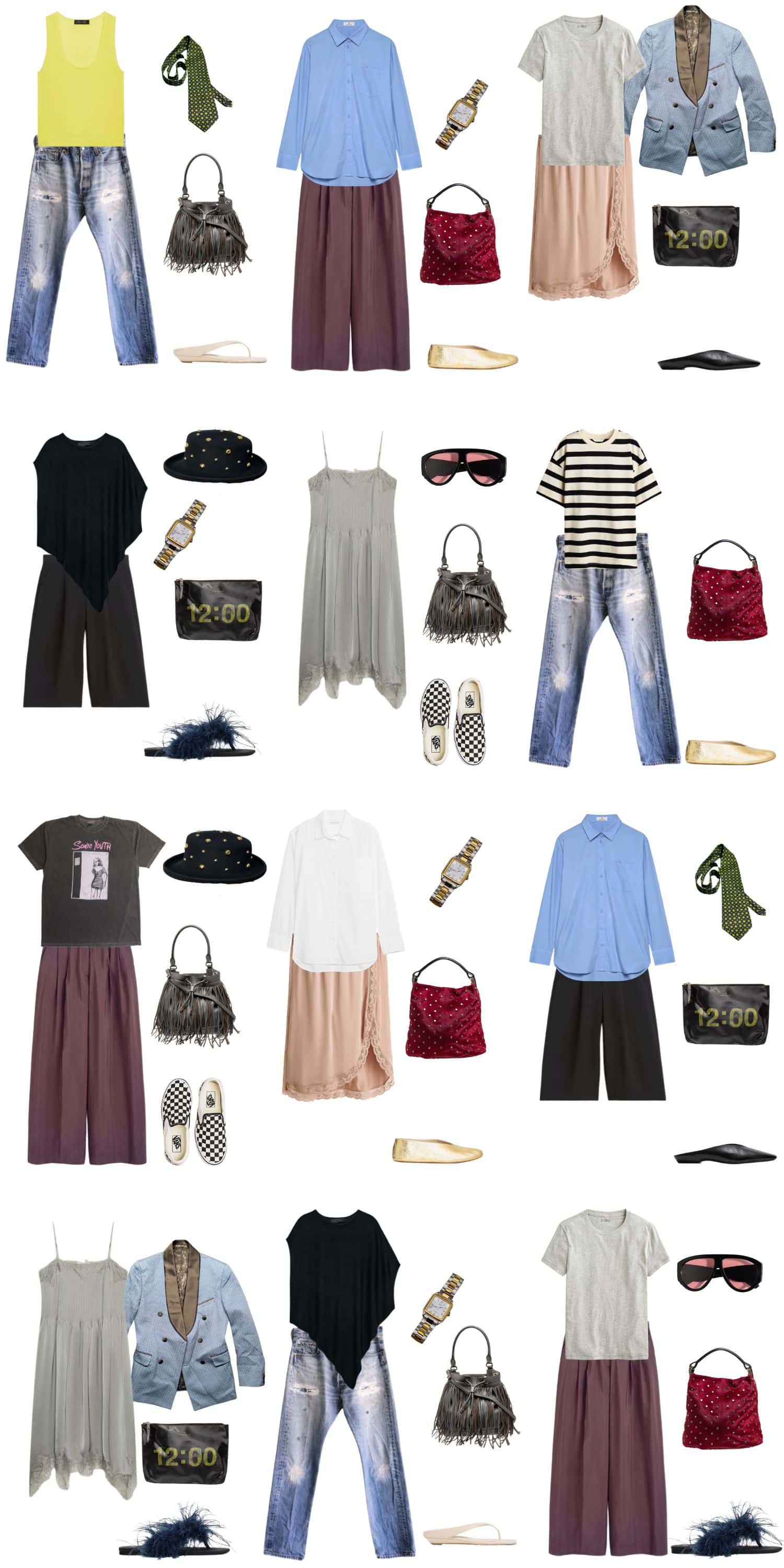
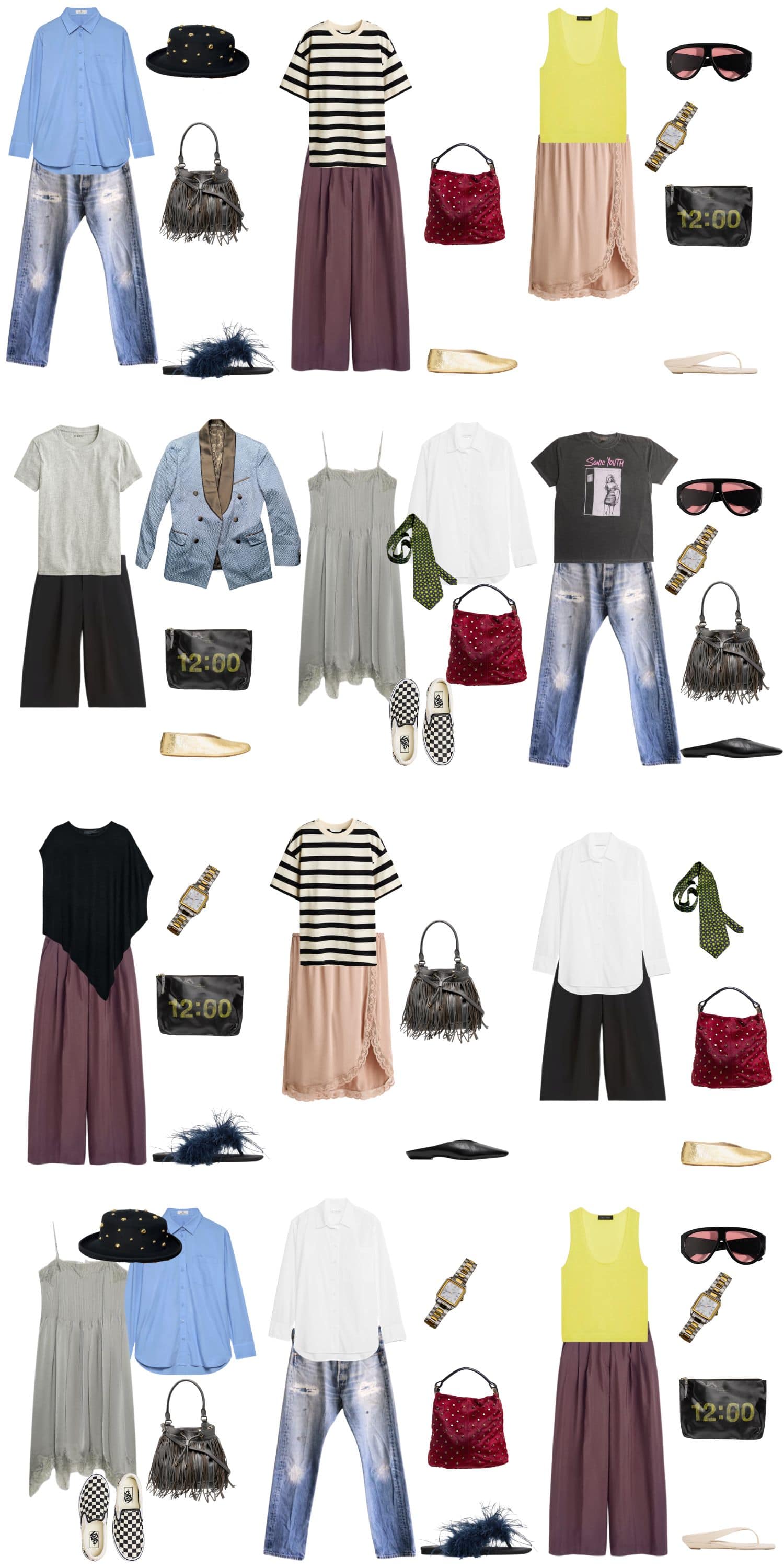
Sonic Youth Tee | Vintage Levis | Fringe Bucket Bag | Gold Flats | Vintage Tie | Tuxedo Jacket | Checkered Vans | Pink Skirt | Striped T-shirt | Off-white Wedge Sandals | Clock Clutch | Grey Dress | Black Asymmetric Top | Studded Hat | Grey T-shirt | Blue Button Up | Vintage Watch | White Button Up | Black Culottes | Yellow Tank Top | Black Mules | Sunglasses | Fringe Flip Flops | Burgundy Studded Bag | Burgundy Trousers
SHOP THE UK LINKS
This post contains affiliate links. By using my links to shop I may receive a small commission (at no cost to you). Thanks for supporting what I do 



I loved your pov on how to create a wardrobe.Since my teen years I’ve been reading style strategies,3 words to define your style,etc. and it all seemed very restrictive. They sound good to follow a vision, but if I would follow it how could I incorporate my rock art necklace bought on a solo trip and connect with an edgy wardrobe? But if I’m the person attracted by both, they have to connect, right?
I’ve found your site looking for this: how could I connect the things I’ve read, the art I love and all instead of just trying to reproduce influencers?
The eureka moment was noticing that I had two bikinis that, when mixed were the same color palette of one of my favorite paintings “Sunday Afternoon on the Island of La Grande Jatte “. (I love the beach and I’m from Brazil, so my bikinis are a big deal for me, lol). Now, I can see my style in a whole new light.
Glad I’ve found your writings and sorry for the rambling thoughts.
Thank you Mariana. I’m glad you’ve been able to have that realization and eureka moment with the bikinis. Sometimes all it takes is someone to nudge you in the direction you are seeking for it to make sense. I hope that you can use this now to view your wardrobe as a story of your life, your experiences, and things and people you loved. Wear that rock art necklace with the confidence and passion you bought it with. The best wardrobes aren’t cohesive, and one story. – Sara
I have many pieces that are collected rather than curated. I’ve also found that certain items I don’t wear and ultimately get rid of because of connotation (a dress worn to a friend’s funeral. A jumper worn during a breakup.). They are tainted by association.
Also to reply to the comment from Mariana above (who might never read this) – check out The Vivienne Files, it’s a blogger will create wardrobes based on artwork, or a piece of jewellery.