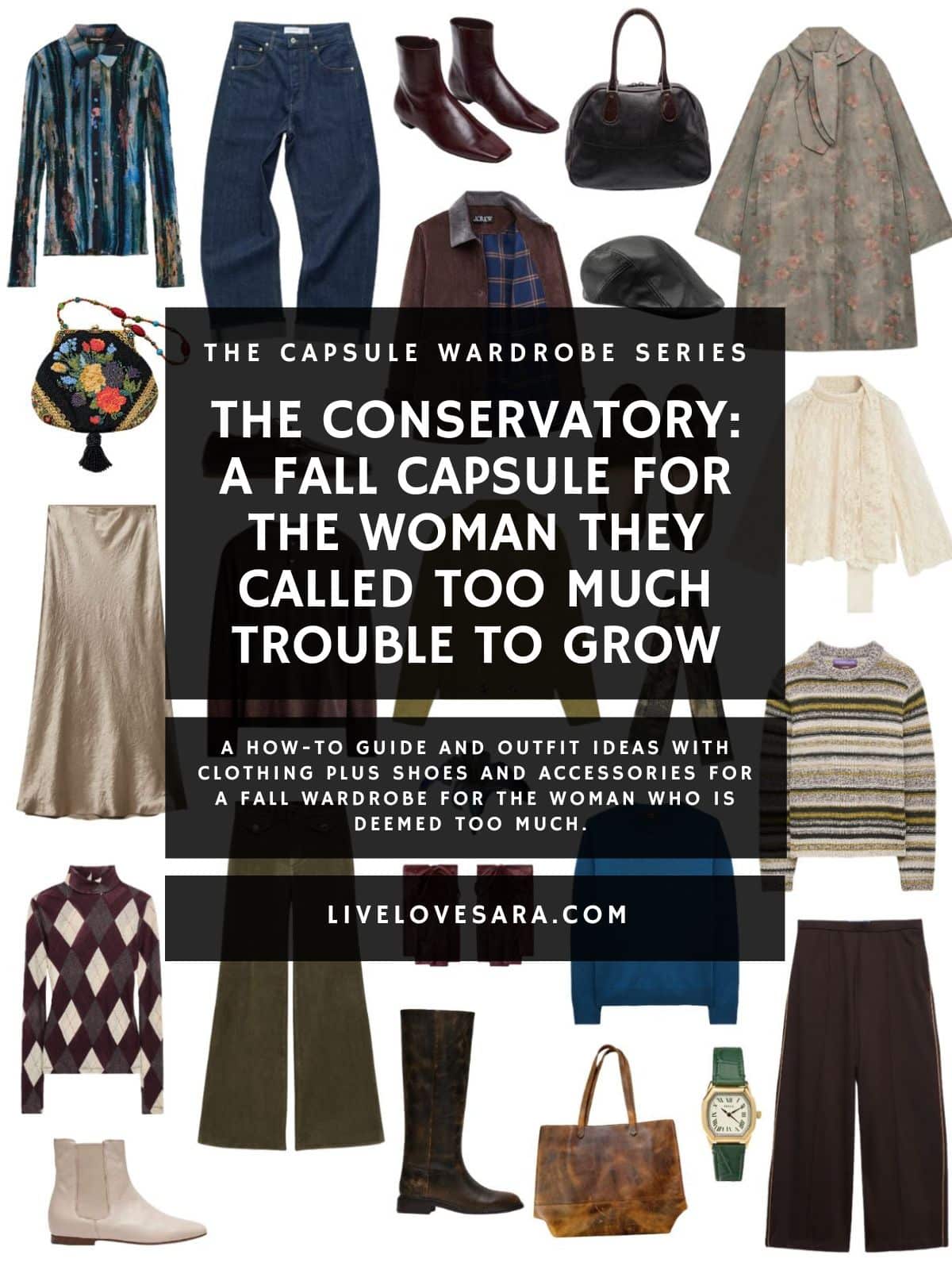
TL;DR
The Conservatory is a character-driven fall capsule wardrobe about the woman who got called high-maintenance, precious, or “a lot,” and decided those were just bad translations for rare. Built from corduroy, suede, lace, satin, and old brass hardware, this wardrobe reclaims the “hothouse flower”, not as something too delicate for the world, but as something someone built an entire structure around, because it was worth the trouble. She did not ask to be easy. She asked to be kept alive on her own terms.
Last week’s piece about The Understudy got a great response, and a few of you mentioned that you saw yourselves backstage too. I’ve been sitting with that. Apparently we are all, in one way or another, tired of auditioning.
Full disclosure before we go any further: the moment I landed on this concept, my brain skipped past every genteel, botanical association a conservatory is supposed to have and went straight to Colonel Mustard, in the Conservatory, with the lead pipe.
Clue is a very serious matter in this house. We own several different renditions, even though nothing beats the original. I rewatched the 1985 movie after Tim Curry died, which felt like the correct way to mourn a man who gave us one of the great unhinged comedic performances of all time.
My girls take the game extremely seriously as well, which I consider excellent parenting on my part. My husband, meanwhile, has been banned from playing since the 2020 lockdown, after he was caught lying about which cards he was holding.
You do not cheat at Clue. He remains banned. It has been years. I do not see this changing.
So this week I want to talk about a different insult, one with nothing to do with lead pipes, although sometimes I want to swing one.
This one is not about being overlooked, but the one about being too much: too particular, too sensitive, too high-maintenance, too many conditions attached to your continued thriving.
I’m not sure when someone decided this was a character flaw instead of a fact about horticulture, and I would like to unpack that, ideally while wearing something with a very good collar.
The Conservatory Was Never Built for the Fragile
You already know the phrase. Hothouse flower. A woman who cannot survive outside of very specific, very controlled conditions.
It is deployed as an insult more often than it is deployed as a fact, and it always implies the same thing: that needing anything at all is evidence of weakness, that the correct amount of maintenance a woman should require is none, and that if you cannot thrive in whatever you’re handed without complaint, the failure is yours.
Here is what that phrase leaves out.
Nobody builds a greenhouse for a dandelion. You don’t run copper pipe, regulate the humidity, and glaze an entire structure in glass to keep alive something that would have been fine anyway.
A conservatory gets built because what’s inside it is worth the architecture. The orchid did not choose to be difficult. Someone decided it was worth the trouble of difficulty, and that is not the same story at all.
The woman this capsule belongs to has spent a long time being told that her requirements were the problem. The specific temperature at which she does her best work. The kind of quiet she needs to think. The fact that she wilts under certain kinds of attention and opens completely under others, and that this is not a character flaw.
She has finally stopped apologising for this perceived flaw. She built the glasshouse herself.
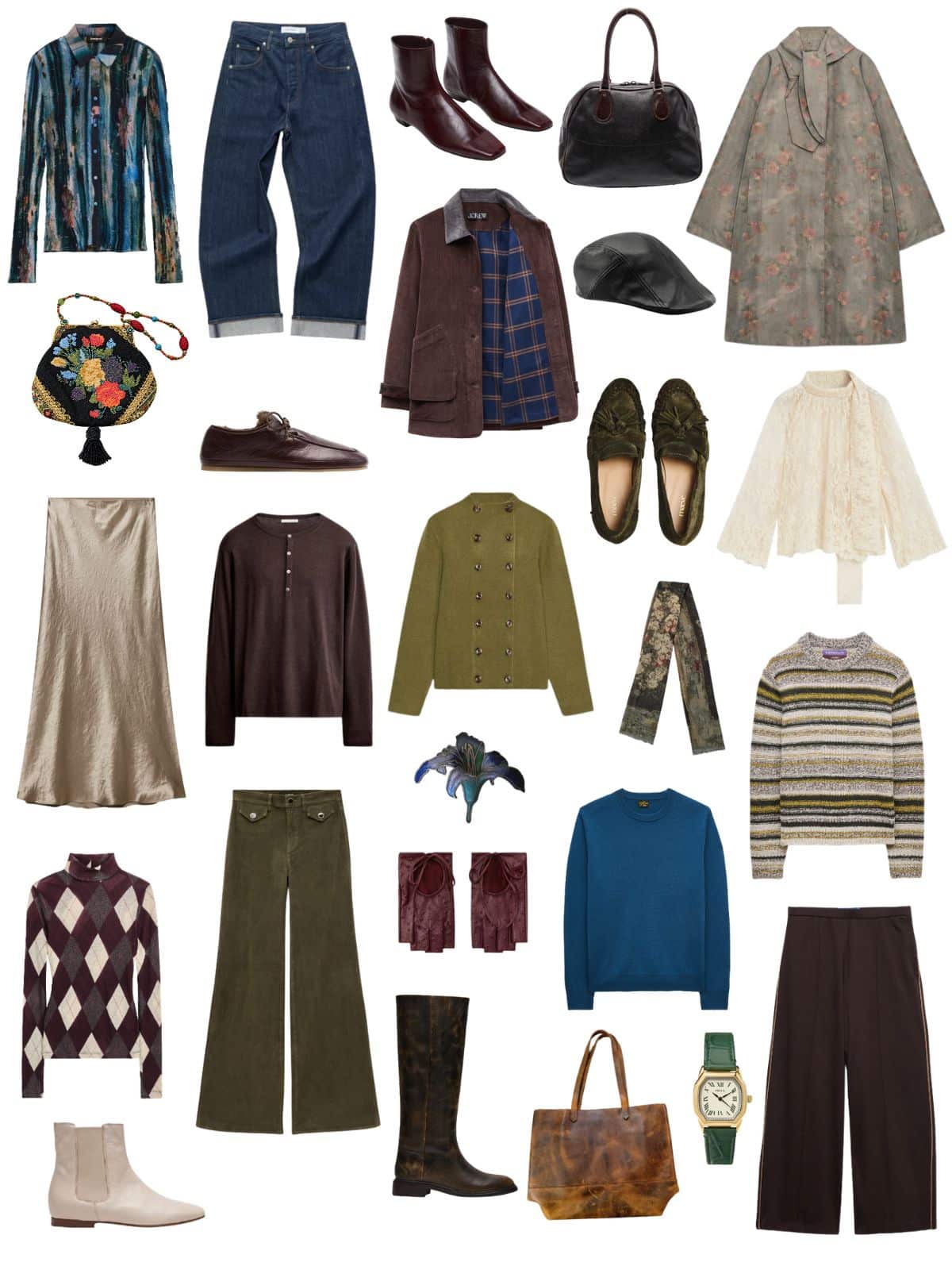
Blue Print Blouse | Cuffed Indigo Jeans | Burgundy Boots | Black Bowler Bag | Floral Trench | Leather Cap | Corduroy Barn Jacket | Brown Fur Lined Flats | Antique Bag | Midi Slip Skirt | Brown Henley | Green Cardigan | Green Loafers | Floral Scarf | Lace Blouse | Striped Sweater | Blue Sweater | Iris Brooch | Fingerless Gloves | Green Cords | Argyle Turtleneck | Cream Boots | Knee High Boots | Distressed Tote | Green Watch | Brown Trousers

The Frame
Every conservatory needs the structure that holds the whole climate together. The part that isn’t decorative, the part that does the actual work of keeping the temperature where it needs to be.
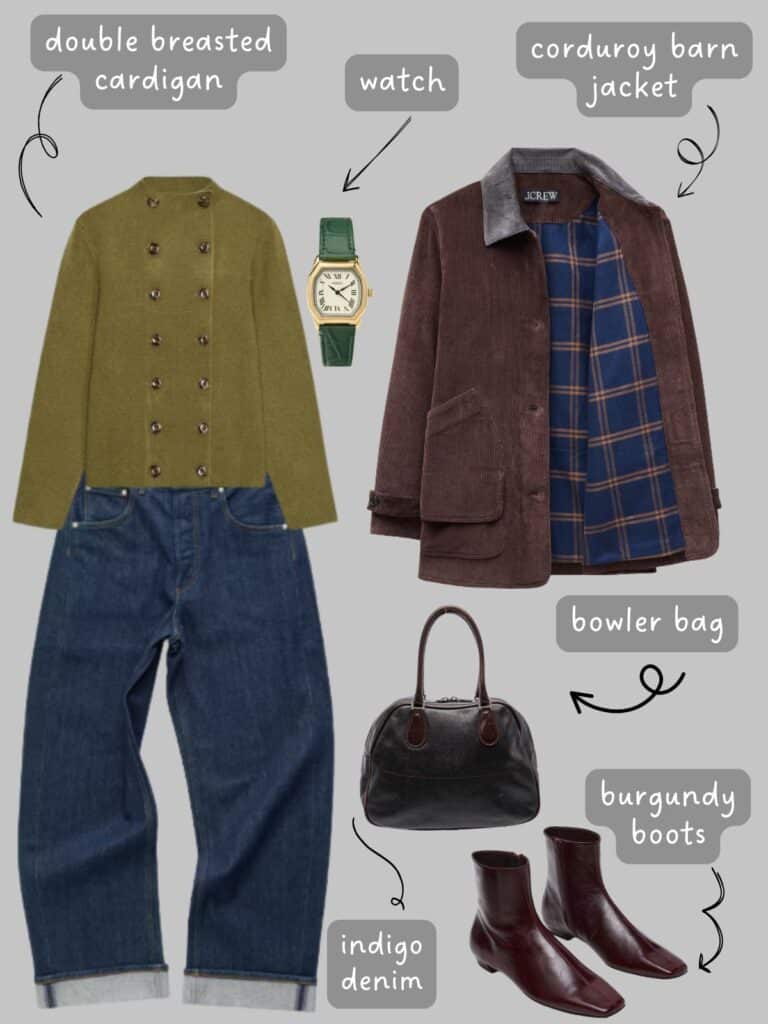
The olive double-breasted knit jacket cardigan does that job here. It reads almost like a garden officer’s coat with a high stand collar, military buttons marching in two straight rows, nothing about it casual or accidental.
It is the piece that says someone is in charge of this ecosystem, and it can anchor either a soft or a severe outfit depending on what you pair it with.
The brown corduroy chore coat, with its quietly plaid lining, does similar work in a lower register, but less officer, more head gardener.
It’s the coat you wear to actually do the labour, ribbed and practical, with pockets deep enough to be useful rather than decorative. I like this coat a lot, it has a purpose, and I love when a piece has a truly useful purpose.
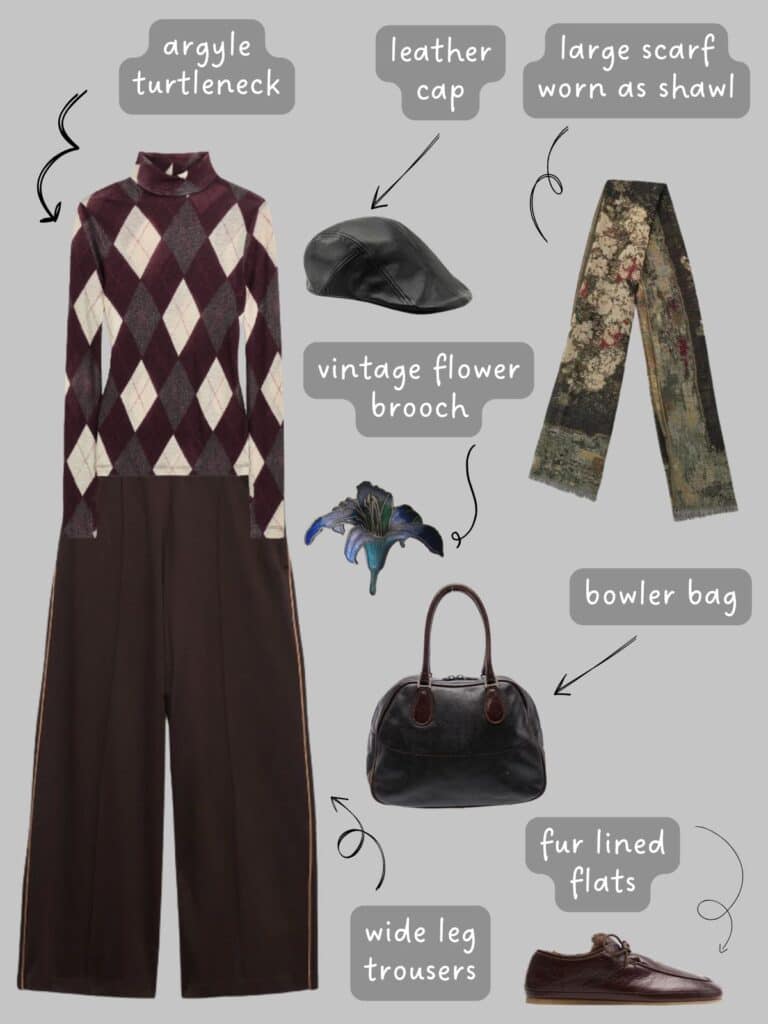
The argyle turtleneck, in burgundy, grey, and cream, I think might be the cleverest piece in the whole capsule, even though it doesn’t look like it at first glance.
That diamond lattice is, structurally, a windowpane. It’s the one garment doing the actual conservatory-glass pattern and without needing anyone to explain it to you, you can see it.
The black leather flat cap and the oxblood square-toe ankle boots finish the frame.
Both a little severe, both doing the job of containing everything else so it doesn’t sprawl past its own good sense. And the black leather bowling bag, boxy and unglamorous, is the tool bag. It looks like it has secateurs in it, which it probably does.
Last, the gold-cased watch with the green crocodile-embossed strap, Roman numerals, a face that looks pulled from another century even though it wasn’t.
Every conservatory has an instrument for measuring what’s happening inside it: temperature, humidity, bloom time. This is that instrument, worn on the wrist of the person who actually keeps track.
What Climbs Past the Frame
A greenhouse only stays interesting because something inside it refuses to stay tidy. If everything grew exactly to the shape of its trellis, you would just have a very expensive shed.
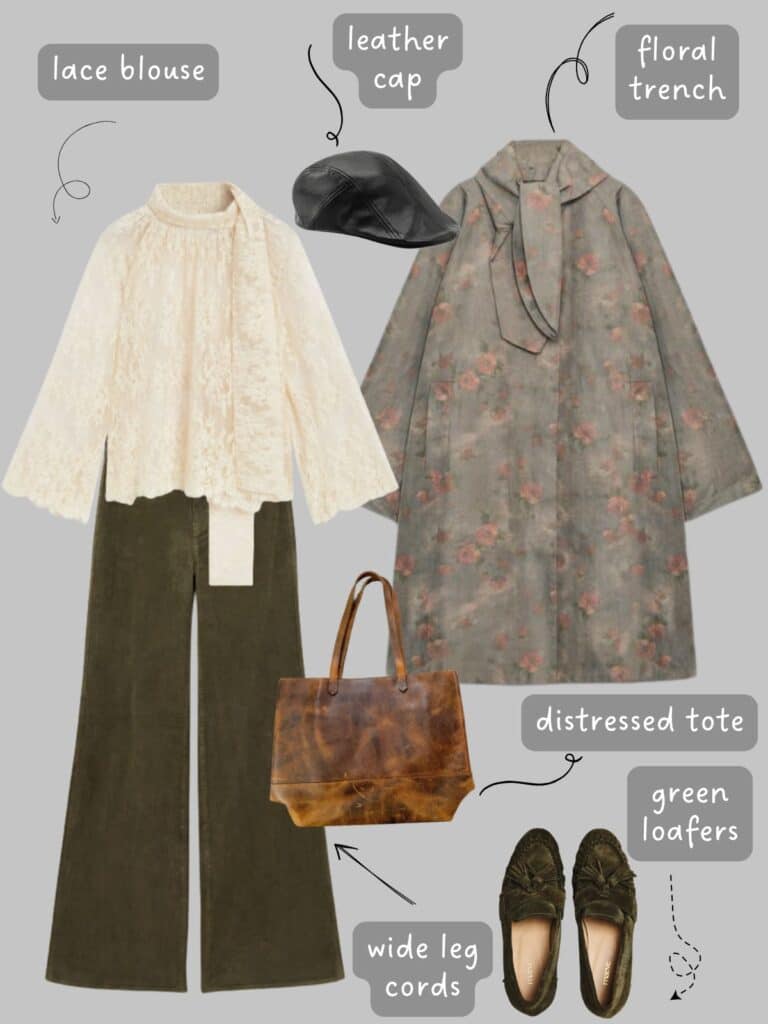
The ivory lace blouse, with its exaggerated tie neck, is the closest thing this capsule has to an actual bloom, all that scalloped floral lace, worn under the corduroy coat so it peeks out at the collar like something that got in through a gap in the glass.
It’s romantic in the specific way an overgrown vine is romantic: uninvited, and correct anyway.
The floral trench coat is doing something more complicated. That faded, almost bruised rose print on a weathered grey ground doesn’t read as fresh-cut, it reads like wallpaper in a conservatory nobody’s maintained in a decade, roses climbing a structure that’s started to rust.
Worn open over the corduroy or the knit jacket, it’s less “florals for spring” and more “I found this growing somewhere it shouldn’t have been, and I let it stay.”
The botanical print shirt is the actual centrepiece of this category, and it was worth the search. That streaked, vertical wash of teal, moss, and rust reads less like a print and more like a painting left out in the rain.
I know it is expensive, but it is an example piece. I picked it because it reminded me of Monet’s Water Lilies, and I keep thinking of it as the water lily pond after somebody’s dragged a hand through the surface.
It doesn’t behave like a botanical print is supposed to behave, all tidy repeat and clean line. It behaves like the pond itself.
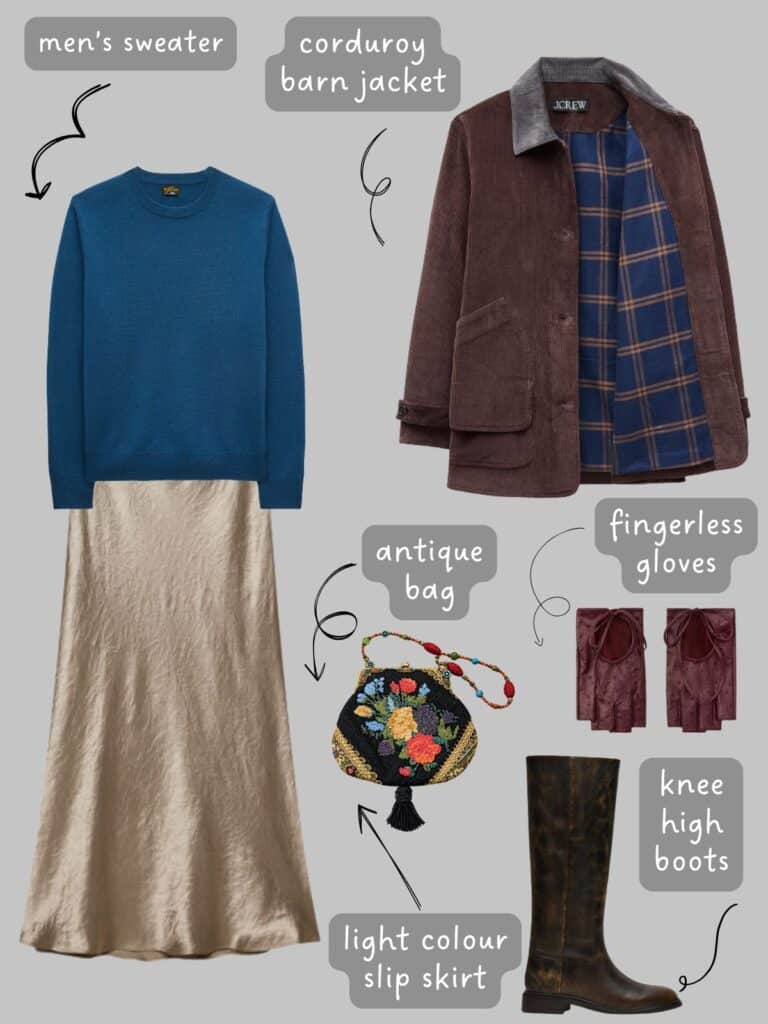
The champagne satin slip skirt brings in the only real shine in the whole wardrobe, that liquid, bias-cut drape is light hitting glass, humidity made into fabric.
It’s the piece that keeps the capsule from tipping entirely into brown and olive, and it earns its shimmer by being cut so simply.
The antique tapestry evening bag and the enamel iris brooch, cobalt and green, clearly old, clearly loved by somebody before it was loved by you. They feel discovered rather than purchased.
And the brooch has a second job this time: the large, muted floral jacquard scarf, too generous to be a neat rectangle around the neck, gets wrapped shawl-style over the shoulders and pinned in place at the collarbone with the iris.
It’s the one piece of literal staging in the whole capsule, a climbing thing, restrained on purpose, held exactly where someone wanted it.
That is, incidentally, also a description of everyone this wardrobe is for.
The Unglamorous Work
Nobody photographs the potting shed. But everything that blooms in the front room got there because somebody spent a lot of quiet, dirty hours in the back one.
This is the largest category in the capsule, and it should be, this is the wardrobe of someone who actually does the tending. The brown henley and the striped sweater are your plainest layers, warm enough that you forget you’re wearing them.
The petrol blue crewneck sweater, pulled, correctly, from the men’s section, because the best plain sweaters usually live there, does something a little sneakier: it’s cut from the same blue-green family as the brooch, which means the specimen colour turns up more than once in this capsule.
Not competing with the jewel tone so much as confirming it wasn’t an accident.
The indigo jeans, still stiff with that unwashed rinse, and the two trousers, olive corduroy with flares and dark brown wide legs with tan piping, are the bottoms that actually let you move, kneel, reach, work.
Footwear does the heaviest lifting here. The moss suede tasseled loafers and the fur-lined brown moccasins are slip-on-and-go pieces, worn in exactly the way garden clogs are worn in, quickly, without ceremony, several times a day.
The cream leather chelsea boots and the distressed knee-high boots, with that burnished, almost oxidised patina, look like they’ve had actual weather on them, actual dirt under actual fingernails.
And the oxblood ostrich-embossed fingerless gloves are the detail that gives the whole capsule away: gloves you can still use your hands in. Beautiful, but not for show.
The distressed leather tote carries the actual tools. It’s slouchy, worn pale at the corners, and it is doing more real work than any other bag in this wardrobe.
Cultivated Is Not the Same as Difficult
It’s tiring to your core being told, for most of your adult life, that wanting things, the right conditions, the right pace, the right amount of solitude before you’re expected to perform warmth on command, makes you high-maintenance.
As though ease were a moral virtue instead of an accident of temperament. As though the correct amount of care an adult woman should require from the people and environments around her rounds to zero.
Nobody says this about anything else that’s actually worth keeping. We don’t call a vineyard high-maintenance for needing a specific slope and a specific amount of sun. We call that terroir, and we charge more for the bottle.
We build entire buildings out of glass to keep a fig tree alive through a Canadian winter and call it devotion, not neediness.
It is only ever women who get the framing flipped, where need becomes a character flaw, and thriving on your own terms becomes an inconvenience you should apologise for.
The Conservatory doesn’t apologise. She has simply stopped pretending the greenhouse was optional.
She knows exactly what temperature she needs to be interesting, exactly which kind of attention makes her open up and which kind makes her close like a mimosa at dusk, and she has finally stopped treating that knowledge as a flaw to be managed instead of information to be used.
Perhaps the Glass Was Always the Point
There’s an old idea that a conservatory is a kind of compromise: nature, but tamed, but permitted, but only within reason. A halfway state between the wild and the domestic, built because the real outdoors was deemed too much for what needed protecting.
I’d like to propose a less apologetic reading. Maybe the glass was never a concession.
Maybe someone looked at what she needed to survive and decided it was worth building an entire structure around, on purpose, out of love for the specific and inconvenient thing she actually was.
She was never a hothouse flower because she couldn’t hack it outside. She was a hothouse flower because somebody, maybe her, eventually, mostly her, decided she was worth it.
The Conservatory: Fall Outfit Ideas
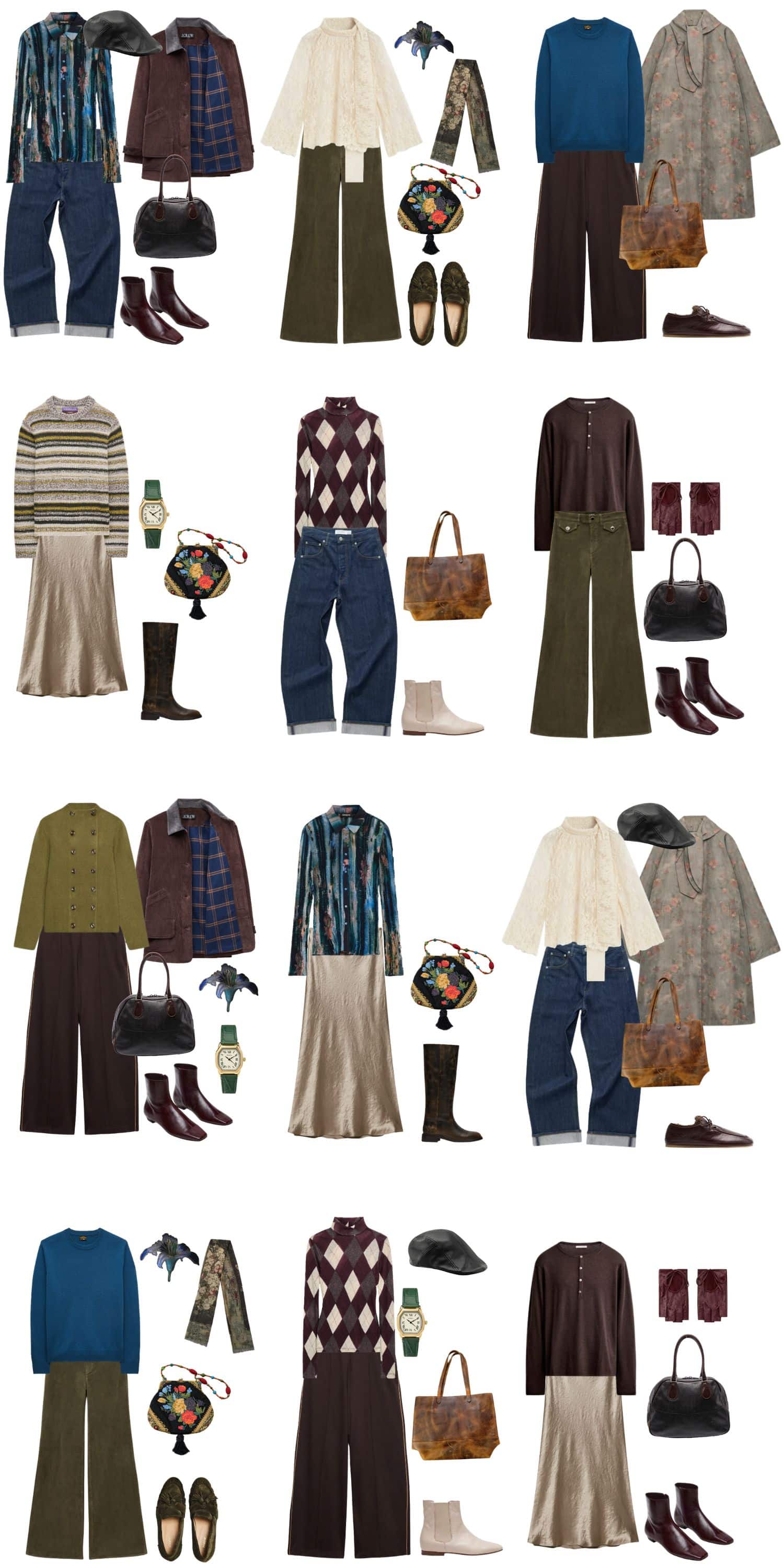
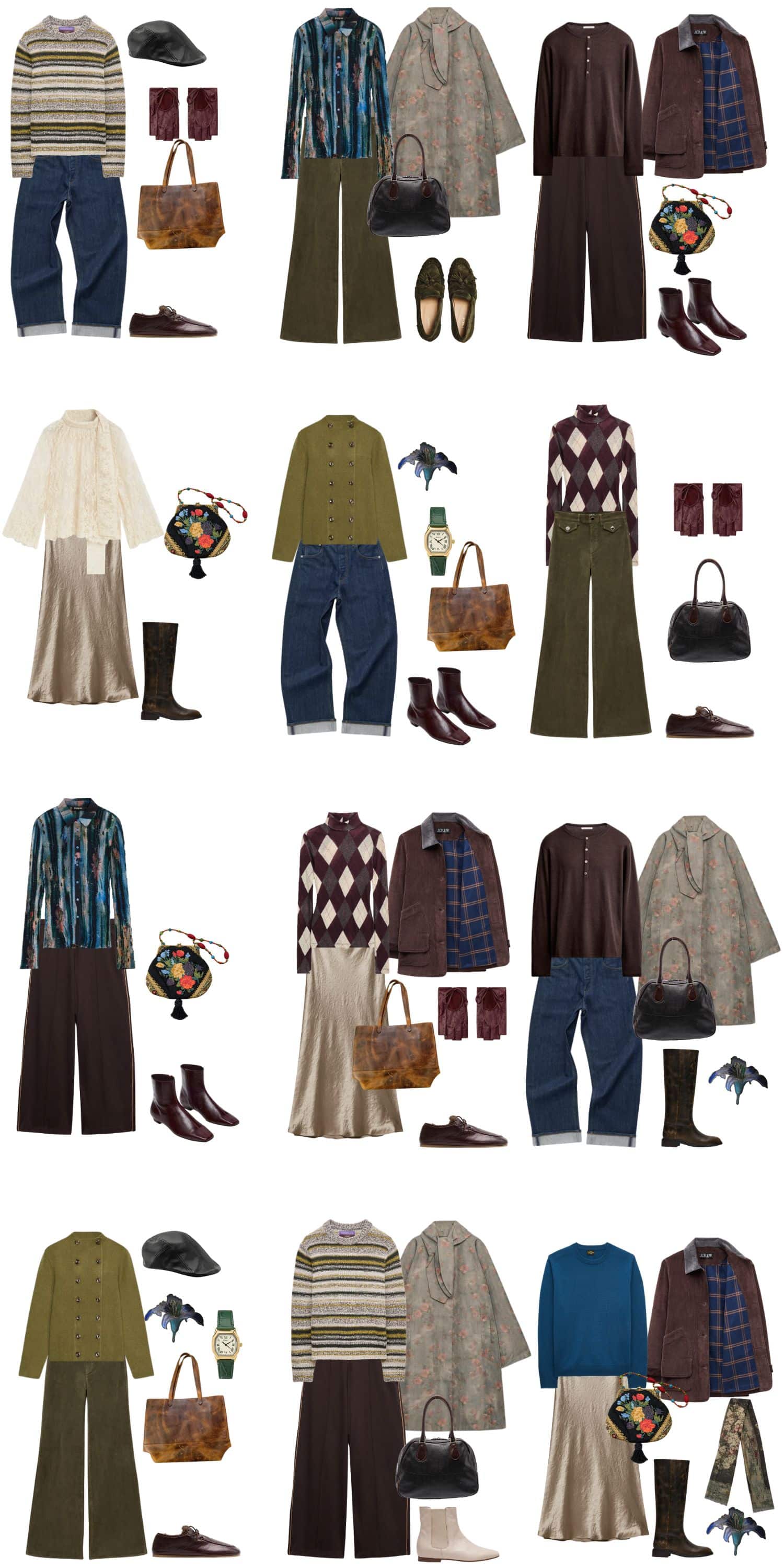
Blue Print Blouse | Cuffed Indigo Jeans | Burgundy Boots | Black Bowler Bag | Floral Trench | Leather Cap | Corduroy Barn Jacket | Brown Fur-Lined Flats | Antique Bag | Midi Slip Skirt | Brown Henley | Green Cardigan | Green Loafers | Floral Scarf | Lace Blouse | Striped Sweater | Blue Sweater | Iris Brooch | Fingerless Gloves | Green Cords | Argyle Turtleneck | Cream Boots | Knee-High Boots | Distressed Tote | Green Watch | Brown Trousers
SHOP THE UK LINKS
This post contains affiliate links. By using my links to shop I may receive a small commission (at no cost to you). Thanks for supporting what I do 



Perhaps I am not a “hot house flower” per se – but this capsule is making me want to be one. The pieces work so well with each, and present interesting usual and tactile texture. And the purses 👌 I want more of this uncompromising quirkyness in my life.
As an aside, I once asked my partner what attracted me to him, and he replied
“ low maintenance “. 🥺 I have been learning ever since how to build my own greenhouse and what kind of flower I want to be.