Every season, fashion cycles try to convince us that new equals better and as we are now in the Black Friday and Cyber Monday sales, the urge to buy new increases.
Stand your ground.
Because great style has less to do with new and everything to do with intentional.
Why “Secondhand-First” Matters
The secondhand-First Winter Capsule is about shifting the starting point.
Instead of opening a tab of your usual fast fashion retailers, you start by opening your closet, or seeking out some new favourite secondhand shops.
Obviously, you can still buy new, and this capsule mixes a bit of new with used.
But when you are buying new, you need to be careful so you don’t end up with a cart full of items that were not actually what you were looking for, and you are only buying because the sale gave you fomo or a sense of urgency.
So shift your shopping mindset during this peak holiday sales period to keep the focus on what you are searching for, not the promotions available.
The item you want might or might not be included in a sale, and purchasing it will be a decision that you have to make based on how you truly feel and not by the influence of a discount.
This week, I wanted to show you that you can build a capsule wardrobe by mixing secondhand and new (or already owned) items, and it will still be as fantastic as a capsule where everything is brand new.
And if I am being honest, it will probably have more personality because this kind of capsule celebrates patience, curiosity, and the satisfaction of finding something that’s perfect for your wardrobe.

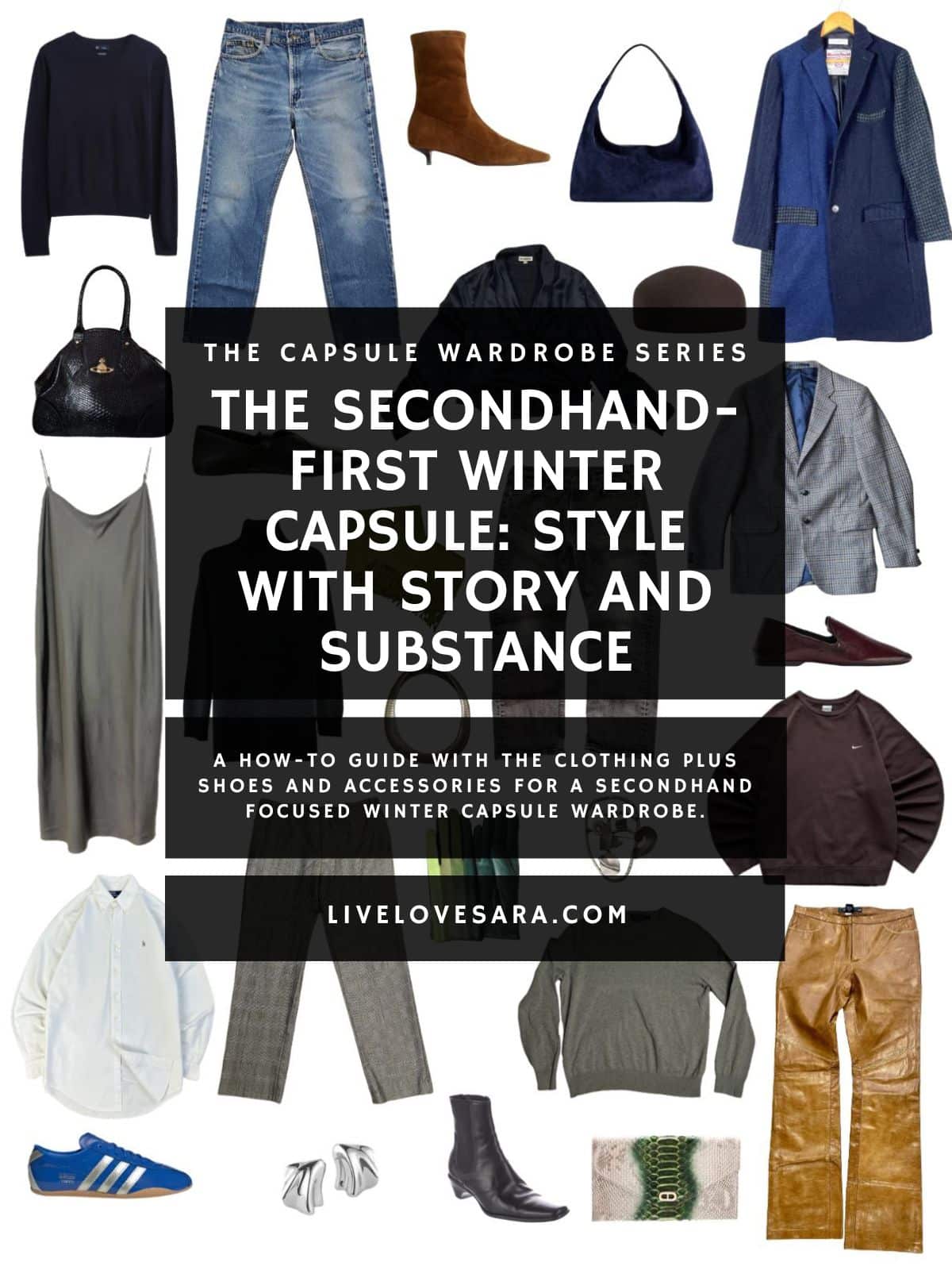
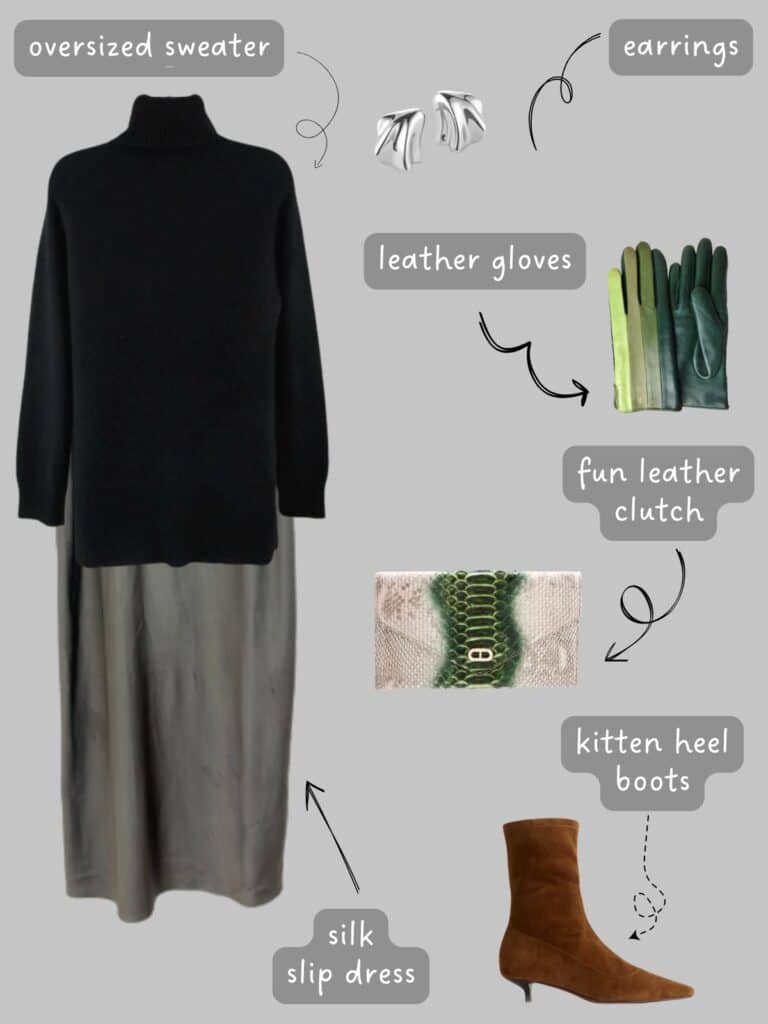
Navy Blue Sweater | Vintage Levi’s | Brown Boots | Blue Bag | Blue Coat | Wool Hat | Silk Blouse | Black Flats | Black Bag | Slip Dress | Black Turtleneck Sweater | Green Scarf | Necklace | Black Jeans | Men’s Blazer | Loafers | Brown Sweatshirt | Vintage Brooch | Green Gloves | Grey Trousers | Button Up | Sneakers | Earrings | Black Boots | Grey Sweater | Snake Print Clutch | Leather Pants

The Mindset: Hunt Like a Stylist
Building a capsule that has a thrift-base means that you are going to have to think like a fashion editor on assignment. You’re collecting categories, not chasing trends.
Before you buy, ask:
1. Can it mix with at least three things I own?
2. Does it have texture or structure that makes it stand out?
3. Is the fabric quality higher than what I’d find new at the same price?
That mindset turns secondhand shopping into curation, and suddenly your wardrobe feels personal, not pieced together.
The Romance of the Hunt
There’s a kind of magic that happens in a thrift store. Rows of forgotten wool coats, shelves of weathered boots, the quiet shuffle of hangers. It’s not shopping; it’s discovery, that can feel like an epic treasure hunt.
The Secondhand-First Winter Capsule begins here, in that space between curiosity and patience.
This isn’t about minimalism as restriction or sustainability as sacrifice. It’s about rediscovering fashion’s oldest joy: finding beauty in what already exists.
Each piece carries a past life, a history you get to continue. When you buy secondhand, you’re not just saving fabric; you’re saving stories.
The Why: Slowing the Pace of Style
A secondhand-first mindset is like rebelling against urgency. It asks you to look longer, touch more, and imagine differently.
Fast fashion promises immediacy; thrifting promises longevity. You learn to trust your taste, not the algorithm.
And winter is the perfect season for this slower rhythm. Layers build naturally, textures repeat, silhouettes simplify.
You don’t need an avalanche of new things , you just need the right few that feel lived-in, weighty, and real.
The result is a wardrobe that looks intentional because it is intentional. One built slowly, piece by piece, like a collection of meaningful moments.
Colour, Texture, and the Story of Use
Secondhand clothes rarely come in perfect palettes, and that’s their beauty. Instead of crisp uniformity, you get variation, a symphony of near-neutrals that feel more human than curated.
Think camel that’s mellowed with time, denim that’s faded into something softer, leather that’s taken on the patina of years.
The colours of a thrifted wardrobe are winter’s natural tones: deep brown, washed black, navy, olive, cream, a hint of burgundy or moss.
Texture becomes your anchor. Wool, cashmere, suede, tweed, corduroy, fabrics that hold.
Thrift stores are gold mines for natural fibres and lived-in shades that already look perfectly broken-in.
The slight imperfections, the softened edges, the mismatched buttons, they’re not flaws, they’re like fingerprints.
Nothing in this palette screams “new drop,” and that’s its charm.
Key Pieces to Source Secondhand
These are the backbone items worth the hunt. Classic silhouettes that age well and turn up often in quality fabrics.
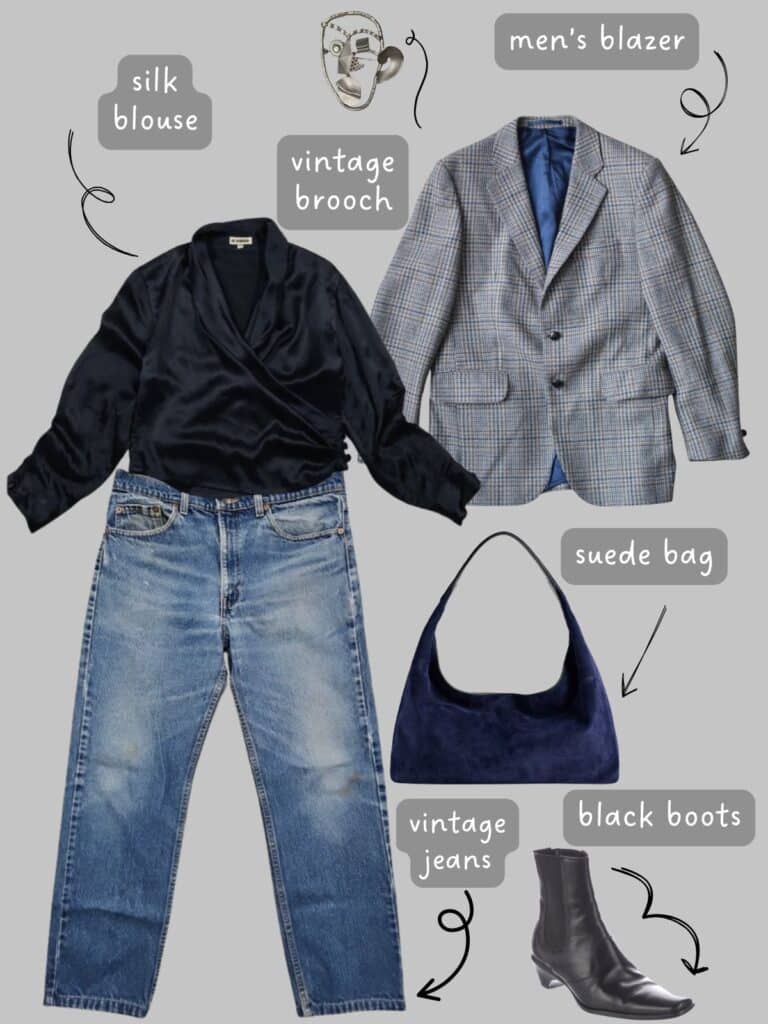
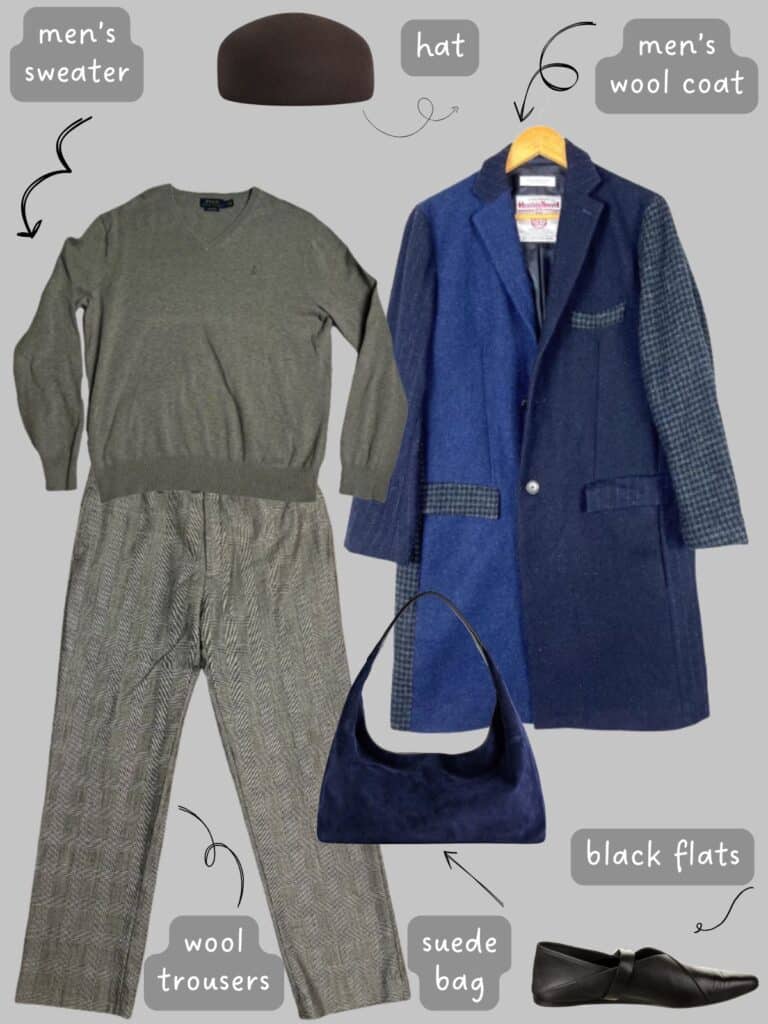
Men’s Wool Coat – Thrift store MVP. Oversized, structured, endlessly re-styleable. I found a the perfect classic stunner for $35.
Cashmere or Merino Knit – Look in men’s sections; better quality, timeless cuts.
Straight or Wide-Leg Denim – Focus on fit at the waist and rigid cotton. The vintage Levi’s I found are the same size and a very close wash to my favourite 505s that I wear constantly.
Tailored Blazer – 90s or early-2000s cuts are perfect; focus on drape and shoulder shape.
Wool Trousers or Leather Pants – Neutral tones you can tailor if needed.
Leather Boots or Flats – Real leather lasts; condition them, and they’ll outlive fast fashion.
Cashmere Scarf / Minimal Bag – Small touches of polish make thrift pieces look editorial.
Optional extras: a statement coat (plaid, shearling, or trench), vintage jewellery, a men’s button-up for layering.
How to Thrift Like a Pro
Start with fabric: Natural fibres hold up best, like wool, silk, linen, and cotton. Skip synthetics unless the silhouette is exceptional.
Ignore size tags: Try everything. Vintage sizing lies.
Touch first, look second: Texture will tell you quality faster than labels.
Use the tailor: A $50 thrifted coat + $40 tailoring = $400 look.
Shop categories over outfits: You’re building blocks, not complete looks in one go.
Thrifting requires faith. You walk in with an open mind and a small list: coat, sweater, maybe boots. You leave, hours later, with one perfect find and a story to tell.
There’s intimacy in that process. You learn to read quality by touch, to recognize real wool from synthetic, to spot good tailoring even under bad lighting.
You stop seeing clothes as trends and start seeing them as craftsmanship.
Over time, the hunt itself becomes your ritual. A creative practice that rewards patience more than impulse. It turns shopping into something soulful.

The Character of a Thrifted Wardrobe
When you dress from what’s secondhand, you begin to notice a different kind of cohesion. Outfits feel less “assembled” and more like a conversation.
The vintage blazer that balances a modern turtleneck, the men’s wool trousers that fall just right with heeled boots, the silk scarf that catches the light.
The wardrobe tells on you, in the best way. It reveals that you value texture, proportion, and timelessness more than novelty.
It shows that you’ve edited carefully, not consumed thoughtlessly.
There’s also comfort in the knowledge that what you wear is unique. No algorithm could’ve built this combination of stories.
How to Dress Like a Collector
Building a thrift-first capsule is about restraint and curiosity. Start with the foundation: a long wool coat, a few knits in neutral shades, perfectly cut trousers, one pair of sturdy boots.
Then, let character creep in slowly, a plaid scarf, a textured skirt, a vintage brooch you didn’t expect to love.
Mix eras the way a stylist mixes fabrics. 90s menswear blazers meet modern denim; 70s suede meets minimalist outerwear.
Let each outfit hold contrast, soft against structured, tailored against relaxed.
There’s no wrong way to layer when everything shares the same lived-in soul.
If retail is acquisition, thrifting is authorship. You edit, you curate, you reimagine. Look for texture, structure, and stories before brand, label, or style.
The more selective you become, the clearer your wardrobe’s language grows.
Visit your local thrift or vintage store with curiosity and patience, not a checklist.
Let your hand guide you, the brush of real wool, the weight of lined fabric, the gleam of good hardware. Hold each piece up and ask: Does this belong in my story?
Thrifting well isn’t always about luck; it’s also about noticing.
And maybe that’s what modern style should be: less about what’s next, and more about what endures.
Secondhand Winter Outfit Ideas


Navy Blue Sweater | Vintage Levi’s | Brown Boots | Blue Bag | Blue Coat | Wool Hat | Silk Blouse | Black Flats | Black Bag | Slip Dress | Black Turtleneck Sweater | Green Scarf | Necklace | Black Jeans | Men’s Blazer | Loafers | Brown Sweatshirt | Vintage Brooch | Green Gloves | Grey Trousers | Button Up | Sneakers | Earrings | Black Boots | Grey Sweater | Snake Print Clutch | Leather Pants
SHOP THE UK LINKS
This post contains affiliate links. By using my links to shop I may receive a small commission (at no cost to you). Thanks for supporting what I do 



“If retail is acquisition, thrifting is authorship. “. ❤️
Love thrifting and thank you for the inspiring post.