Someone once said to me that my style reminded them of a dishevelled art student. I know that they meant it as an insult, but to me, that was probably one of the best descriptions that I could ask for.
Some people dress for the runway; others dress for the lecture hall. And then there are those who dress like the art department’s unofficial muse.
Something I strive for.
The person who somehow makes paint-splattered jeans, a crisp blazer, and a 20-year-old tote bag look like a thought-out outfit.
Note to self: I need to find a beat up 20 year old leather tote.
That is what I tried to do with this Art School Capsule Wardrobe. I want to piggy back of the summer version, which was so much fun and received a lot of great feedback.
For fall, I wanted a wardrobe that feels collected, not curated; layered, not polished; intentional, but never too serious.
It’s the sweet spot between creative nonchalance and a subtle sense of chic. The kind of style that shows that you are artistic and make things for a living (or in your spare time) without screaming it from the rooftops.
It’s part minimalist, part chaotic genius. It’s a wardrobe that says: “I have opinions about texture and negative space,” but also “I didn’t try that hard.”
For fall, this aesthetic takes on a richer, moodier form. Wool instead of linen, ink-black instead of white, and layers that feel as considered as a brushstroke.
The Mood: Eclectic, Effortless, and Just a Little Dishevelled
This isn’t about chasing trends or building a capsule of ten beige items you’ll wear to death.
It’s about curating a wardrobe that looks like you, the version that thrives in texture and contradiction.
It’s polished enough for the gallery opening but lived-in enough for a long day in the studio.
Think slightly rumpled cotton, perfectly broken-in leather, and handmade jewellery that looks like a story.
The magic of the art school aesthetic lies in the tension between precision and ease. It’s not bohemian in the carefree sense, and it’s not minimalist in the sterile one.
It’s about harmony. How pieces speak to each other through contrast: rough and refined, soft and structured, modern and vintage.
You might start the day in wide-leg trousers and a boxy blazer, but by mid-afternoon, you’ve swapped in sneakers and rolled up your big striped sleeves.
It’s all about creative evolution, not perfection.
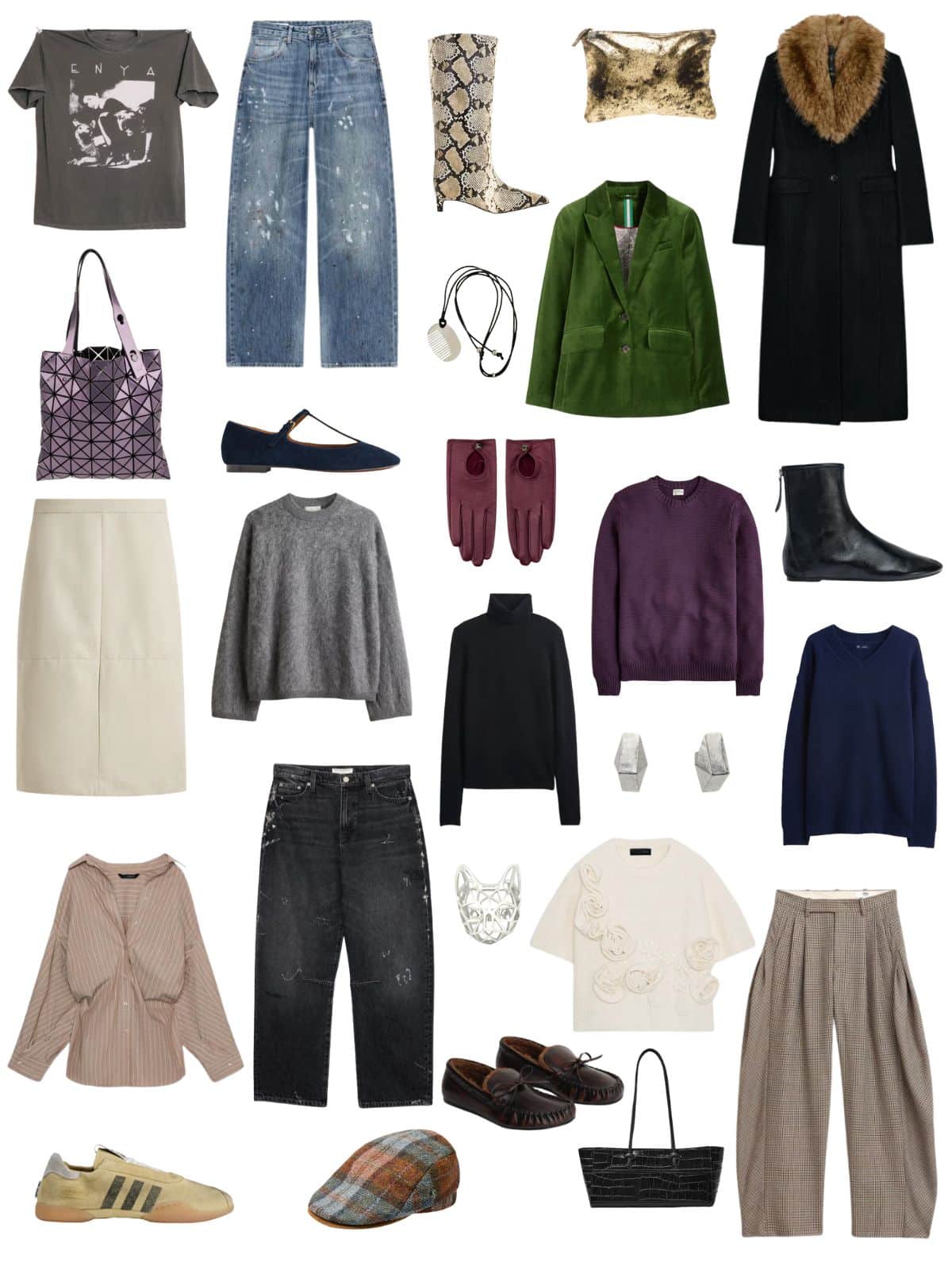
Enya T-shirt | Blue Jeans | Snake Print Boots | Gold Clutch | Long Coat | Green Blazer | Pendant | Half Gloves | T-strap Flats | Issey Miyake Bag | Cream Skirt | Grey Sweater | Turtleneck | Purple Sweater | Black Boots | Navy Sweater | Earrings | Cream Sweater | Cat Ring | Loafers | Black Jeans | Button Up | Sneakers | Driving Cap | Black Bag | Plaid Trousers

The Foundation: Where Structure Meets Chaos
Even the most “messy” aesthetic needs some structure to hold it together. The Art School Capsule thrives on balance. One polished piece anchors every look.
Interesting trousers ground the look, whether they’re navy wool or vintage khaki.
Crisp button-downs (in white, striped, or intentionally oversized styles) serve as a blank canvas for layering.
Structured outerwear — think a painter’s coat, trench, or vintage tweed blazer brings academic polish.
Then comes the creative twist: a hand-knit vest layered over silk, or a patterned skirt that feels like something you thrifted in Paris and never stopped wearing.
The mix of textures like wool with satin, denim with silk is what gives this capsule its edge.
Think of an oversized charcoal wool blazer over a worn-in cotton graphic tee. A sculptural knit with trousers that puddle slightly at the hem.
Loafers that could belong to an art professor.
These are pieces that carry personality. They’re not “look at me” clothes, but “if you look closer, you’ll see the story.”
And that’s really what this capsule is about. Clothes that feel like they have a life. Maybe they were found secondhand, maybe they’ve been altered, maybe they were bought new but feel like they’ve always belonged to you.
The art school capsule doesn’t care about trends. It cares about form, comfort, and expression
How to Build It
Here’s the thing: no one actually wants to “build a capsule wardrobe.” That sounds like a PowerPoint presentation. What we really want is a closet that makes mornings easier and more inspired.
Start by thinking of silhouettes, not single pieces. What shapes make you feel the most yourself?
Maybe it’s long lines, a drapey coat, wide trousers, a scarf that trails a little dramatically. Or maybe it’s structure, crisp shirts, defined shoulders, clean boots. You don’t need a formula. You just need a rhythm.
A few pieces anchor the fall art school look: an oversized blazer or jacket, a textured knit, trousers with shape, a classic button-up, a piece of outerwear that feels architectural (a cocoon coat, a structured trench, something unexpected).
Then mix in your “artistic elements”, jewellery that looks like sculpture, unexpected layering, maybe a pop of an unusual colour like mustard or deep teal.
The rest? Let it evolve. Add, subtract, repeat. Just like art.


The Palette: Muted, But Never Boring
If summer was all about easy whites and soft neutrals, fall brings depth. Rust, ink, olive, espresso, plum; the colours of dried leaves and oil paint.
In the art school wardrobe, these tones don’t have to match perfectly. In fact, they shouldn’t. That slight mismatch is what gives outfits soul.
Colour theory takes on new meaning here. You can build this capsule around muted jewel tones, earthy neutrals, or offbeat primary shades. Whatever palette inspires your creative eye.
To reiterate above, think of it less as “fall neutrals” and more like a painter’s palette: ochre, rust, inky navy, washed plum, and the kind of off-white that looks lived-in.
If minimalism leans toward monochrome, art school style leans toward tonal layering, slightly mismatched shades that somehow make sense together.
The next is texture. Texture is everything here.
Tweed, corduroy, brushed wool, ribbed knits, things that invite touch.
Think about how the play of light changes when fabrics have depth; how matte next to shine creates visual interest.
The art school capsule is about seeing your wardrobe like a canvas: light, shadow, and negative space.
In a world obsessed with pristine minimalism, the art school woman embraces patina. She knows that wear tells a story.
And yes, there’s beauty in imperfection. Scuffed leather shoes. A slightly frayed hem. Paint-splatter jeans (intentional or not).
I figured it was okay to use my favourite paint-splattered jeans again because they fit perfectly with this wardrobe, and I love the shit out of them, so resharing something I love makes sense.
The Details: Accessories That Tell a Story
Accessories are where the creative personality shines. The Art School Capsule isn’t about pristine luxury bags or perfectly coordinated jewellery. It’s about pieces that feel collected.
A vintage leather tote that’s seen better days, a scarf found at a flea market, sculptural earrings that look handmade, these details are what pull the look together.
It’s the difference between “put-together” and “curated chaos.”
Try layering delicate gold with chunky ceramics, or mix classic loafers with bright socks and a silver chain. Nothing has to match, it just has to belong.

The Silhouette: Slouchy, Sculptural, and a Little Unfinished
The key to the art school silhouette is playing with proportions. Oversized blazers, wide-leg trousers, cropped knits, and long coats that almost swallow you whole.
It’s that tension between volume and restraint that makes it so compelling.
Imagine pairing a voluminous pleated skirt with a shrunken turtleneck. Or wearing a painter’s smock with heeled boots.
Each piece should have an element of contrast. Something that keeps it interesting.
If you love minimalism, this is where you can still shine: strip back the colour, but keep the texture and shape.
The look becomes architectural. Celine for someone who keeps their sketchbook in a canvas tote.
The Mindset: Dressing Like You Live in Your Clothes
The best part about this capsule is its imperfection. You don’t have to iron everything, and you don’t need to coordinate each piece like a Pinterest flat lay.
The art school wardrobe works because it looks like you got dressed between thoughts, and somehow, it still works.
It’s about layering intention with ease.
You’re allowed to look like you spent your morning reading art theory or wandering a flea market, because maybe you did.
For Those of Us Over 40 (or Just Tired of Dressing for Others)
There’s a beautiful freedom that comes with getting older, especially when it comes to style. You start realizing that you don’t owe anyone “youthful.”
You don’t owe “age-appropriate.” You just owe yourself something that feels good and true.
The art school approach is, in many ways, the antidote to the performative nature of dressing.
It’s not about trying to look young, thin, rich, or trendy. It’s about creating. About showing up in your clothes the way an artist shows up to a canvas, with curiosity, not rules.
Maybe that means layering a menswear shirt under a sculptural vest. Maybe it’s a pair of voluminous trousers when everyone else is wearing skinny jeans (again).
Maybe it’s choosing hand-crafted jewellery over status bags. Whatever it is, it’s yours.
Where to Find It: Secondhand, Independent, and Slightly Offbeat
You don’t need to spend a fortune to look like a gallery-dwelling muse. In fact, the art school aesthetic thrives on the secondhand market. eBay, Etsy, local thrift stores, and vintage boutiques.
These are the treasure hunts.
Look for quality materials, interesting shapes, and unique details.
If you’re buying new, focus on brands that lean artistic without being overly conceptual: COS, ARKET, Tibi, The Frankie Shop, Toteme, or smaller independent designers who care about craftsmanship.
You want clothes that feel designed, not mass-produced.
Thrift stores for oversized blazers, tweed coats, and painterly skirts.
Etsy and eBay for handmade jewellery and vintage bags.
Independent brands like Paloma Wool, St. Agni, and Cawley Studio for modern art-school pieces that feel wearable.
And if you’re thrifting, remember: fit doesn’t need to be perfect, it just needs to feel right.
The goal isn’t to look like you belong to a specific scene. It’s to feel like you belong to yourself.
You can think of your wardrobe as your studio. Some days it’s minimalist; others it’s chaotic. That’s the point.
Some days you nail it. But every outfit teaches you something about proportion, about comfort, about who you’re becoming.
What I love about this aesthetic, and why it resonates especially in fall, is this mindset.
For women in their 40s, 50s, beyond, this mindset is powerful. You’ve lived enough to know what doesn’t feel right. Now it’s time to explore what does.
No pressure to reinvent yourself, just permission to experiment.
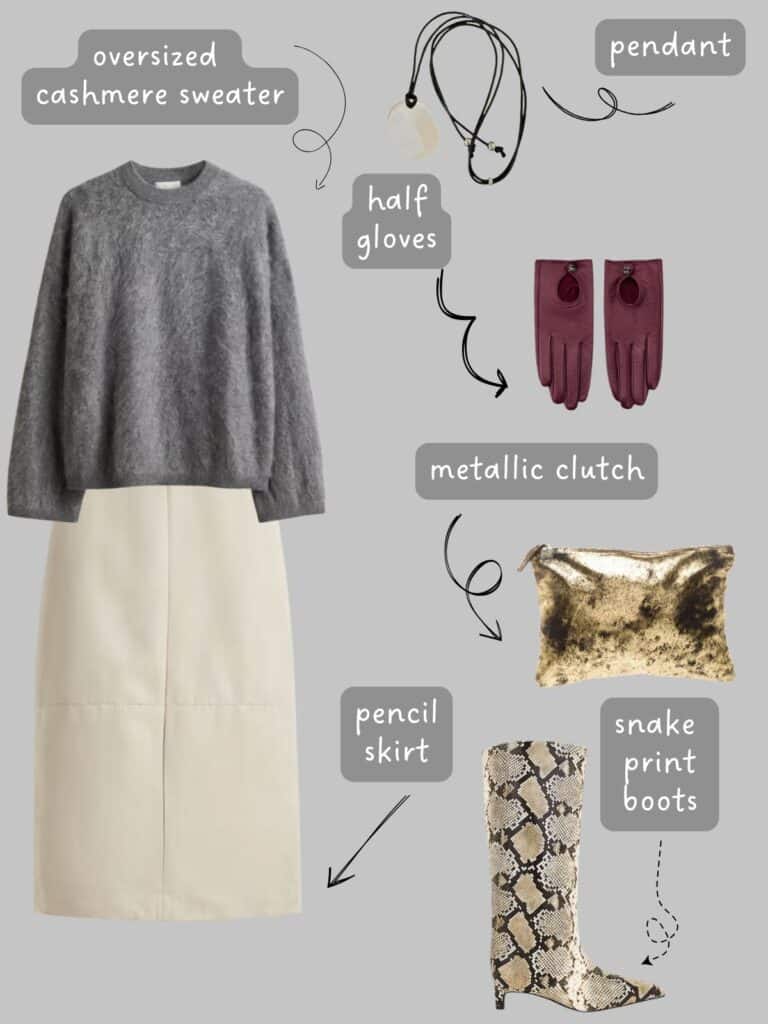
Art School Inspired Fall Outfits
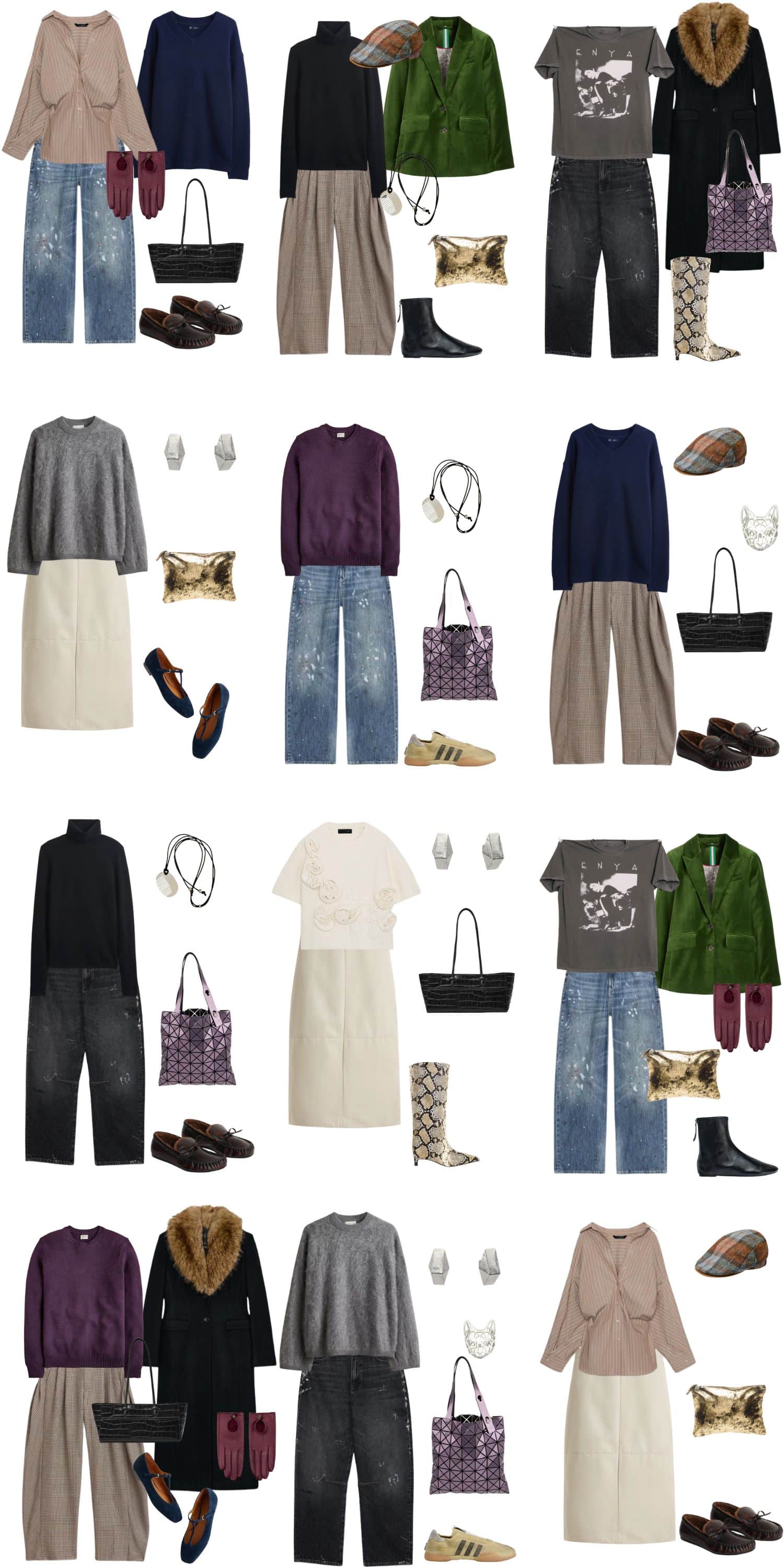
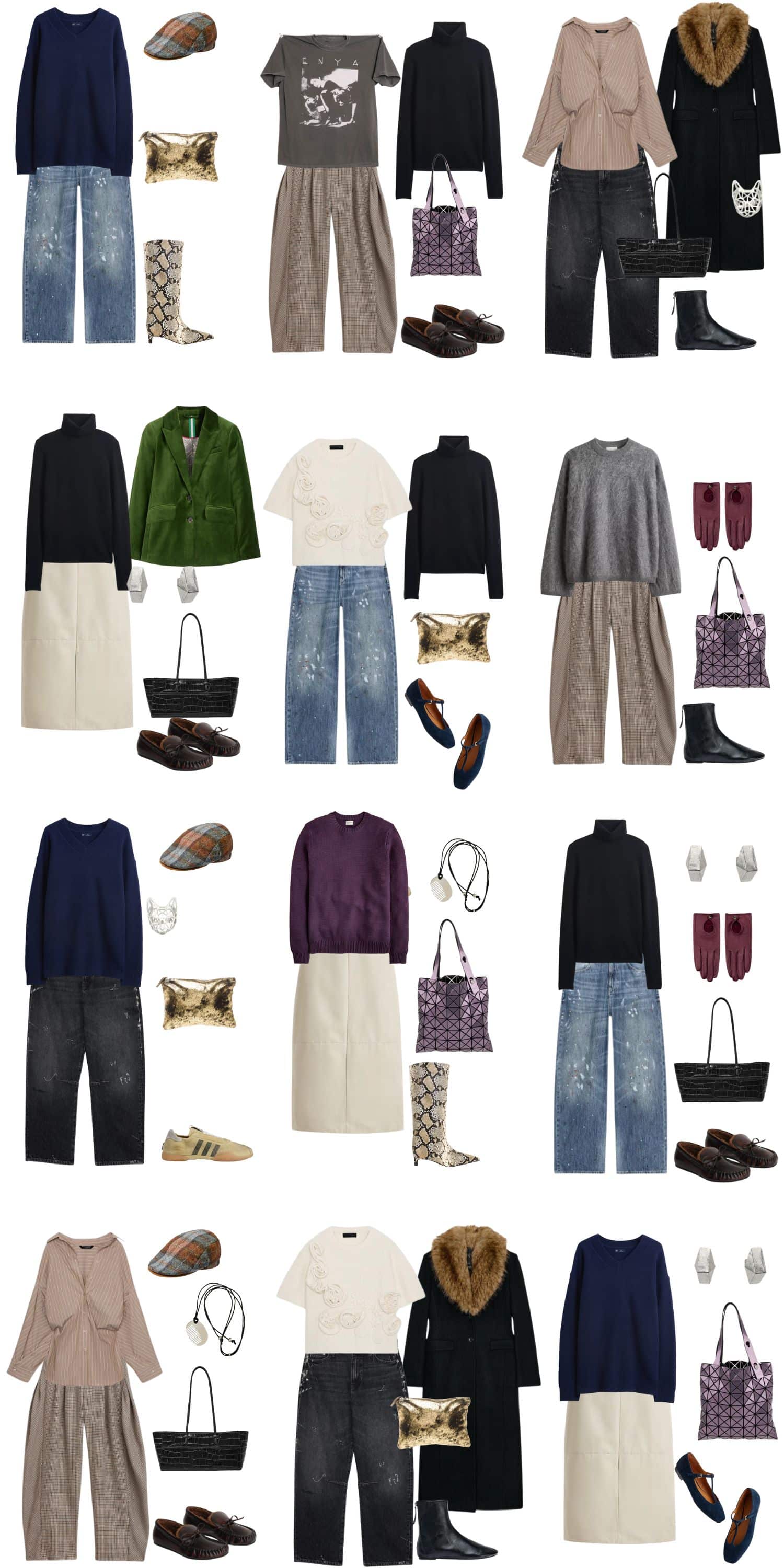
Enya T-shirt | Blue Jeans | Snake Print Boots | Gold Clutch | Long Coat | Green Blazer | Pendant | Half Gloves | T-strap Flats | Issey Miyake Bag | Cream Skirt | Grey Sweater | Turtleneck | Purple Sweater | Black Boots | Navy Sweater | Earrings | Cream Sweater | Cat Ring | Loafers | Black Jeans | Button Up | Sneakers | Driving Cap | Black Bag | Plaid Trousers
SHOP THE UK LINKS
This post contains affiliate links. By using my links to shop I may receive a small commission (at no cost to you). Thanks for supporting what I do 



I just love you. As an aging “vintage” eclectic art student, I say you hit the nail right on the head. My whole life I’ve made excuses for worn in garments and things, saying “it makes it all the more mine!” Thanks Sara for always inspiring.
Thanks so much Kerri. I’m glad it resonated. I agree with your “it makes it all the more mine” sentiment wholeheartedly.
“You don’t need a formula. You just need a rhythm.” Great advice. Back in the 80’s, before Polyvore, Pinterest and Instagram, my wardrobe was all me and what I liked. That is something I’m getting back to. These wardrobes don’t reflect my personal style but they inspire me to try new combinations. I’m thoroughly enjoying wearing my old clothes in new ways. I also love what you write about inspiration, structure, texture etc. This leads me to focus on what I like within the larger idea of “fashion”. And leads me to make more of what I already have. Thanks!