TL;DR
September has always felt like the real beginning of the year. Long before algorithms told us what to buy next, we built wardrobes with intention because we had to. This capsule isn’t about dressing like an academic. It’s about dressing like someone who never stopped being curious. Someone whose wardrobe, like her education, has been built slowly over time.
I was thinking this week about how excited I would get when the back-to-school issues of my favourite magazines started to show up. There was always that very specific excitement to the September issue.
Not the ones we have now, where next month’s trends arrive before you’ve even finished reading about this month’s. The old ones. Thick enough to feel like books, arriving in the final stretch of August when summer had already started to loosen its grip.
They promised a new season, and it actually felt believable at that time. Those were the days.
You didn’t scroll through them while standing in line at the grocery store. You lived with them. You folded down pages. You circled shoes you knew you couldn’t afford. You imagined the person you might become if you found the right blazer or the perfect pair of loafers.
You sat with it. You dog-eared. By the time back-to-school shopping actually arrived, most of the decisions had already been made.
You already knew exactly what you wanted, because you’d spent two weeks plotting it in your head like a syllabus for the year ahead.
That word is doing more work than it looks like it’s doing. A syllabus isn’t a wish list. It’s a plan for what you’ll actually use, in what order, for what purpose. Nothing on it is aspirational filler.
And going back-to-school shopping, for most of us, functioned the same way, because for many of us, late August was the one meaningful chance each year to add anything new.
Sure, there might have been the occasional thrift store find, back when you could still walk out with a shirt for a dollar or fill an entire bag for two, but the foundation of the year was built in that single shopping trip.
There wasn’t room for impulse purchases that only worked once. Everything had to earn its place.
Somewhere along the way, we stopped treating wardrobes like syllabi and started treating them like subscriptions. New arrivals every week. Endless micro-trends. And always the insinuation that if your wardrobe feels tired, the solution is always to buy something else.
But I don’t think that’s what made getting dressed feel exciting.
The excitement came from limitation.
When you couldn’t buy your way out of wardrobe boredom, you learned how to wear the same blazer five different ways.
You borrowed from your father, your sister, your best friend.
You thrifted. You tailored. You experimented. You discovered that personal style isn’t something you purchase all at once; it’s something you practice.
Wanting less and choosing better was never a punishment. It was a skill.
That is the instinct this wardrobe is built around. Not academia as an aesthetic, but curiosity as a way of moving through the world.
The woman I picture isn’t trying to look like a professor.
She sometimes resembles one because she has spent years collecting the kinds of things that accumulate around an interesting life.
Her shelves are full of books she’s actually read, alongside plenty she still intends to. Museum tickets slip out of novels she’s halfway through.
There are notebooks tucked into handbags, postcards pinned to the refrigerator, flowers from the grocery store in an old jar because she liked the colour.
She notices architecture when she walks through a new neighbourhood. She lingers in used bookstores longer than she planned. She still believes learning something new is one of the best ways to spend an afternoon.
Her wardrobe reflects that life without trying to advertise it.
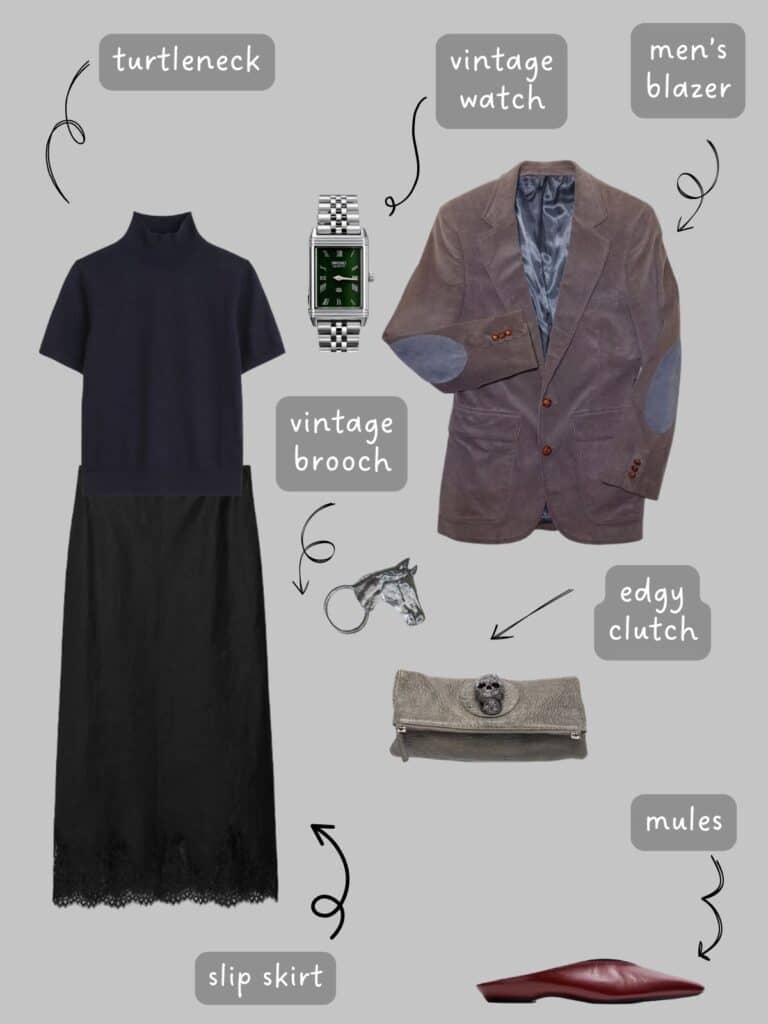
The blazer isn’t academic because it’s tweed. It’s academic because it has been worn for years, softened at the elbows, and thrown over everything from tailored trousers to a silk skirt without a second thought.
The satchel isn’t a costume. It’s genuinely carrying books. The loafers are scuffed because she’s walked everywhere in them.
The femininity arrives quietly sometimes. A ribbon tied through a bag handle. A pearl ring on the hand holding a coffee that’s gone cold. A dusty rose cardigan beneath a charcoal blazer. Details that feel discovered rather than arranged.
The most interesting women rarely look as though they’re trying to be interesting. They’re simply too occupied by other things.
Which is perhaps why the traditional image of the academic still holds such appeal. Not because of the elbow patches or the turtlenecks, but because it suggests a life where ideas matter more than appearances, even if appearances still matter a little.
That’s the balance this capsule chases. Tailoring with a sense of humour. Menswear softened by silk. Structure interrupted by something unexpectedly delicate.
Enough femininity to feel personal, but never so much that it becomes the point.
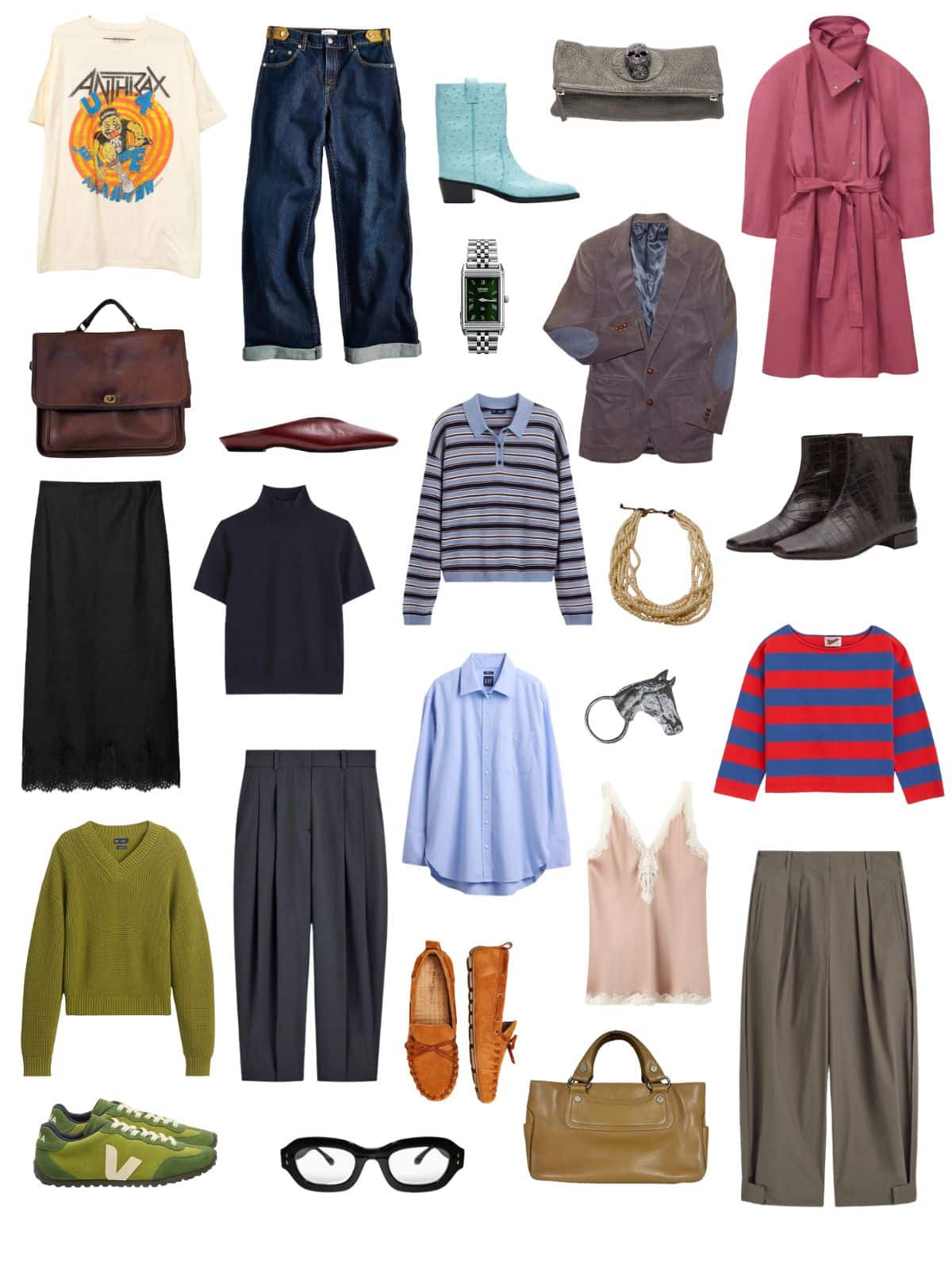
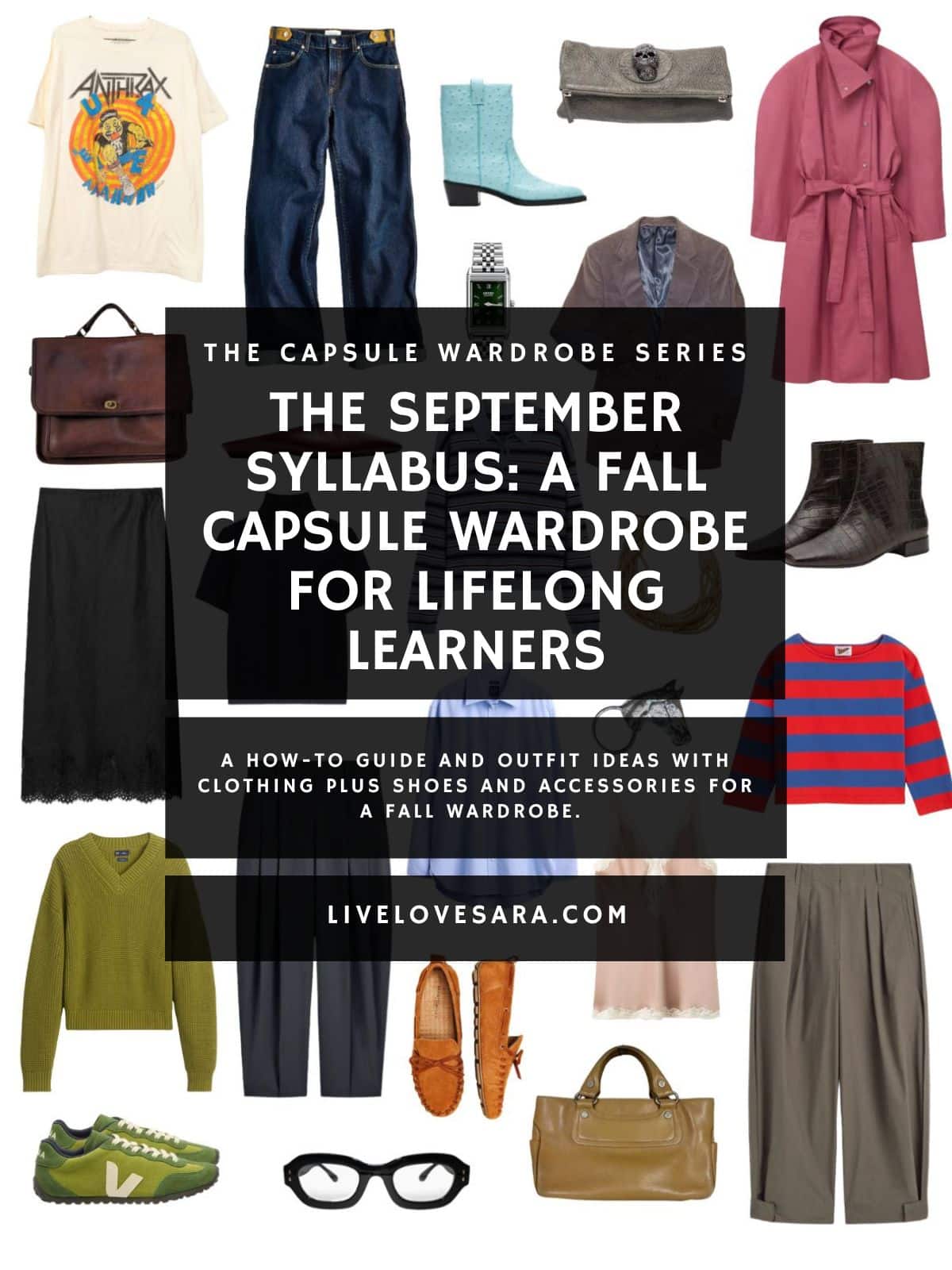
Anthrax Tee | Dark Denim | Blue Boots | Vintage Watch | Men’s Blazer | Skull Clutch | Pink Jacket | Brown Boots | Vintage Necklace | Blue Striped Polo | Burgundy Mules | Brown Satchel | Slip Skirt | Turtleneck | Blue Button Up | Horse Head Brooch | Red Striped Shirt | Pink Camisole | Driving Loafers | Ankle Trousers | Green Sweater | Green Sneakers | Black Frame Glasses | Tan Bag | Tan Trousers

Required Reading: The References
Susan Sontag — the streak of silver, the turtleneck under an oversized blazer, an austerity so confident it never needed softening. This is your baseline for restraint.
Miuccia Prada — proof that “intellectual” and “girlish” were never opposites. Prada’s whole design language lives in the friction between severe tailoring and something almost twee interrupting it. Maybe it is a strange colour, an ugly-pretty shoe, or a bow where you’d expect a buckle.
Joan Didion — the oversized cardigan, the enormous sunglasses, a minimalism that reads as removed rather than absence. Didion never dressed for anyone’s approval.
Fran Lebowitz — blazer, collared shirt, trouser, full androgyny, zero apology. If this capsule has a patron saint of not caring what people think, it’s her.
Course Materials: The Anchor Pieces
A wardrobe built this way doesn’t require dozens of pieces. Like any good reading list, every inclusion has earned its place.
The blazer. Menswear-cut, tweed or herringbone, ideally thrifted and slightly too big. The kind of piece that’s clearly lived a previous life in someone else’s closet. This is your entire thesis statement in one garment. Don’t fix the oversizing. It’s the point.
The turtleneck. Fine-knit, fitted, in a colour that reads more faculty-lounge than campus quad; oxblood, forest, charcoal, cream, black. This is your Sontag base layer, and it’s doing the quiet work of keeping the whole look feeling deliberate rather than borrowed.
The slip skirt. Bias-cut, midi length, in silk or a silk-look fabric, worn under the blazer instead of trousers. This is your one unexpected garment, and it should feel almost accidental, like you grabbed it without thinking rather than styled it on purpose.
The loafer. Worn-in, or if new, then soft and easy to wear in. Penny loafers, if you can find them secondhand with real character, because scuffed leather reads more intellectual than pristine ever will.
The bag. Structured, leather, in a shape closer to a satchel than a handbag. This is doing double duty as both the academic reference and the practical “I am carrying my actual life around” piece.
None of these pieces are remarkable on their own.
Together, they tell the story of someone whose wardrobe has been assembled slowly rather than curated all at once.
In the Margins: The Wrong Notes is Where the Femme Edge Lives
The best books are often remembered for what was written in the margins. A thought scribbled beside a paragraph. A sentence underlined twenty years ago. A question that still hasn’t been answered.
The same is true of getting dressed.
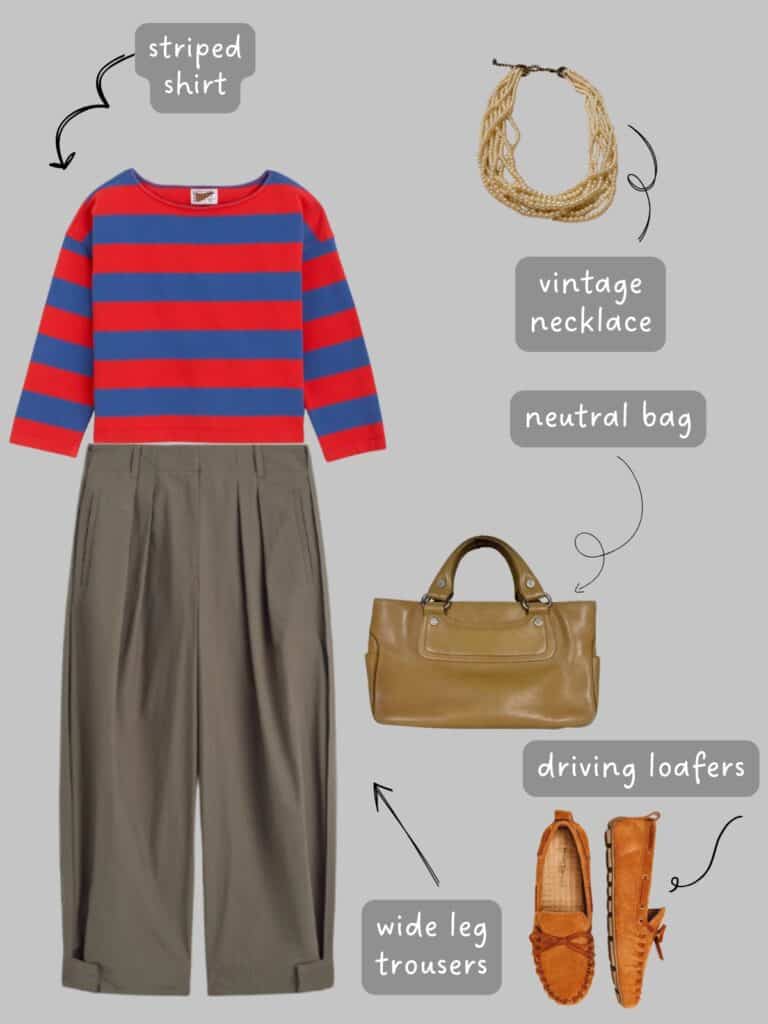
A signet or pearl ring or a pearl necklace worn on a hand otherwise doing very unglamorous things like turning book pages, holding a coffee that’s gone cold or if it is a necklace, then paired with something masculine.
A ribbon, thin and slightly worn, tied around the strap of the satchel or through a belt loop. Not bow-topped-gift ribbon, but grosgrain, a little undone.
Reading glasses worn as an accessory if they are not a necessity, pushed up into the hair when not in use. I actually found a couple of really cool vintage brooches that have a loop to hold reading glasses. A gold zebra and a pewter horsehead for something more refined and minimal.
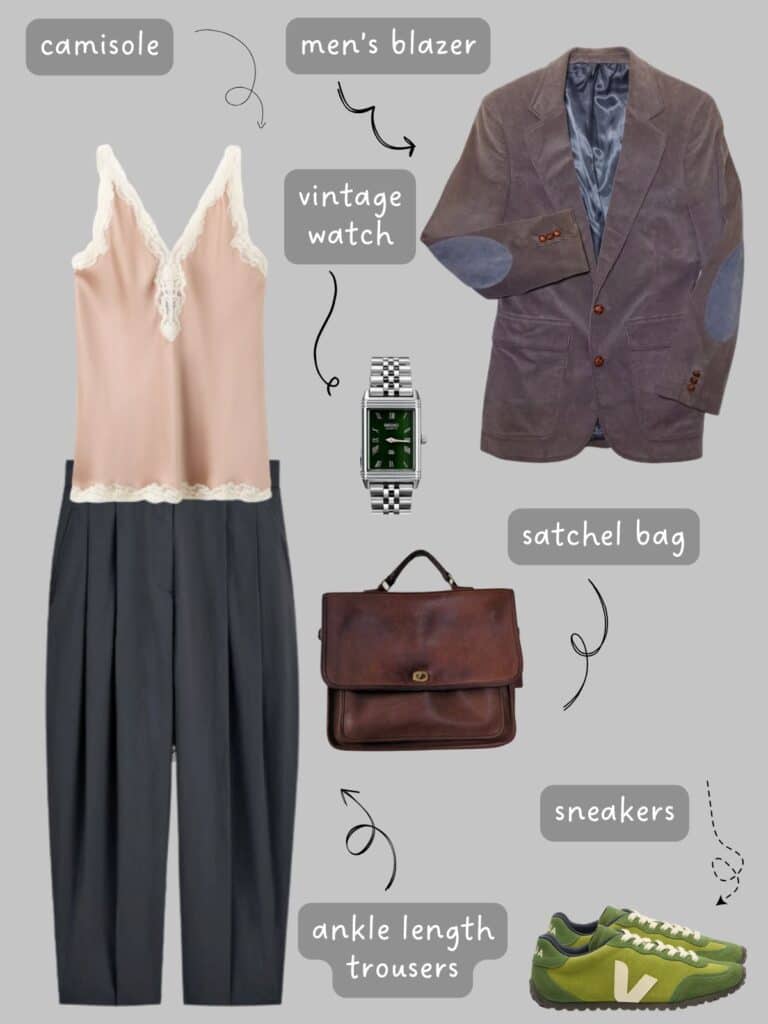
One piece in a rogue femme colour like a dusty pink, or a bruised lavender that shows up somewhere like a cardigan under the blazer, a camisole, socks, a hair clip, or if you want something bigger, try outerwear like a coat.
Chipped or bare nail polish, because polished hands read as performance, and this capsule isn’t performing for anyone.
The rule: one or two wrong notes per outfit, maximum. Anything more starts to look styled. One or two looks like you didn’t think about it, which is the entire trick.
Five Formulas for the Semester
1. The Lecture Hall Oversized tweed blazer + fitted turtleneck + wide-leg trouser + loafers + signet ring. Rogue colour: a lavender sock, barely visible.
2. The Office Hours Blazer worn open over a slip skirt + turtleneck tucked in + satchel with ribbon detail + loafers. This is your slip-skirt-instead-of-trousers moment. Let the blazer stay structured so the skirt reads as the deviation, not the softening.
3. The Reading Room Oversized cardigan (Didion mode) + turtleneck + wide trouser + reading glasses pushed into hair + bare nails. No blazer here because this is your one fully soft outfit, earned by the structure everywhere else.
4. The Faculty Meeting Full tailoring: blazer + trouser + collared shirt underneath instead of the turtleneck, unbuttoned at the top. Fran Lebowitz mode. Add the pearl necklace as the single interruption.
5. The Late-Semester Uniform The one you default to when you’ve stopped trying to prove anything: blazer, turtleneck, loafers, the same ring every day. This is the outfit that shows up once you’ve actually internalized the thesis, because you’re not building a costume, you’re just dressing like yourself, permanently.
The Point
The real back-to-school ritual was never about the new clothes. It was about knowing, with real precision, what you wanted before you got there because you weren’t going to get another shot at it until next year.
That kind of intention is harder to come by now that everything is available all the time. This capsule is an argument for building it back: dress like you already read the syllabus, already know the material, and have nothing left to prove.
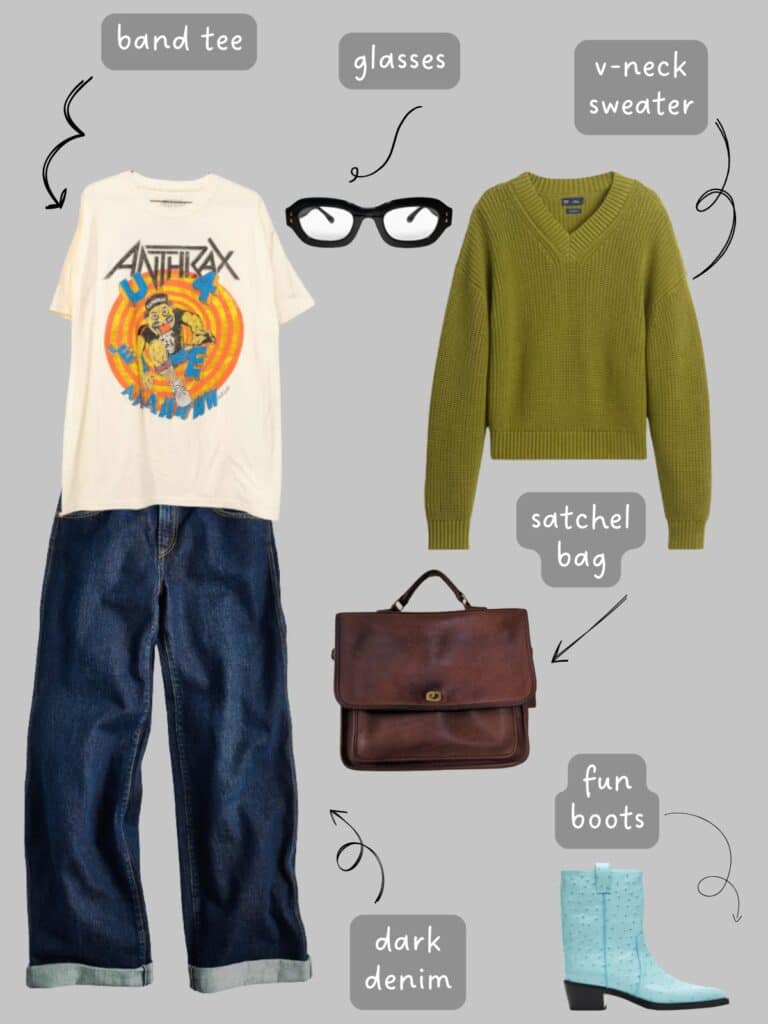
Fall Outfit Ideas
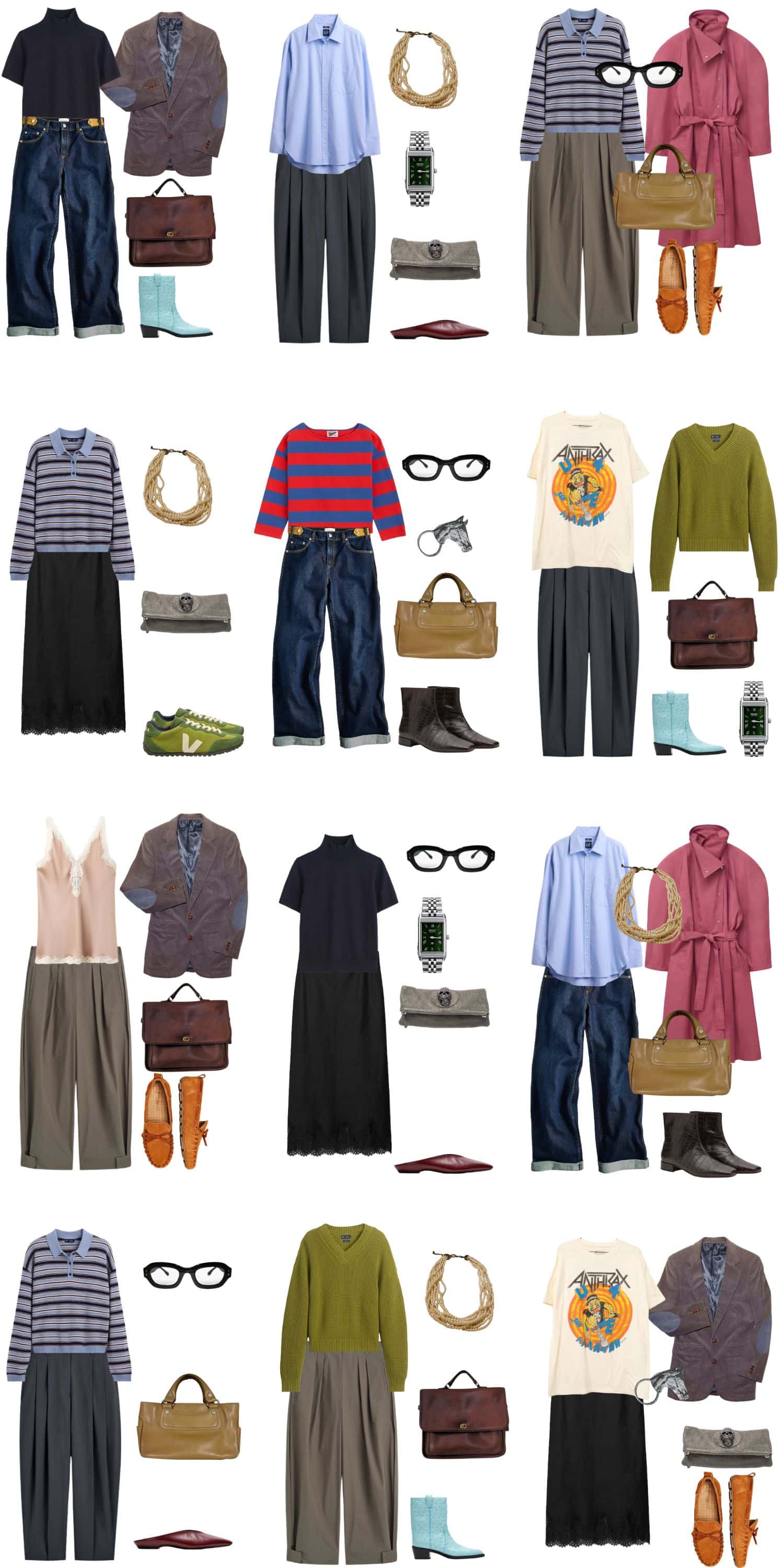
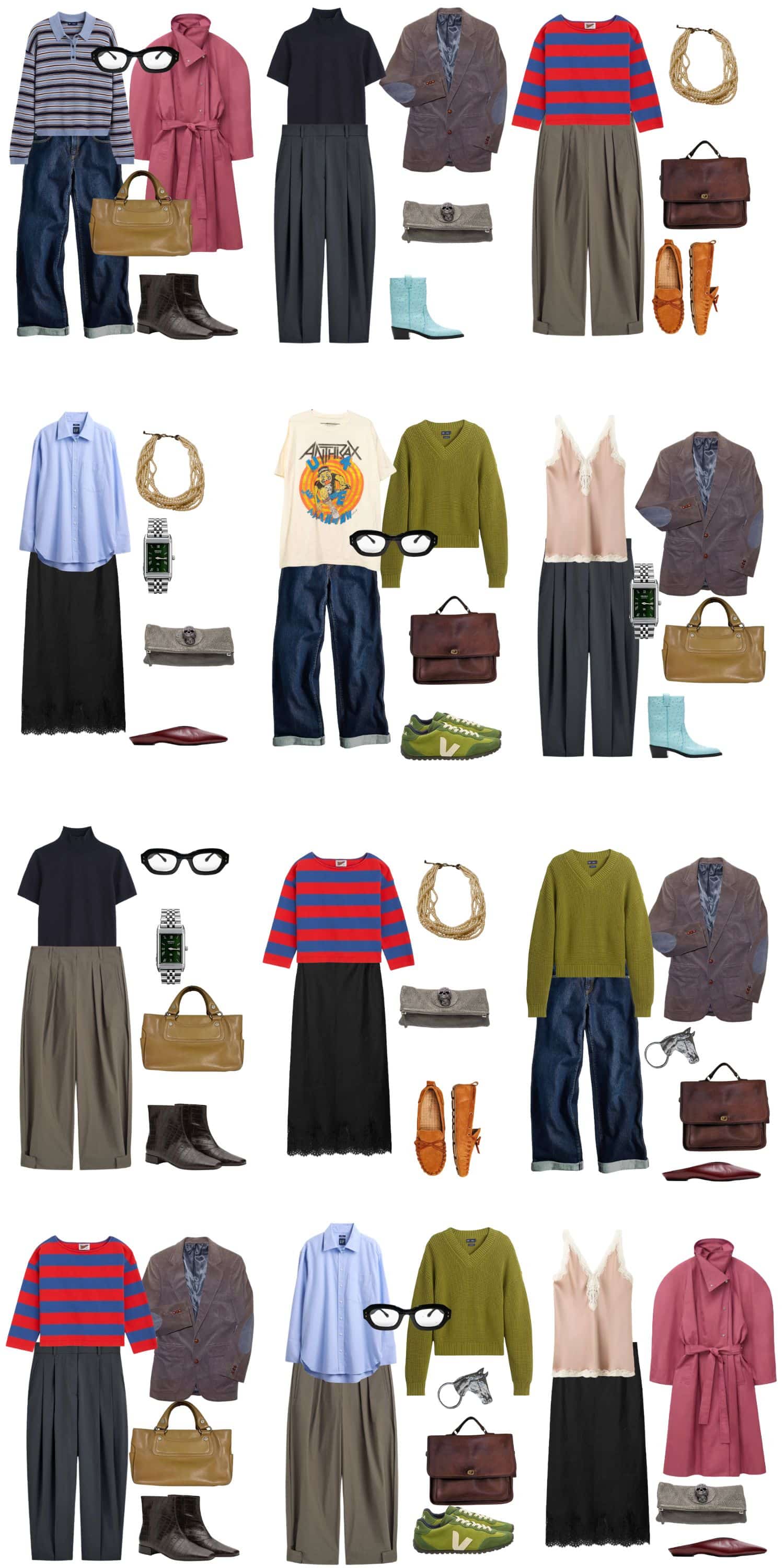
Anthrax Tee | Dark Denim | Blue Boots | Vintage Watch | Men’s Blazer | Skull Clutch | Pink Jacket | Brown Boots | Vintage Necklace | Blue Striped Polo | Burgundy Mules | Brown Satchel | Slip Skirt | Turtleneck | Blue Button Up | Horse Head Brooch | Red Striped Shirt | Pink Camisole | Driving Loafers | Ankle Trousers | Green Sweater | Green Sneakers | Black Frame Glasses | Tan Bag | Tan Trousers
SHOP THE UK LINKS
This post contains affiliate links. By using my links to shop I may receive a small commission (at no cost to you). Thanks for supporting what I do 


Instead of a band tee, this woman would wear a book cover, philosophy or other literary tee. Former academic here.
Ooooooh yes!
I gotta get on this capsule. Surprisingly I have items similar to these -this is a wonderful capsule 😃🥰