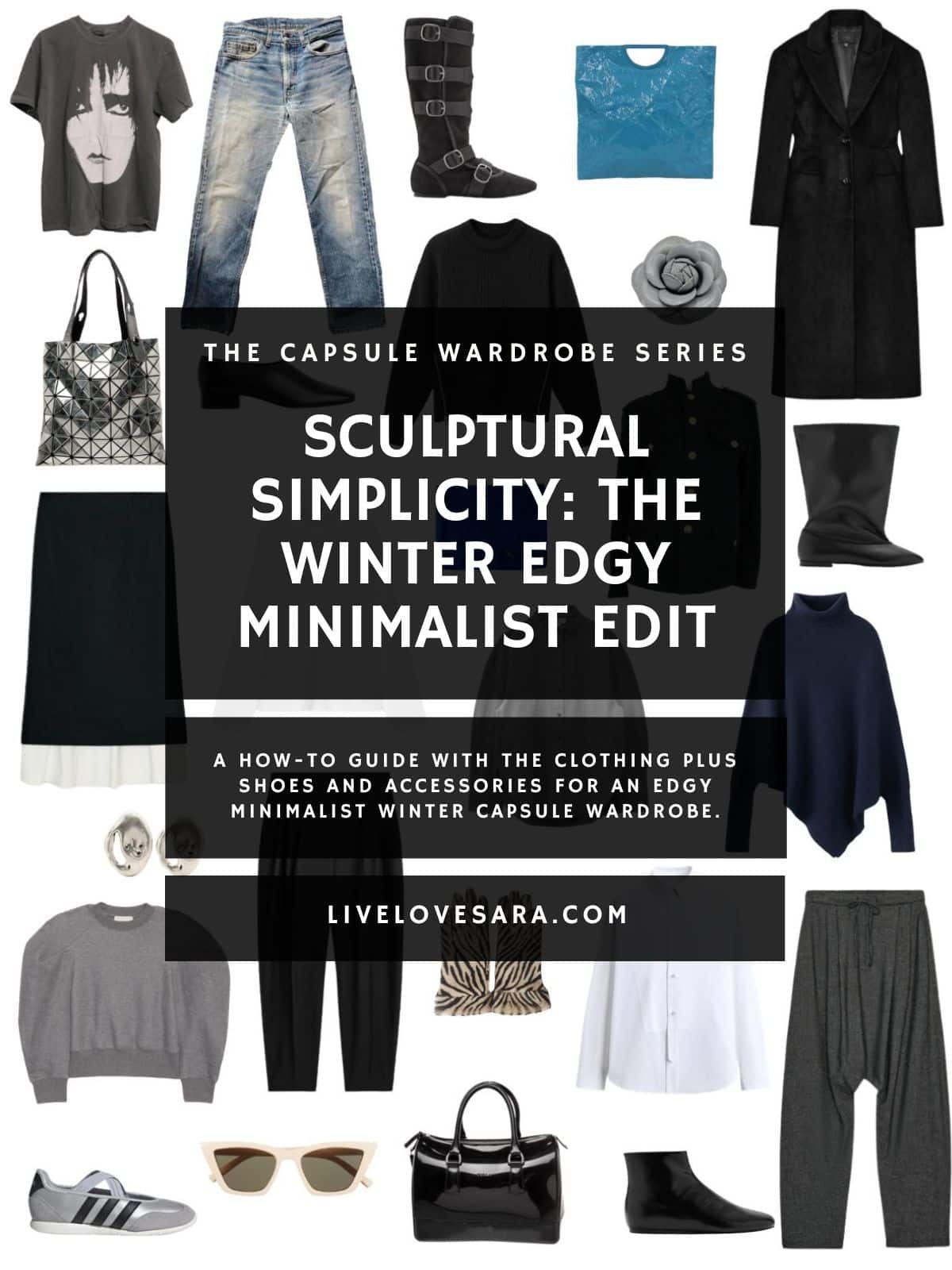
My personal style over the last 10 or so years has often leaned into a bit artsy depending on what I am wearing, but at the core of it, it has always been edgy minimalism, which is why this is usually my favourite post every season.
Recently, and by recent I mean over the last year or so, I have found myself shifting and gravitating to Japanese brands when I shop on the secondhand and vintage market.
And if I am being honest, I search almost every day because secondhand shopping is a long haul process.
You need to be vigilant because the turnover rate is quick.
So this week, when I chose edgy minimalism, I decided that I wanted to keep the general vibe around where I have been in my own journey.
Mood: Architectural. Intentional. Cool with conviction.
A Study in Sculptural Restraint
I like to think about tension when getting dressed, and edgy minimalism has a quiet tension, which is that space between simplicity and severity.
It balances softness and structure, elegance and something a little dangerous or “edgy”.
It’s like taking minimalism and stripping away the sweetness to rebuild it with angles, shadows, and unexpected precision.
This winter capsule isn’t gentle like the cozy-core minimalism we often see, or the soft quiet luxury of camel coats and cashmere scarves.
It’s sharper. More architectural. More urban. I like to think of it as what happens when minimalism grows a spine.
This aesthetic suits the woman who prefers black over beige, who appreciates sharp tailoring as much as she loves drape, and who believes one strong silhouette is worth more than a rack of trend pieces.
She’s not intimidating (or maybe she is), but she is undeniably intentional.
There’s a reason designers like Yohji Yamamoto and Junya Watanabe have quietly shaped the wardrobes of women who want substance over spectacle for decades.
I wanted their influence to be felt within the seams of this capsule. It is minimalism with teeth; an elegant, sculptural, and winter-proof attitude.
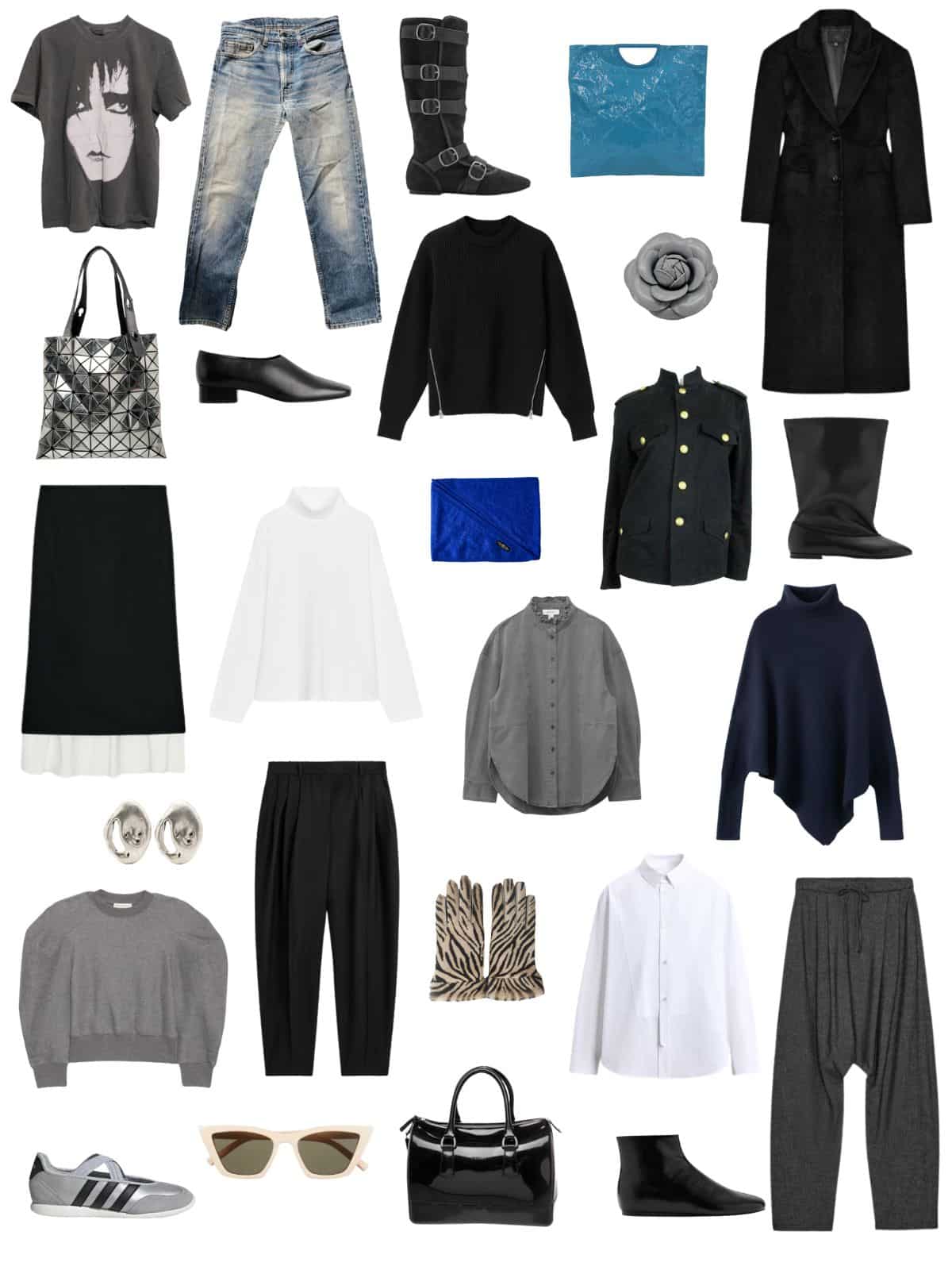
Band T-shirt | Vintage Levis | High Buckle Boots | Blue Bag | Long Coat | Flower Brooch | Black Sweater | Black Block Heel Shoes | Silver Bag | Layered Skirt | Loose Fit Turtleneck | Blue Scarf | Military Jacket | Wide Shaft Boots | Asymmetrical Sweater | Grey Button Up | Black Trousers | Earrings | Grey Sweatshirt | Ballet Sneakers | Sunglasses | Animal Print Gloves | Black Bag | White Button Up | Flat Boot | Drop-Crotch Pants

The Why: When Minimalism Needs a Little Menace
For years, minimalism has been associated with softness: rounded edges, tonal palettes, oatmeal knits, quiet luxury. Beautiful, yes, but also very predictable.
Edgy minimalism answers the craving for something bolder, cooler, and more directional.
It speaks to the woman who likes simplicity but also refuses to disappear. Someone who appreciates clarity but wants a silhouette.
Someone who wants her wardrobe to feel modern, not muted.
Winter amplifies this desire. The season begs for structure, coats with intention, boots with gravity, layers that communicate identity.
When the world turns grey, edgy minimalism becomes the stylistic equivalent of turning on the headlights.
It works because it’s elemental:
black, shape, contrast, shadow, movement.
Honest, strong, unmistakably modern.
Colour, Texture, and the Architecture of Shadows
If classic minimalism lives in beige and greige, edgy minimalism lives in shadow.
Core Tones
black, charcoal, deep ink, graphite, espresso
Contrast
optic white, blue, winter silver
Accent Metals
chrome, brushed steel, tarnished silver
Black forms the backbone, not for its darkness but for its depth.
Inspired by Yohji Yamamoto, black becomes a landscape: matte, glossy, ribbed, quilted, woollen, leathered. Layered thoughtfully, black feels like oxygen, not absence.
Textures take the place of colour. Instead of prints, you have:
- leather against cashmere
- matte wool beside patent shine
- smooth jersey layered under structured tailoring
- a crisp shirt under a sculptural coat
The luxury comes from contrast, not decoration.
The Avant-Garde Influence: The Art of Precision
Yohji Yamamoto: The Poet of Darkness
Yohji’s black is not the black of minimalism; it’s the black of philosophy. He taught us that:
- Drape can be powerful
- Volume can be quiet
- Asymmetry can be serene
- Garments should move like breath
His long coats, fluid trousers, and sculptural knits form the softer side of winter edge with pieces that envelop rather than constrain you.
Junya Watanabe: The Engineer of Cool
Junya brings tension: leather panels, hardware, patchwork denim, engineered silhouettes, protective shapes.
His pieces feel like urban armour, structured but wearable, sharp without being loud.
He adds the “bite” that turns minimalist outfits into something unforgettable.
Together, their influences give the capsule its duality:
Yohji’s poetry + Junya’s precision
soft shadow + hard shape
movement + tension
An edgy minimalist wardrobe becomes, essentially, wearable architecture.
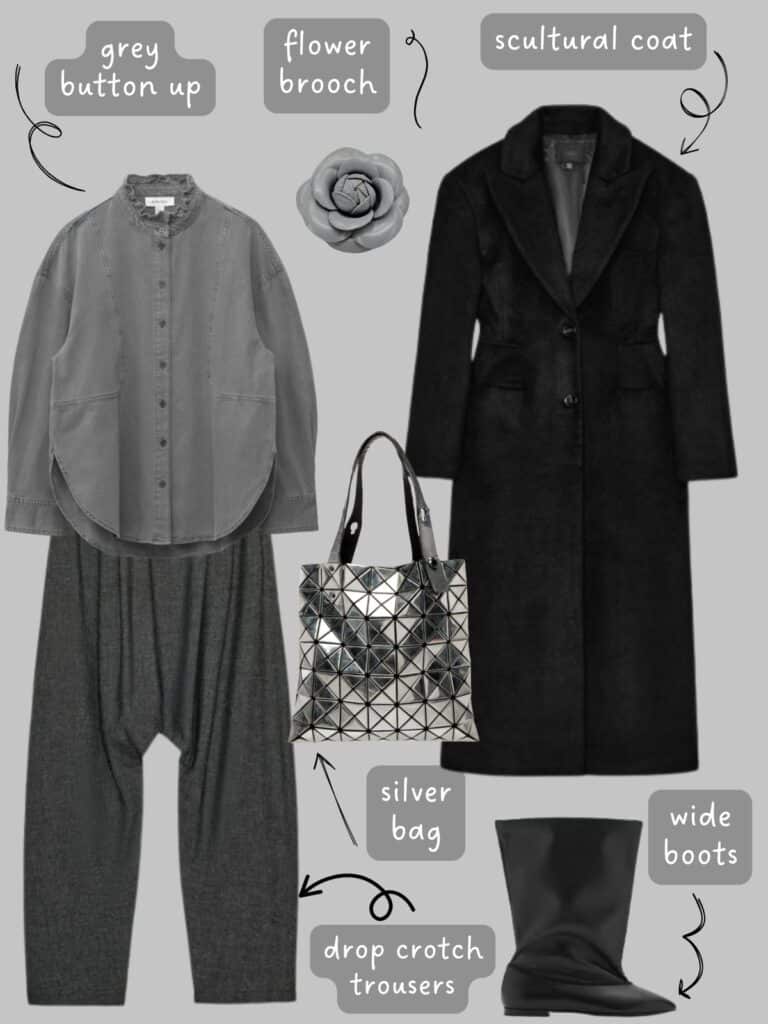
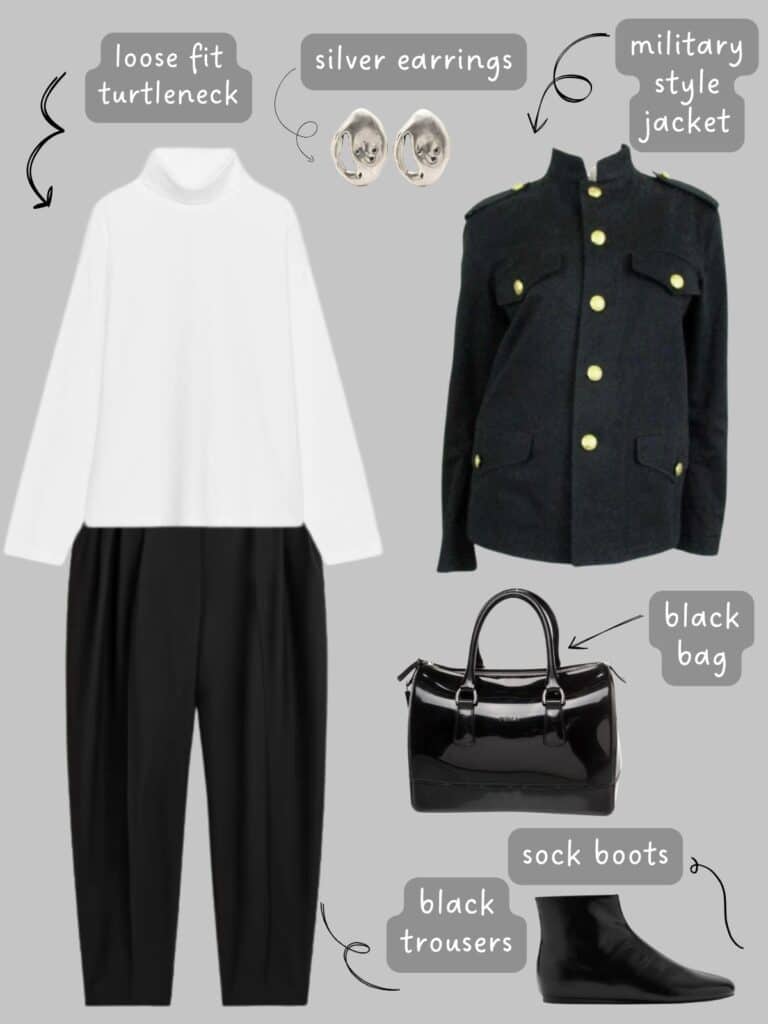
The Power of Negative Space
In Japanese aesthetics, the concept of ma (間), meaning “the space between”, shapes the visual balance. When you apply it to winter dressing, it becomes:
- oversized coat + slim trousers
- structured boot + fluid skirt
- sharp lapel + draped scarf
- wide trouser + fitted turtleneck
It’s what makes every outfit feel intentional. The negative space is as important as the garment itself. The silhouette is built as much by emptiness as by fabric.
This is why edgy minimalism never looks cluttered, even when dramatic.
Silhouettes That Cut Through Winter
The edgy minimalist silhouette is architectural, severe in the best way, and determined by shape rather than colour.
Think:
- long tailored coats with sharp lapels
- trousers with heavy, deliberate drape
- structured leather jackets
- column skirts with pointed boots
- crisp shirts under oversized knits
- asymmetrical hems
- knit layering under sculptural outerwear
Each piece feels like a line in a sketch that is deliberate, directional, and clear.
How to Dress the Edgy Minimalist Way
Picture a winter street at dusk: long shadows, cold air, city noise softened by snow.
Now picture yourself stepping onto that street in:
- a sharp black coat that falls like a blade,
- a fitted charcoal turtleneck,
- wide wool trousers that move like ink,
- and sleek leather boots, adding rhythm to each step.
Or maybe it’s:
- a draped Yohji-inspired skirt,
- a structured Junya-style leather jacket,
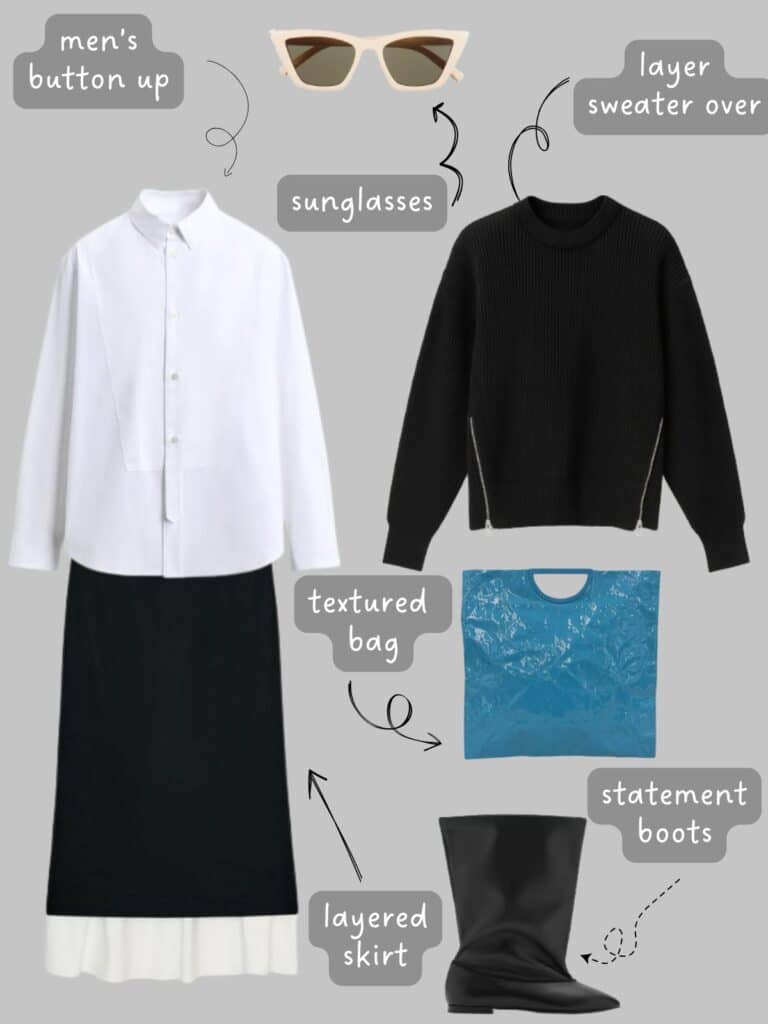
- a white shirt breaking the darkness,
- silver hoops catching the low winter light.
These outfits aren’t complicated.
Their power comes from intention. It is one strong line, one unexpected angle, one architectural moment.
Edgy minimalism is less about “Does this match?” and more about “Does this shift the silhouette?”

Shopping: Precision Over Plenty
This capsule doesn’t require a haul; it requires a point of view.
Look for:
- A long, impeccably cut black coat
- Sculptural boots
- A single dramatic oversized scarf
- Leather pieces with structure or panelling
- Asymmetrical skirts or dresses
- Wide wool trousers with weight & drape
- Crisp cotton shirting
- Architectural knitwear
And to bring it all together, the occasional avant-garde vintage piece (Yohji, Junya, Comme Des Garçons) and any of the other plethora of incredible Japanese designers.
Edgy minimalism thrives on quality, construction, and shape, not quantity. One architectural coat will do more than five trendy sweaters.
And I know you are thinking, but Sara, these are entirely out of my budget. Yep, mine too…when they are brand new.
But when I thought about how much was being spent on “new arrivals” from brands like Zara, H&M, Cos, and many others, I realized that if I pulled back in that area…
Not stop entirely. Just be less impulsive and more intentional. There’s that word again.
Then I could actually save money and redirect it into one or two really great pieces that I source secondhand.
As I was talking about intentional dressing, you also need to make intentional purchases, and this is very doable on a fast fashion budget.
Because it isn’t about labels, it’s about silhouette, texture, and intention (intention is the whole key).
The Japanese avant-garde has always been more philosophical than luxurious, which makes this aesthetic surprisingly accessible even on a tight budget.
Bear with me, this is going to be long. But here are my 10 tips on how capture the look without splurging:
1. The Philosophy Is Free: Start There
Authenticity is the heart of edgy minimalism.
And philosophy costs nothing.
Adopt their approach:
- Choose fewer but stronger pieces.
- Prioritize shape over trend.
- Use black as canvas, not default.
- Chase texture, not colour.
- Let the clothes feel lived, not precious.
- Embrace asymmetry, looseness, imperfection.
If your mindset is avant-garde, your outfits will follow.
2. The Silhouette Is Everything (and Free to Recreate)
The silhouette is the most “Yohji” or “Junya” part of the look, and silhouettes can be created with basics.
Their key shapes:
Long coat + loose trousers (Yohji)
Findable anywhere:
Structured jacket + narrow pant (Junya)
Look for:
- faux leather panelling
- structured shoulders
- asymmetric zippers
- moto details
Volume paired with restraint
Uniqlo has some great wide-leg silhouettes for under $60.
This is about form, not luxury.
3. Texture Is the Language, and You Can Fake It
Yohji uses wool and crepe; Junya uses leather and engineered denim.
But fast fashion has surprisingly good alternatives:
Affordable substitutes:
- Faux leather → Junya vibes for $80
- Poly-blend drape → looks like Yohji crepe from afar
- Oversized knits → sculptural volume
- Matte synthetics → industrial, utilitarian, modern
Texture-rich outfits read as elevated even if the materials aren’t.
Mix matte + shiny + structured + fluid, and you’re already speaking the language.
4. Use the Men’s Section Like It Was Made for You
Truly, this is the best-kept Yohji-adjacent secret.
Men’s:
- trousers
- blazers
- coats
- shirts
…have the structure and oversized proportions that define Japanese avant-garde silhouettes.
And they cost less.
A $79 Zara men’s shirt can look more Yohji than a $600 women’s designer blouse simply because the shape is right.
5. Asymmetry Is the Cheapest High-Fashion Trick
A top with:
- one longer hem
- an off-centre button
- a diagonal zipper
- uneven drape
- mismatched panels
…automatically looks conceptual and expensive.
Fast fashion LOVES asymmetry.
So do Yohji and Junya.
Lean into it.
6. Secondhand Is Where the Magic Happens
The real secret?
Japanese avant-garde fashion circulates in secondhand markets more than any other high-fashion genre.
Search on:
I just taught my 15-year-old how to use several of these Japanese sites for finding some of the Japanese cat dolls she likes to collect.
Yes, they look a bit sketch, but they aren’t. Some have been around since the late 90s, and I don’t think they have changed their interface since then.
But Junya Watanabe and Yohji Yamamoto pieces often resell between $80–$250, especially older or simpler pieces.
So even if your budget is small, you can own actual avant-garde items for the price of Zara outerwear.
This is where you hunt when you want the real thing.
7. Don’t Aim for the Label, Aim for the Feeling
The aesthetic isn’t about copying exact pieces.
It’s about channelling the mood:
- mysterious
- architectural
- intellectual
- urban
- dark
- soft but severe
You can evoke Yohji with:
- a long black skirt that moves well
- a draped scarf creating asymmetry
- a structured shoulder shape
- black layered on black layered on black
You can echo Junya with:
- leather paneling
- sharp jackets
- engineered seams
- denim with structure
The emotional impact is the same regardless of price.
8. Invest Slowly in the “Forever Silhouette,” Not the “Designer Piece”
If you want to slowly build a wardrobe that feels designer on a budget, do this:
Invest (if you can) in:
- a perfect long black coat
- leather or leather-look boots
- tailored black trousers
- a crisp men’s white shirt
Save on:
- knits
- asymmetrical pieces
- layering tops
- trend textures
- accessories
Designer or not, the silhouette does the heavy lifting.
9. Fast Fashion Is at Its Best When Used for Edge, Not Basics
Fast fashion basics look cheap. But fast fashion weird pieces look amazing.
Like this turtleneck from Zara, which, using the term “turtleneck” seems like it is a basic, but it is 100% cotton and more like a loose-fitting long-sleeve tee with a funnel neck.
Not basic at all. Interesting.
This is what we are looking for.
Examples:
- an asymmetrical hem
- a wild sleeve shape
- a huge funnel-neck knit or shirt
- a coated denim
- a sculptural scarf
- an offbeat boot shape
These mimic runway details far better than a $19 tank top.
Buy the strange things, not the staples.
10. Final Rule: It Doesn’t Have to Be Expensive to Be Avant-Garde
This is the heart of it.
Avant-garde was founded on:
- anti-fashion
- anti-luxury
- anti-status
- pro-art
- pro-experimentation
- pro-intellect
Yohji and Junya built their worlds outside the traditional fashion system.
Their influence is democratic by nature.
You don’t need money, you just need shape, curiosity, and conviction.
Edgy Minimalist Winter Outfit Ideas


Band T-shirt | Vintage Levis | High Buckle Boots | Blue Bag | Long Coat | Flower Brooch | Black Sweater | Black Block Heel Shoes | Silver Bag | Layered Skirt | Loose Fit Turtleneck | Blue Scarf | Military Jacket | Wide Shaft Boots | Asymmetrical Sweater | Grey Button Up | Black Trousers | Earrings | Grey Sweatshirt | Ballet Sneakers | Sunglasses | Animal Print Gloves | Black Bag | White Button Up | Flat Boot | Drop-Crotch Pants
SHOP THE UK LINKS
This post contains affiliate links. By using my links to shop I may receive a small commission (at no cost to you). Thanks for supporting what I do 



Absolutely love EVERYTHING about this capsule. The clothes, the descriptions and the break down. Thank you!
You had me at the Siouxsie tshirt. I love everything about this