TL;DR
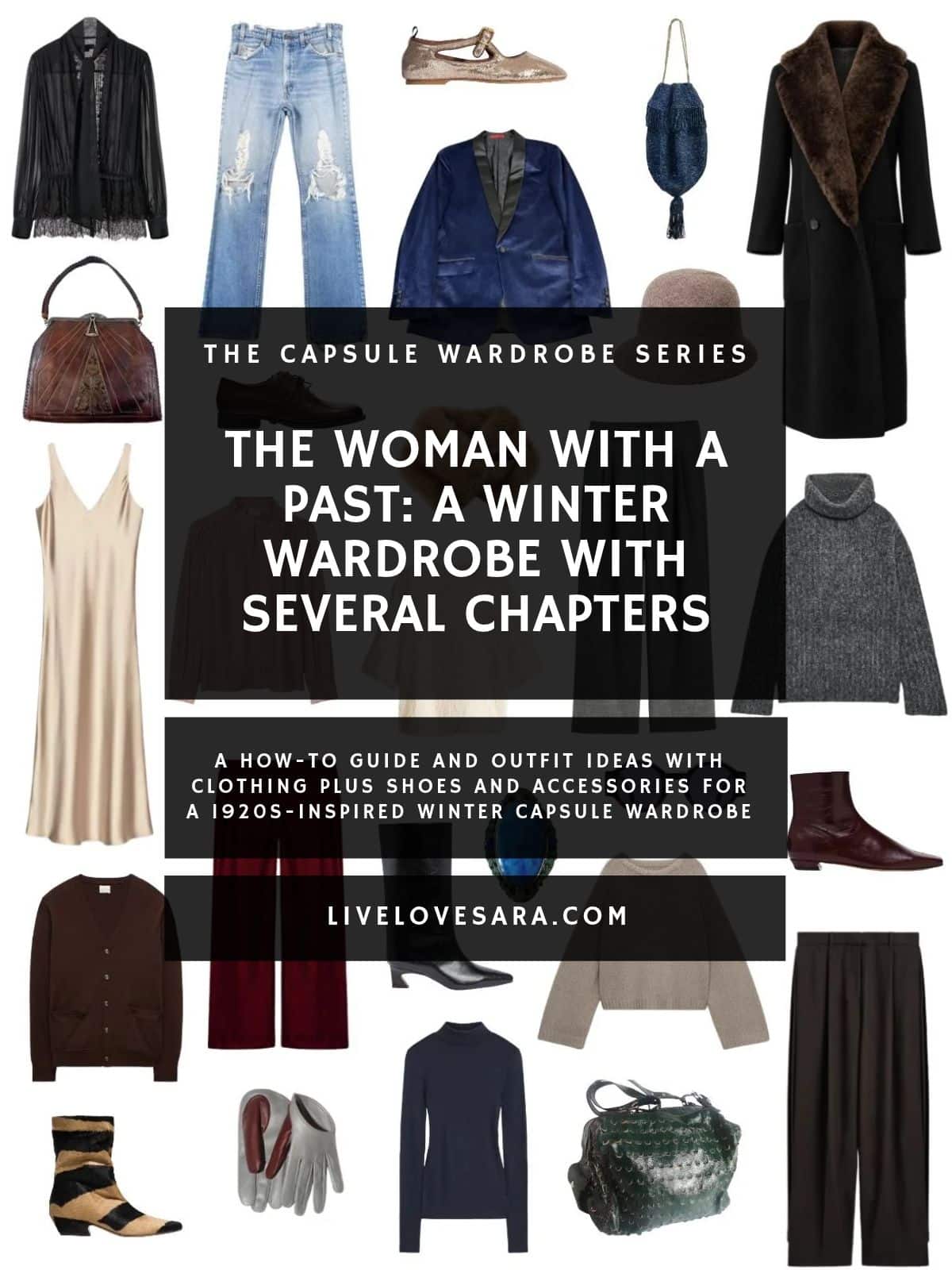
The Woman with a Past is a winter capsule inspired by the ease, experimentation, and decorative richness of 1920s fashion. A vintage coat, a men’s blue velvet smoking jacket, generous trousers, everyday knits, and soft blouses build her wardrobe; burgundy velvet, cream satin, and a century-old beaded bag give it depth. Distressed denim keeps her firmly in the present. For women over 40, the story is about keeping every interesting part of yourself, and leaving room for what comes next.
There was a time when “a woman with a past” was almost like a warning label. She was a fixture of stage melodrama and silent film: the stranger who arrives in the drawing room with an amazing coat and a look, whom everyone whispers about and nobody can stop looking at. The past was always implied, but it was the implication that was the whole point.
I would like to take the phrase back. It is presumptuous and suggests that a record is being maintained about her life. Maybe there was a bad relationship, or she disappeared for a time with no explanation.
But who cares? Because she doesn’t.
A past, in the sense that matters for a wardrobe, is not a scandal either. It is accumulated material. It is what makes a person’s taste specific instead of merely current, and it is the one thing the trend cycle cannot sell you.
This winter’s capsule is built for her. She is dressed by the 1920s, but she is not dressed as the 1920s, and the difference is the whole article.
The decade was an aftermath
The twenties get remembered as a party, which is the least interesting thing about them. They were an aftermath. The history was complicated.
A war had ended, a pandemic had just burned through, and the British census of 1921 counted well over a million more women than men. Women had been handed wartime work and then, in many places, asked to hand it back.
Freedom arrived unevenly, and a fashionable appearance could say very little about a woman’s actual rights.
The vote was arriving in fits and starts. Here in Canada, many women gained the federal vote in 1918, while racial and other exclusions continued to keep others from the ballot.
Even the apparent ease of twenties fashion came with a demanding ideal of a slender, youthful body; shaping garments continued to be worn. Hemlines rose, hair was cut, the waist wandered out of the silhouette entirely.
Those contradictions make the inspiration more interesting. We can appreciate the experiments in dress and the possibilities women claimed while acknowledging the limits surrounding them.
For this wardrobe, I want the ease of a long line, the pleasure of beautiful surfaces, and the sense of a woman choosing how to inhabit her clothes. Her body gets to come as it is.
And the clothes that came out of all this were not naive. They were chosen.
It is worth remembering who was doing the choosing. Chanel’s little black dress appeared in Vogue in 1926, when she was in her early forties.
Madeleine Vionnet, well into midlife, was cutting cloth on the bias with an almost architectural wizardry, so that a dress hung from the body instead of being built around it.
Then there is Elsa Schiaparelli. She launched her house in 1927, in her late thirties, having arrived in Paris with a small daughter, a marriage behind her, and very little money. The shocking pink, the lobster dress, and the hat shaped like a shoe all came when she was in her forties.
Chanel dressed women for ease. Schiaparelli dressed them for wit, and she was never afraid of being looked at. A woman with a past could do worse than take notes from both.
The flapper imagery we all know is the poster. The women actually making the decade’s look were grown, with histories, and they had decided to be glamorous anyway.
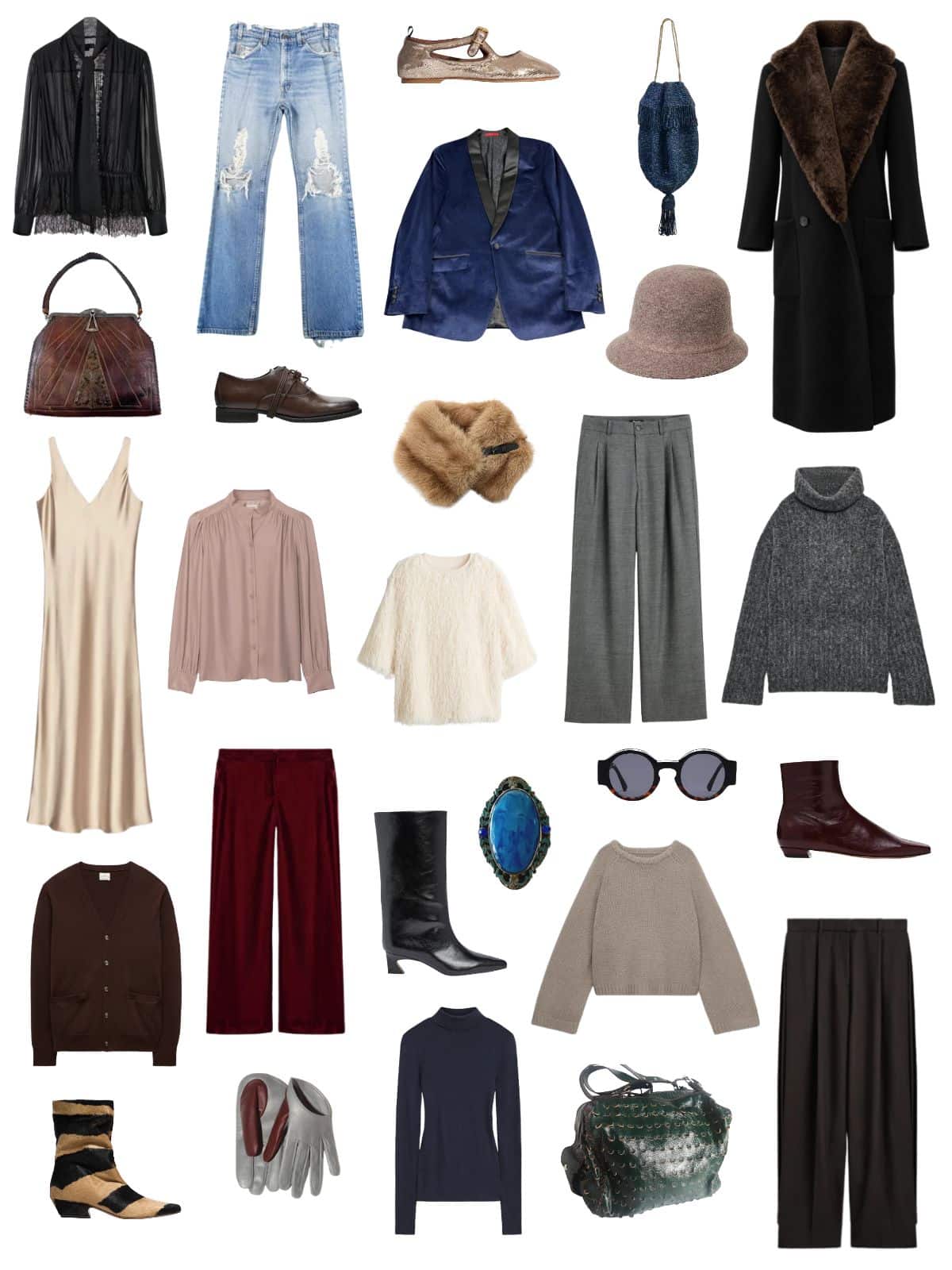
Black Lace Blouse | Vintage Levi’s | Metallic Mary Janes | Velvet Blazer | Blue Beaded Bag | Cloche Hat | Vintage Coat | Grey Sweater | Grey Trousers | Faux Fur Collar | Brown Oxfords | Brown Bag | Cream Slip Dress | Pink Silk Blouse | White Fringe Top | Round Sunglasses | Burgundy Flat Boots | Taupe Sweater | Antique Brooch | Black High Boots | Burgundy Velvet Pants | Brown Cardigan | Striped Boot | Leather Gloves | Navy Blue Turtleneck | Green Bag | Dark Brown Trousers

Meet her
She is somewhere in her forties, and she does not explain herself to anyone. Ever. There was a first act: a plan, a role, a version of her life that was built for her or by her, and then it ended, or was interrupted, or just stopped fitting.
She does not narrate this at dinner. She does not hide it, either. It is in the way she dresses, the way a good house shows the families who have lived in it beforehand.
We can all relate to this because by this age we have taken jobs we wanted and also jobs we needed. Loved people. Left people. Stayed too long. Changed our minds. Developed skills that nobody notices because we are just so damn good at them.
Some chapters are easy to talk about. Others remain private because they are tender, complicated, or simply put, nobody else’s business. A life can contain all of these things without resolving into a neat story of reinvention.
That matters here. The Woman with a Past does not need an extraordinary biography to justify her wardrobe. She may have spent years doing ordinary, necessary things while maintaining an interior life far larger than her circumstances suggested.
She might be rediscovering something she set aside. She might be perfectly happy with her life and increasingly impatient with the narrow version of it other people recognise.
She is not nostalgic, and she is not in costume. What she took from the era is its posture: a long, lean line, a coat she can disappear into, and a flat refusal to wait for an occasion. She treats the good thing as something to be used, not saved.
And she wears velvet whenever the fuck she wants. As she should.
As we all should.
She Has Outlived Several Versions of Respectability
Perhaps she once dressed to look serious enough to be listened to. Perhaps she learned to soften herself, to appear agreeable, to make choices that required no explanation. Many women become skilled at dressing for the comfort of a room.
At some point, she started wondering what she actually liked.
Masculine tailoring feels useful to this character because it brings structure, practicality, and a certain self-possession. Women’s experiments with masculine clothes have carried meanings connected to work, independence, gender, and sexuality.
Trousers were still far from universally accepted as everyday womenswear in the 1920s, so the generous trousers in this modern capsule are a contemporary extension of that exploration.
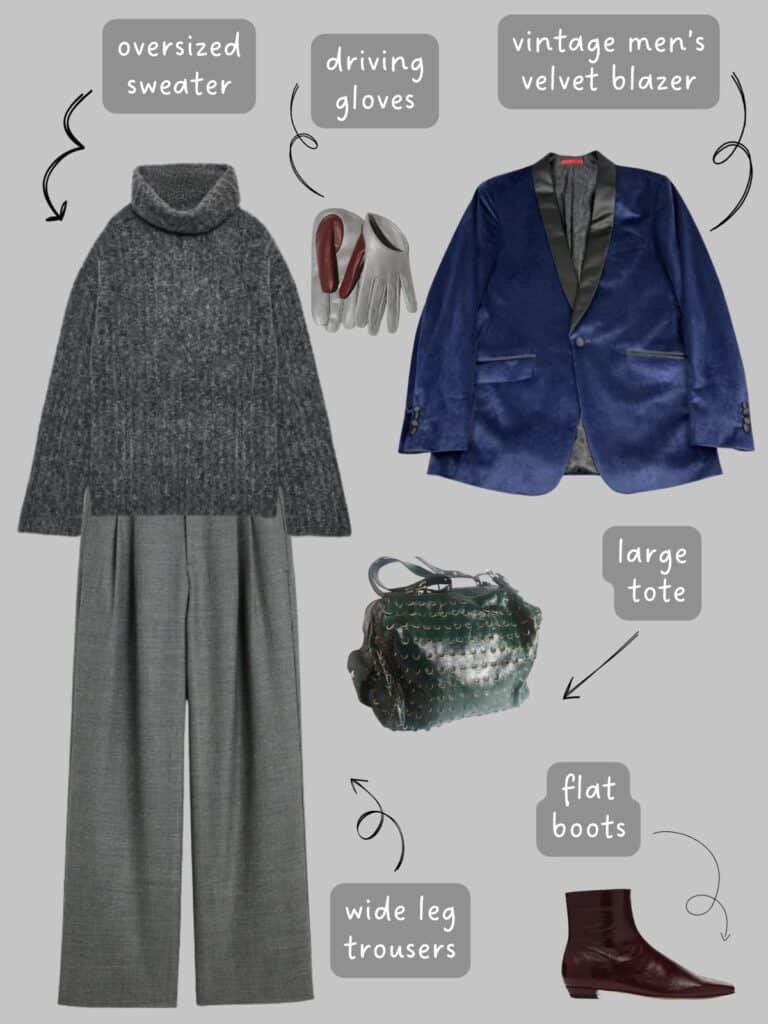
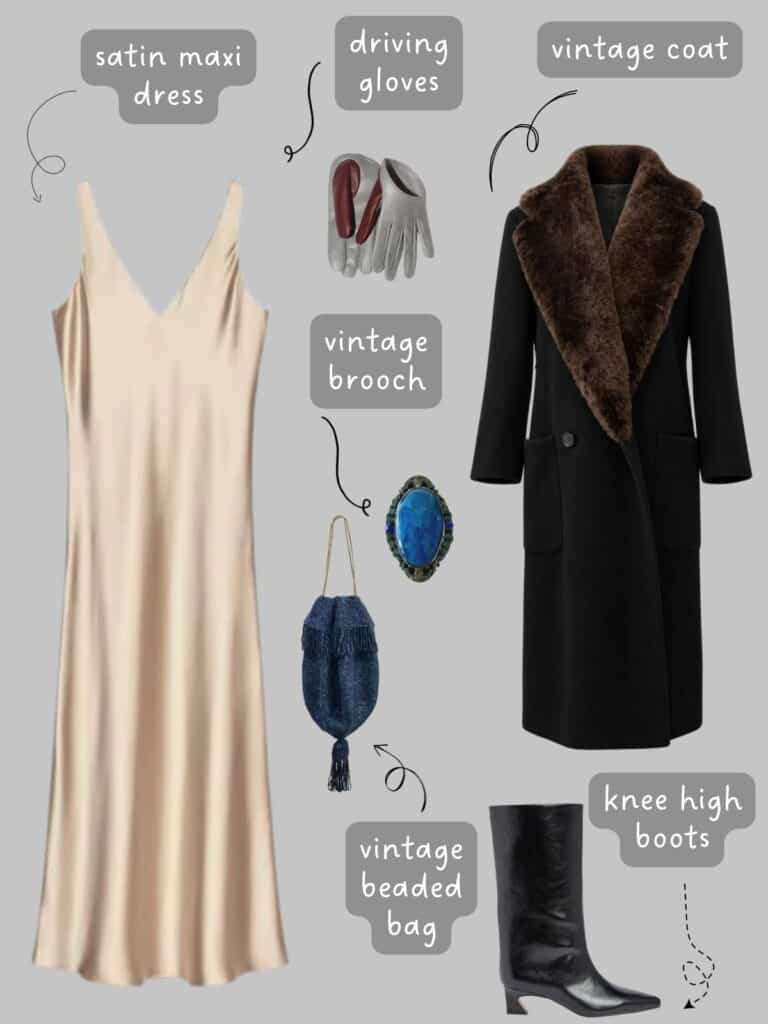
The vintage Perry Ellis winter coat establishes her presence immediately. Its dark body, generous brown faux fur collar, and long line make an ordinary departure feel slightly consequential.
Repeating a coat from an earlier capsule in a different colourway also feels appropriate: sometimes we discover a shape that works and keep returning to it. Personal style develops through those attachments.
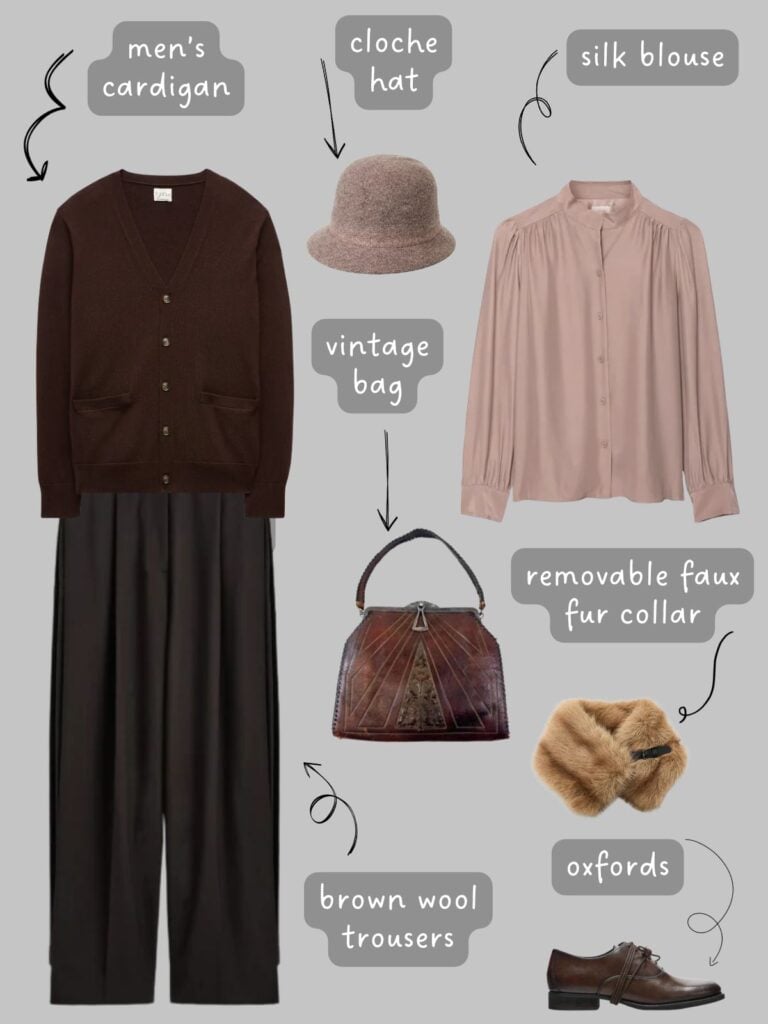
The chocolate brown wool-blend trousers and grey checked wool-blend trousers give that outerwear a useful everyday foundation.
Their generous legs offer ease, while the pleats and cloth provide enough structure to make a soft blouse feel composed.
The brown leather lace-ups extend this masculine influence right down to the floor. Their interest comes from the leather, shape, and unusual wrapping of the laces.
The men’s chocolate merino cardigan brings another kind of ease. Its straight shape and patch pockets connect with the relaxed knitwear direction that drew me to the era.
Over the cream satin dress, it lets a long, fluid line continue beneath an ordinary, useful layer. With trousers, it becomes the sort of cardigan she reaches for without thinking. The pleasure lies in how naturally it belongs.
The tailoring should let her use her body. She should be able to fold her arms, reach for something, and sit down without arranging herself into a more acceptable shape. A coat may need an alteration at the sleeve or shoulder. Trousers need to hang properly.
Ease still benefits from attention.
Some of These Clothes Used to Go Out
It is easy to find joy in a beautiful thing that has become familiar. The velvet jacket no longer saved for the right invitation. The silk blouse that has acquired a place among the everyday sweaters. The small beaded bag that goes to dinner even when dinner is fairly unremarkable.
Twenties eveningwear gives us a lovely reference here. Simple dress shapes could carry elaborate beads, sequins, and embroidery, with decorative details that caught the light as the wearer moved.
In a winter wardrobe now, that richness can be concentrated in a few pieces.
The vintage men’s blue velvet smoking jacket carries much of that atmosphere. Its dark satin lapels and saturated blue introduce evening associations through a familiar tailored shape.
With the fine navy merino turtleneck, the effect becomes quieter: related dark colours, different surfaces, a little light moving across the velvet.
Then there are the burgundy velvet trousers. They make winter decadence remarkably easy to sit down in. The ballet-pink silk blouse softens their richness, while the oversized grey turtleneck gives them a more casual weight.
Burgundy and pink feel good together here, with enough depth and restraint to belong to the woman we are imagining.
The black semi-sheer lace and tie-neck blouse adds delicacy and a little sensuality. Its ties can hang loosely or be fastened as the wearer prefers.
The cream short-sleeved fringe top brings movement in a different way: the surface shifts with the body, offering a clear visual connection to decorative eveningwear without requiring an entire evening ensemble.
The cream satin maxi slip dress gives these heavier textures a long, luminous counterpart. It is a contemporary piece within this wardrobe’s historical conversation.
Under a cardigan or the taupe-grey boat-neck wool sweater, it can function almost like a skirt, leaving a sweep of satin below the knit. The wide sleeves on that sweater introduce a different proportion from the fine navy turtleneck.
Those changes in volume help the clothes keep feeling alive
Note: If you wanted to dive right into that 1920s vibe, an opera jacket would be the ultimate piece to add. Either vintage or new. It would really pair well with the dress (like something the Olsen Twins would wear), but also could be easily dressed down.
The balance becomes believable through repetition. Wear the beautiful blouse often enough, and it starts to feel like yours. Carry the unusual bag with the coat you use every day. Let a decorative piece develop associations with the life you actually lead.
Winter Has Read None of the Mood Board
There is, inevitably, the weather.
A wardrobe can contain all the intrigue in the world and still require a warm layer at the bus stop.
The coat needs enough room for what goes underneath it. Fine base layers can support the softer blouses and knits. Trousers should work with useful footwear, and any longer hem needs consideration before being introduced to slush.
The silhouette is elongated and relatively easy: the brown cardigan falling over the satin dress, generous trousers beneath the long coat, or a soft blouse left loose enough to move.
These proportions let us suggest the era without depending on exposed skin or a precisely positioned waistline. The dress’s length contributes to that line; its winter warmth will come from base layers, knits, and outerwear.
They can also be adjusted. An open cardigan creates a vertical line; a shorter knit changes the balance of fuller trousers. A belt can sit where it feels good. The historical reference is a resource for finding shapes you enjoy.
The burgundy flat ankle boots provide a sleek everyday option and repeat the colour of the velvet trousers.
The black knee-high boots introduce a curved heel with the Louis-heel quality that caught my eye. That is a visual association rather than a claim that the boots reproduce a twenties design; their shape adds another historical echo to the mix.
The bold black-and-tan patterned ankle boots suggest a woman who still makes certain decisions entirely for her own amusement. The metallic Mary Janes supply a smaller glint of glamour. Their strap and light-catching surface work especially well against plain knits and worn denim.
These are styling shoes, with different uses depending on conditions. Wet weather and ice may call for a separate practical boot and a change on arrival. The long satin hem deserves particular care around slush.
A woman with a past has presumably encountered a pavement before.
Colours That Have Been Out After Dark
Chocolate, navy, charcoal, and taupe establish the foundation. Cream and ballet pink bring light; burgundy adds warmth and depth. The bottle-green bag introduces another dark colour with enough richness to sit comfortably alongside the blue velvet.
The blue continues through the old beaded bag and the brooch. Those repetitions help the unusual objects belong to the everyday clothes.
Grey in the two-tone kid-leather gloves picks up the trousers and knits, while their burgundy thumbs connect with the velvet and boots. A detail does not have to be visible all the time to give its wearer pleasure.
Texture does much of the work. Brushed wool, smooth silk, satin, velvet, fringe, beads, and softened leather each respond to light differently. With several related colours in play, the wardrobe can feel rich without every piece competing for attention.
The quieter pieces matter. A plain sweater gives an unusual brooch somewhere to belong. Simple trousers allow a beautiful blouse to register. Her clothes can take turns being interesting.
Her Bags Have Different Accounts of the Evening
The large bottle-green leather bag is the one with room for her actual day. Its cutout details and softened shape make it difficult to place at a glance. That ambiguity is useful: it connects comfortably with the vintage pieces while carrying the practical weight of the wardrobe.
The vintage tooled-leather frame bag has a more architectural presence. Radiating lines, the geometric clasp, and the combination of structured shape and worked leather give it the Art Deco quality that drew me to it.
Beside a simple sweater and checked trousers, those details have room to register.
The blue beaded reticule-style bag, sourced as a 1920s piece, provides a direct link to the decade. Its gathered shape, beadwork, and hanging tassel bring the movement and decorative richness discussed earlier into a single object.
A bag that has travelled through approximately a century has earned a little consideration over what we ask it to carry. Its condition and construction should determine its use.
The brooch, dated to the 1910s, extends the wardrobe’s history further. Its blue centre and green details connect with both the velvet jacket and the bottle-green bag. On a plain knit or a jacket lapel, it becomes a small point of fascination. The wearer can decide how much of its story to tell.
A Few Clues, Sensibly Distributed
The wool cloche makes the twenties reference especially legible. Its close, rounded shape and small brim frame the face, while the neutral colour lets it sit naturally with the coat and knits.
I would enjoy it most with relatively simple clothes, allowing that recognisable shape to carry the historical suggestion.
The removable fur collar offers a way to change the neckline and mood of a cardigan or sweater. It introduces a plush surface without requiring another coat.
The grey-and-burgundy gloves add an unexpected colour detail, and the round sunglasses give the face a distinct frame.
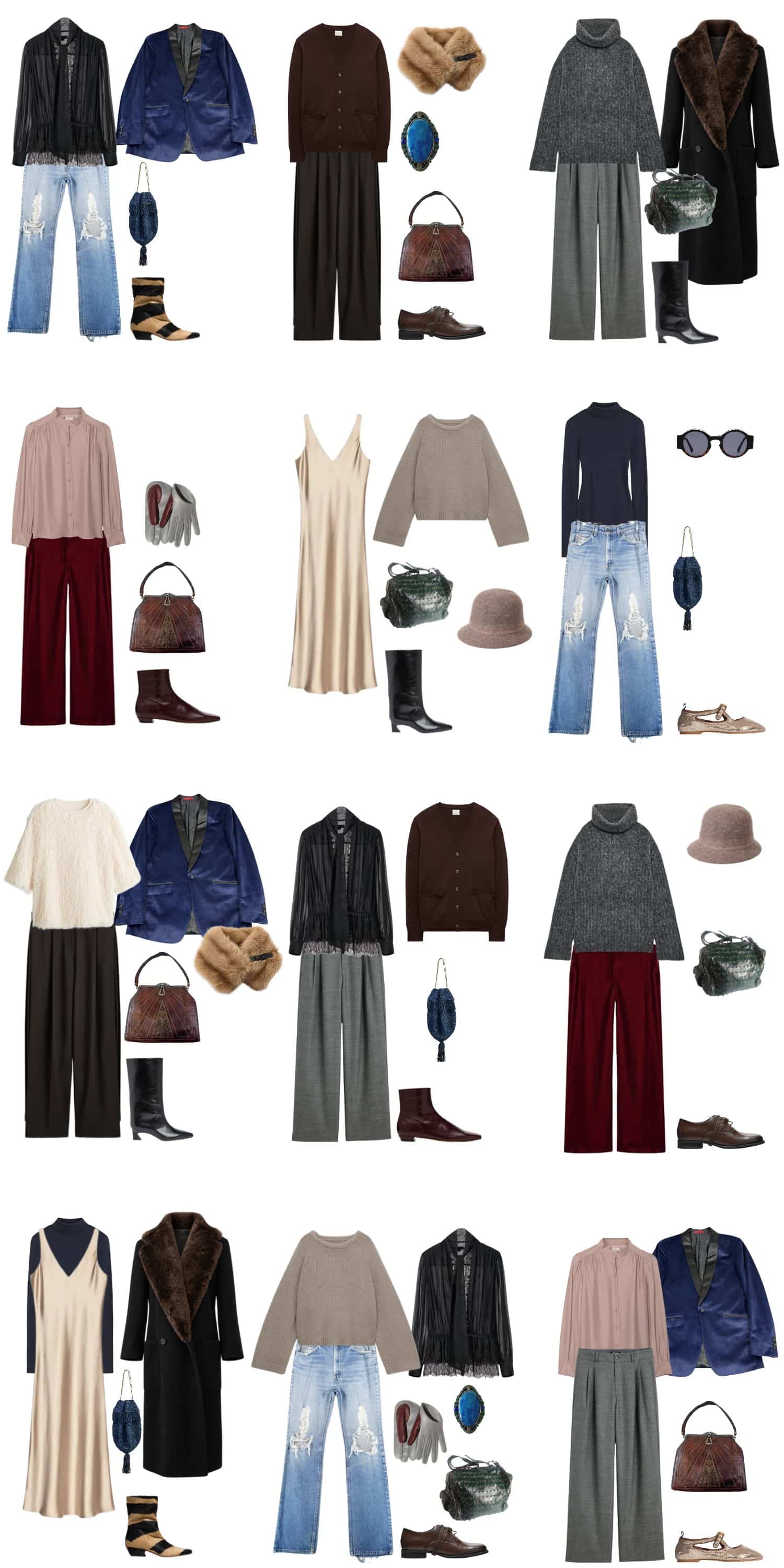
These accessories can circulate through the wardrobe in small groups. The cloche might accompany denim and the coat; the brooch could brighten the grey sweater; the beaded bag might appear with the navy turtleneck and plain trousers.
Giving each piece space helps us notice it. Our woman can get dressed according to her day, her mood, and the amount of attention she wishes to entertain.
She Cannot Live Entirely in the Past
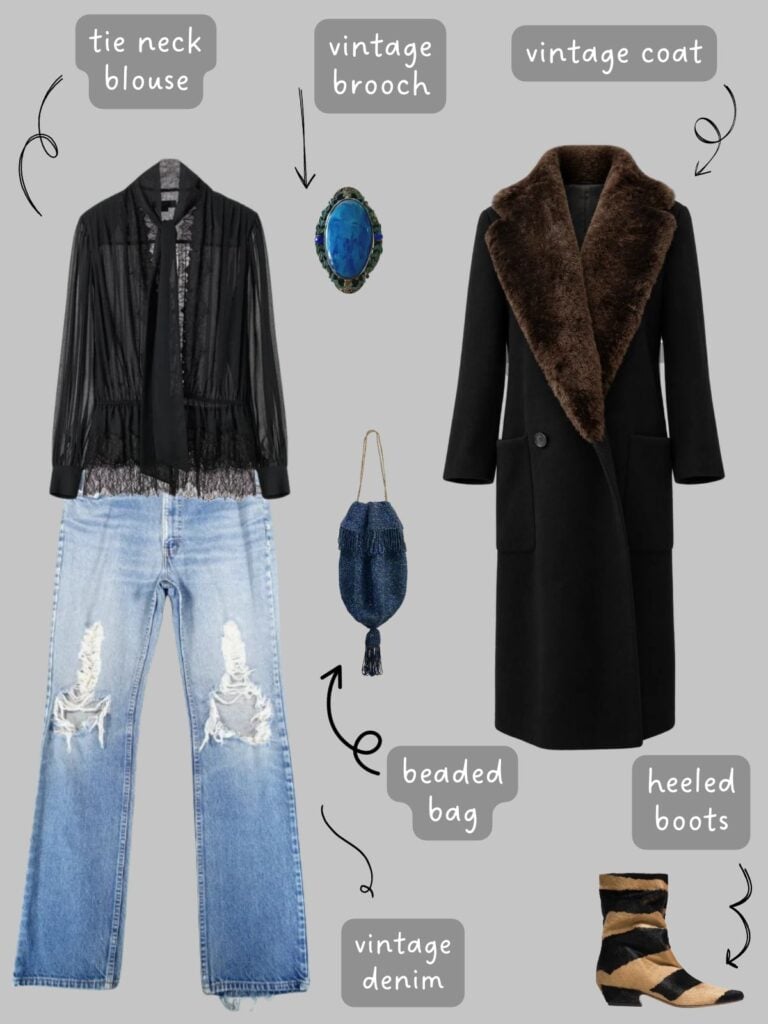
The distressed vintage denim provides an essential change of register. Its faded blue, tears, and worn edges bring the softer and more decorative clothes into a present-day wardrobe.
With the smoking jacket, the denim makes the velvet feel available for ordinary life. With the lace blouse, it adds a rougher texture; with the metallic Mary Janes and a grey sweater, it allows a little glamour to slip into an otherwise casual day. The contrast comes from the clothes’ different surfaces and histories.
Vintage jeans also complicate the idea of “modern.” They can be old and still supply the most contemporary feeling in the outfit. That is part of the freedom of dressing across periods: the relationship between the pieces matters more than their dates.
Secondhand, with References Available on Request
Secondhand sourcing suits this woman because it allows different periods and purposes to coexist. The Perry Ellis coat, men’s smoking jacket, silk blouse, antique accessories, and contemporary boots develop a convincing relationship through colour, proportion, and use.
There is no requirement to find actual 1920s clothing. The shape of a neckline, a low-set fastening, a geometric clasp, or the movement of a scarf may be enough to establish the connection.
Here, the beaded bag and brooch sit alongside much newer clothes, while the cloche, frame bag, and fringe make the inspiration visible in different ways.
Condition deserves attention, particularly with decorative items. Check the handles and closures on old bags, look closely at beadwork, and consider whether a delicate fabric will tolerate the way you want to wear it. A little visible age may add appeal; fragility can make a piece difficult to enjoy.
Dates and materials are worth checking with the seller when provenance matters. Readers can find the same mood through later vintage, secondhand, or pieces they already own.
I would begin with something substantial that you already own: a coat, trousers, or a dependable knit. Add the piece that changes how you see it. Sometimes the whole character arrives through a small bag or an unexpectedly beautiful blouse.
She can develop gradually. There is no need to buy her entire biography in one sitting.
She Still Has Somewhere to Go
The danger of giving a woman a past is that people become terribly interested in treating it as her finished story.
I want this wardrobe to leave room for what she wants now. Her history may explain certain attachments, but she can revise them. She can wear an old favourite differently. She can enjoy a style she once thought belonged to somebody else. She can decide that a former version of herself had excellent taste and retrieve the blouse.
The connection to the twenties lives in that appetite for possibility: movement, experimentation, pleasure, the right to appear in public on terms of her own. Our woman brings decades of experience to those possibilities. She has a better idea of what feels good, what costs too much effort, and which expectations she is willing to entertain.
Her coat has been with her for years. The bag may have been to some very good parties. Neither prevents her from making new plans.
The twenties understood something we tend to forget: you do not have to be young, or finished, or forgiven to dress like it matters. You only have to decide.
Winter Outfit Ideas for Women
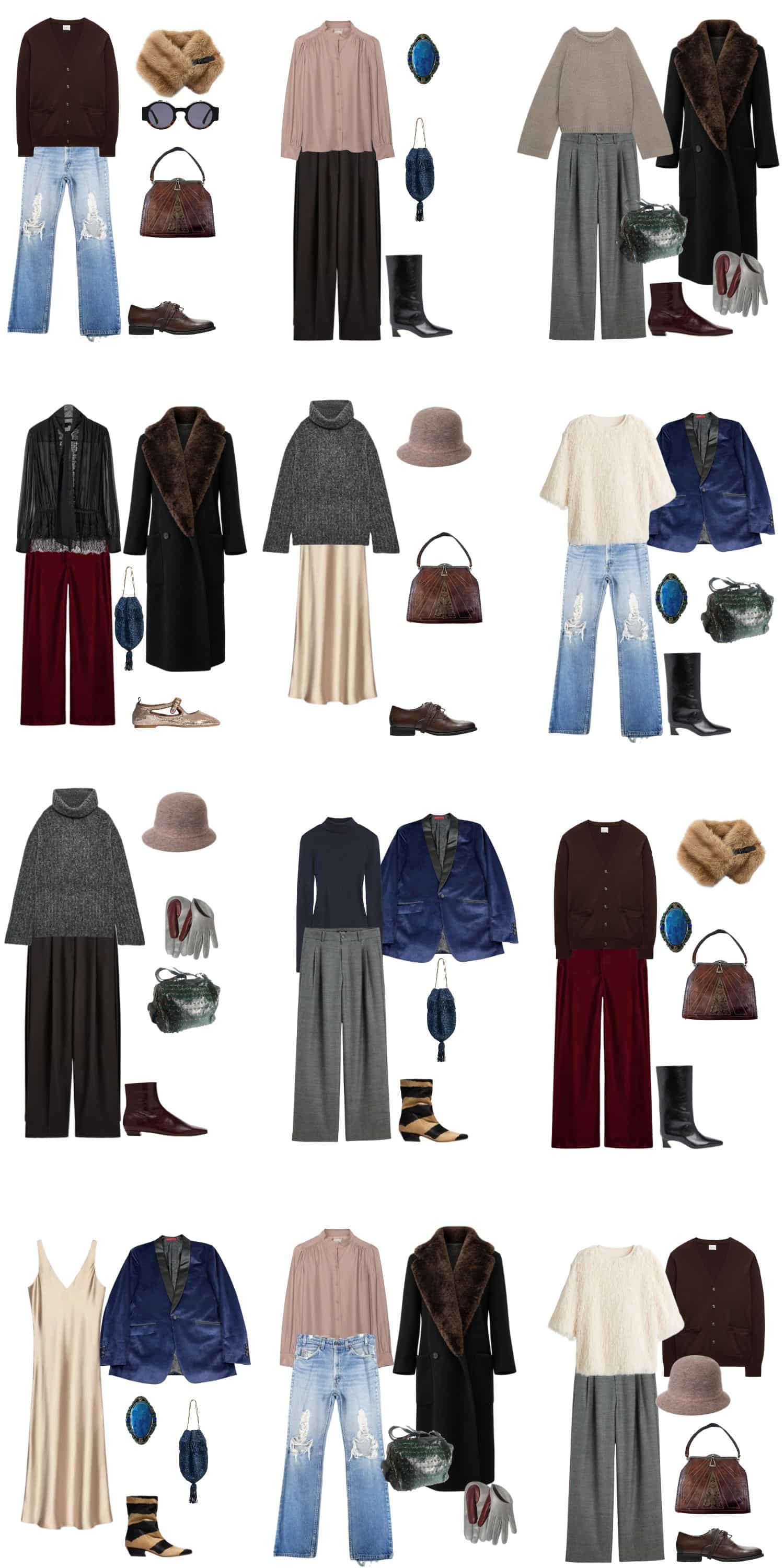
Black Lace Blouse | Vintage Levi’s | Metallic Mary Janes | Velvet Blazer | Blue Beaded Bag | Cloche Hat | Vintage Coat | Grey Sweater | Grey Trousers | Faux Fur Collar | Brown Oxfords | Brown Bag | Cream Slip Dress | Pink Silk Blouse | White Fringe Top | Round Sunglasses | Burgundy Flat Boots | Taupe Sweater | Antique Brooch | Black High Boots | Burgundy Velvet Pants | Brown Cardigan | Striped Boot | Leather Gloves | Navy Blue Turtleneck | Green Bag | Dark Brown Trousers
SHOP THE UK LINKS
This post contains affiliate links. By using my links to shop I may receive a small commission (at no cost to you). Thanks for supporting what I do